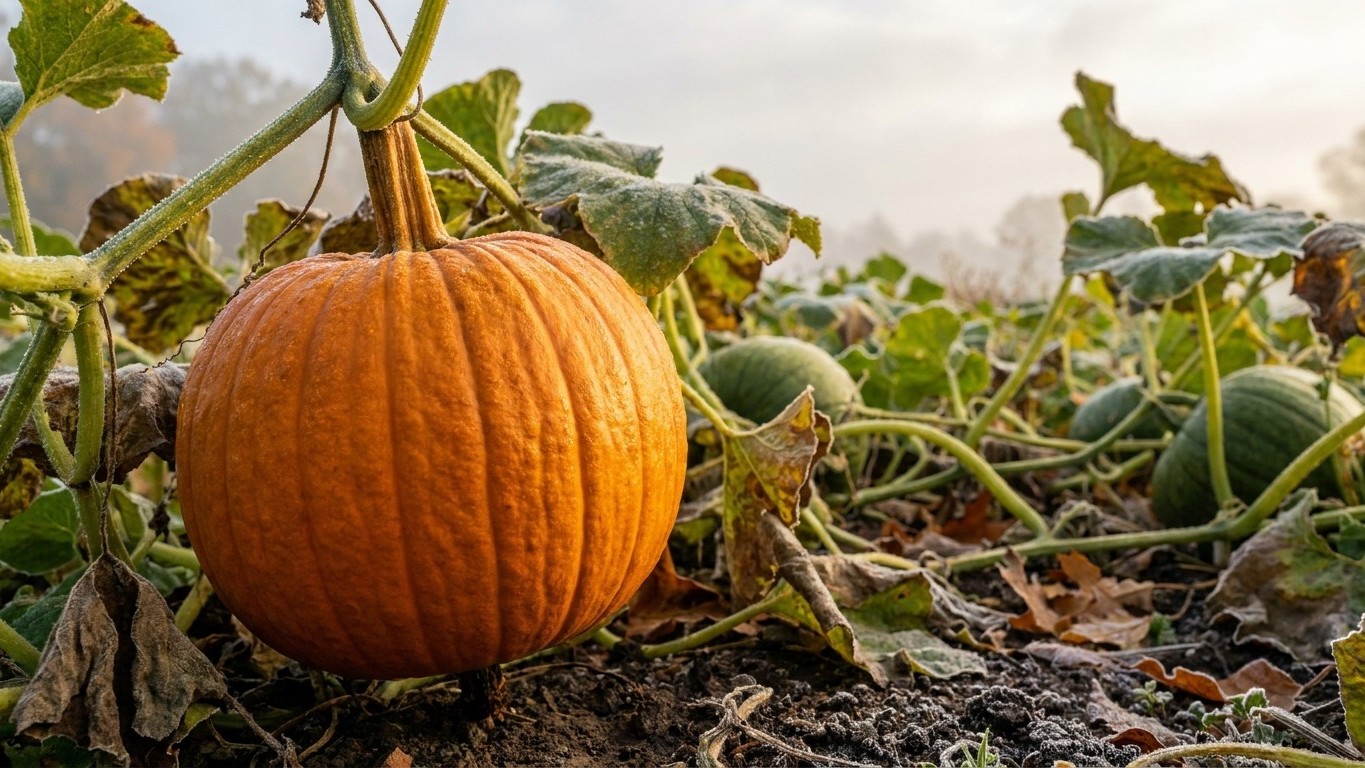

Most years, yes, but the flower matters more than the seed. Minnesota’s growing season closes with the first fall frost sometime between October 11 and October 23, and a pumpkin needs 45 to 55 days after its flower opens to finish. Work that math backward and you get a narrow window, not a single date, for when the last productive blossom needs to show up on the vine.
The short answer
The first fall frost across the Twin Cities metro, according to NOAA’s 1991-2020 Climate Normals, lands somewhere between October 11 and October 23 in a typical year. That’s not a hard cutoff so much as the range where a 32-degree freeze becomes likely enough to plan around. It’s also the mildest part of the state, which raises the question of Will Pumpkins Ripen Before Frost in Minnesota? for gardeners farther north. Northern Minnesota, from Duluth on up through the Iron Range and the Arrowhead, runs two to three weeks tighter at both ends of the season, so anyone gardening north of the metro should shift everything in this article earlier.
Utah State University Extension puts pumpkin maturation at 45 to 55 days after flowering, not from the day you drop the seed. That distinction changes the whole calculation. Count backward from October 11, the earlier edge of the frost window, using the longer 55-day figure, and you land on August 17. Count backward from October 23, the later edge, using the shorter 45-day figure, and you land on September 8. Somewhere in that span, roughly the back half of August into the first week of September, is when a flower needs to open if that fruit is going to have any real chance of coloring up before the cold arrives.
A flower that opens after that window doesn’t necessarily die on the vine. It can still set fruit. What it usually can’t do is finish the job. The pumpkin stays green, or blushes only partway to orange, and the vine runs out of season before the rind hardens. That’s the practical stakes behind all the sowing-date math that follows: it isn’t really about when you plant, it’s about making sure enough flowers open early enough in August to give the fruit its full 45 to 55 days before frost shuts things down.
Gardeners working a shorter northern Minnesota season should treat early August, not late August, as their outer edge for a flower that still has a shot at ripening.
When to sow here
Backward planning from frost only gets you halfway there, and the full breakdown of When to Sow Pumpkins in Minnesota covers the other half: soil temperature, which in Minnesota runs on a different clock entirely.
- Let the last frost window pass first. NOAA’s Climate Normals put Minnesota’s last spring frost between April 17 and April 30 for the Twin Cities area. Seedlings set out before that window closes risk a freeze that a young pumpkin plant won’t survive.
- Then wait on the soil, not the calendar. Pumpkin seed wants soil at 65 degrees Fahrenheit, and soil doesn’t warm at the same pace as the air. Minnesota’s clay-heavy garden soils in particular hold onto spring cold, so that 65-degree mark often doesn’t arrive until well after the frost window has closed, commonly into mid or late May rather than right on its heels. Pushing seed into cold, wet soil just means it sits and rots instead of germinating any sooner.
- Use a row cover or black plastic to close the gap. A row cover laid over the bed, or a sheet of black plastic mulch, traps solar heat and can buy roughly two weeks on that soil-temperature clock. That’s real ground gained toward an August flowering window that’s already tight.
- Sow direct once the soil holds 65 degrees. Pumpkins resent transplanting more than most vine crops, so direct seeding once the soil is reliably warm usually beats starting indoors.
- If you’re starting indoors anyway, use biodegradable pots. Two to three weeks of a head start, transplanted with minimal root disturbance, can be the difference between a flower that opens in late August and one that opens after your realistic window has closed.
What goes wrong here
- A late flower that never colors. This is the direct result of sowing too late, or a cool, slow start to summer that pushes flowering past the safe window described above. The remedy is upstream: use the backward math from the frost window to set a target sowing date, and lean on row covers early in the season to move soil warm-up ahead rather than trying to rescue a late-blooming vine in September.
- A fruit caught by frost while it’s still soft. Even a fruit that colored up nicely can be undersized or thin-skinned if frost arrives on the early edge of Minnesota’s October 11-23 window. Watch the forecast in early October and cover vines with an old sheet or row cover on nights a light frost is possible. If a hard freeze is coming instead, harvest whatever’s on the vine that day rather than gamble on one more week.
- A vine that dies back before the skin hardens. Vines can collapse early from disease pressure or from pests like squash bugs and cucumber beetles working through the season faster than expected; details on identifying and managing those two are covered on this site’s dedicated squash bugs and cucumber beetles pages. Whatever the cause, once a vine is failing, the fruit stops receiving the sugars it needs to finish its rind. Cut the fruit free with the stem attached and move it somewhere it won’t freeze; it won’t get sweeter, but it’ll hold longer than one left exposed on a dying vine.
Checking this against your own county
Everything above is built on Twin Cities data, and Minnesota is a big state. A gardener in Rochester is working with different numbers than one in International Falls, and the two- to three-week gap between southern and northern Minnesota frost dates is wide enough to shift a sowing plan by a full growing-season phase.
The University of Minnesota Extension maintains county-level guidance and local frost-date information that reflects your specific spot on the map rather than a statewide average. Before locking in a sowing date, it’s worth checking their county resources or contacting a local Extension office directly, especially if you’re gardening north of the metro or in a low-lying frost pocket where cold air settles earlier than the regional average would suggest.
Common questions
Can I still plant pumpkins in July in Minnesota?
It’s a stretch. A July sowing pushes flowering into September, right at or past the safe window calculated from the October 11-23 frost dates and the 45-to-55-day maturation clock. Smaller, faster fruit set might still finish; larger pumpkins likely won’t.
What’s the latest a pumpkin flower can open and still ripen?
Based on the state’s frost window and the 45-to-55-day maturation figure from Utah State University Extension, the safest range runs from mid-to-late August into the first week of September, earlier for northern Minnesota.
How do I know when a pumpkin is actually ripe?
Color is the main visual cue, but the rind should also resist a fingernail press. Harvest with the stem attached, and do it before frost rather than after.
Will a pumpkin keep ripening after it’s cut from the vine?
No. Once separated from the vine, a pumpkin holds its color and condition but doesn’t continue maturing. Utah State University Extension’s guidance is simply to store cut fruit somewhere it won’t freeze; it doesn’t publish a specific storage temperature or shelf life beyond that.