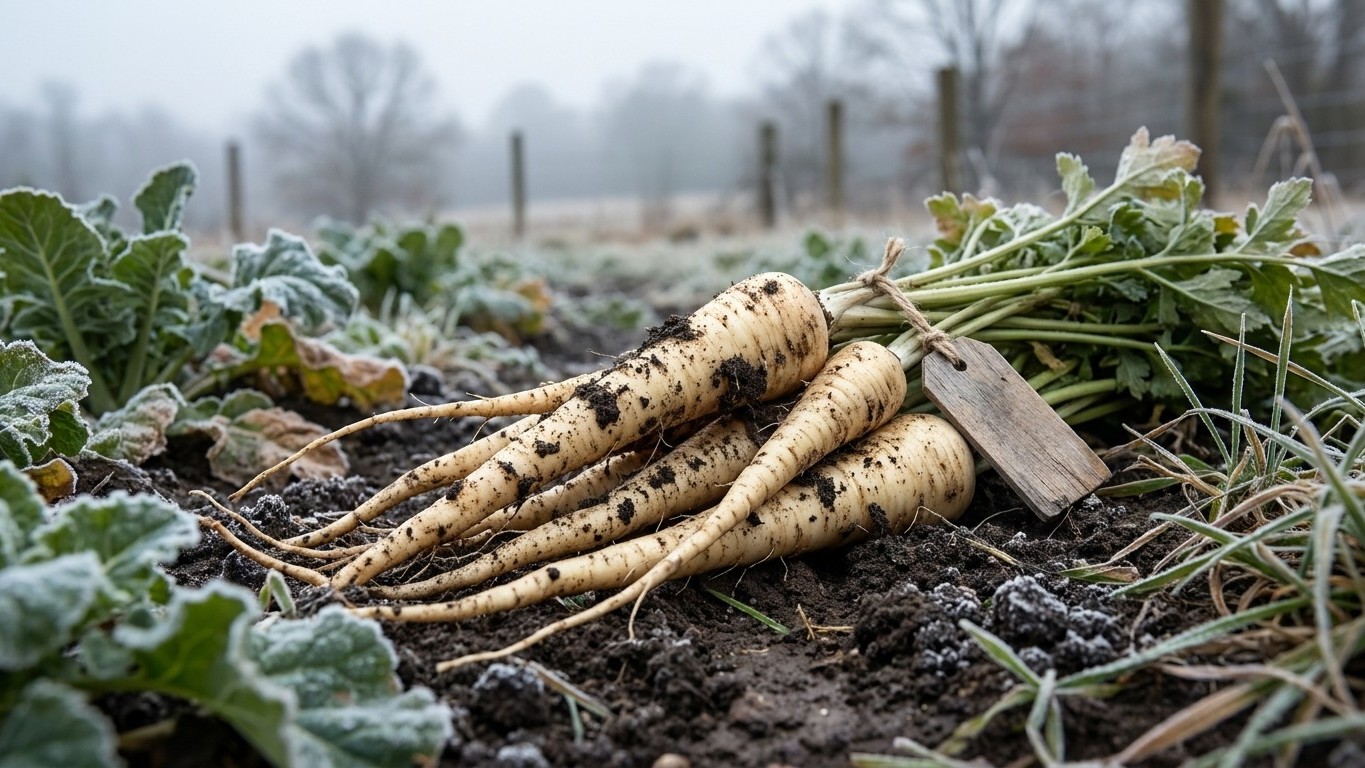

Yes, given typical conditions in the Billings area, Montana’s climate delivers enough frosty weeks to sweeten parsnips left in the ground after maturity. The mean minimum temperature in the coldest month sits at 17.9°F, well below the threshold needed to convert stored starch into sugar. But the sweetening only happens if the crop is timed and handled right, and that’s where most home gardens run into trouble.
The short answer
Start with the question that actually decides this: does the territory deliver several weeks of hard, frosty weather before the ground locks up solid? In the Billings reference area, the answer is a clear yes. NOAA NCEI Climate Normals data (1991-2020) puts the mean daily minimum for the coldest month at 17.9°F. That’s not a record low pulled from one bad night. It’s the average low across an entire month, which means cold nights in that range happen repeatedly, not as a one-off fluke.
That number matters because parsnip sweetness has nothing to do with what hardiness zone a map assigns to a place. A hardiness zone tells you the average annual extreme minimum, useful for deciding whether a perennial shrub survives winter. It says nothing about repeated frost exposure on a root sitting in garden soil in October and November. Parsnips need the second thing, not the first. According to Utah State University Extension, the roots taste best after several weeks of cool, frosty weather, because that cold exposure triggers the conversion of stored starch into sugar. A single light frost does almost nothing. It’s the accumulation of many cold nights that does the work.
A mean coldest-month minimum of 17.9°F tells you Montana isn’t flirting with the edge of “maybe cold enough.” It’s solidly in frost territory for weeks at a stretch. That’s the exact condition parsnips are built for. A gardener in a mild coastal climate with a coldest-month minimum hovering near 40°F could grow a technically mature parsnip and never get the flavor payoff, because the frost simply never shows up in sufficient dose. Montana doesn’t have that problem.
The caveat worth holding onto: this figure comes from a valley station, and Montana is not one climate. Mountain valleys elsewhere in the state can see frost in any month of the year, which changes the timing conversation even though it doesn’t change the sweetening mechanism itself. Cold is cold, wherever it lands on the calendar. The question for a specific garden isn’t “will frost sweeten my parsnips,” which the state answers with a yes almost everywhere. It’s “does my season leave enough days before that frost arrives for the roots to mature in the first place.” That’s a separate calculation, and it’s the one that trips people up.
Does the season fit?
Parsnips are sown directly in place, not started indoors and transplanted, and the full 100 to 120 days to maturity are counted from the seeding date, not from germination. Here’s how that timeline lays out against the Billings frost window.
- Sowing window: Seed goes in the ground 2 to 3 weeks before the last spring frost. With the last spring frost falling between April 29 and May 10 (NOAA NCEI 1991-2020 Climate Normals, 32°F freeze probability, 30-70% band), that puts sowing in early-to-mid April.
- Germination lag: Parsnip seed is notoriously slow. Germination takes 14 to 21 days, so don’t expect visible seedlings until late April or early May. This is a common point of confusion; a bare-looking bed at day ten is normal, not a failed sowing.
- Maturity countdown: Counting 100 to 120 days from an early-to-mid April sowing date lands maturity somewhere between mid-July and late August.
- Frost arrival: The first fall frost in the Billings reference area lands between October 1 and October 14.
- The gap: That leaves roughly five to eleven weeks between when the roots reach full size and when the first real frost hits. That gap is not wasted time, it’s the buffer that lets the grower leave mature roots in the ground, undisturbed, waiting for the cold to do its sweetening work.
Put plainly, the Billings-area season fits comfortably, not tightly. There’s slack built into the calendar on both ends, enough that a slightly late sowing or a slow germination stretch won’t push the harvest past the frost window. That comfortable margin is the exception rather than the rule in shorter-season parts of the state, which is the next thing worth understanding before assuming this applies everywhere in Montana.
What goes wrong here
- Forked roots from heavy or stony ground. Montana’s valley soils often run heavy or contain rock and gravel layers close to the surface. A taproot hitting resistance splits rather than pushing through. Utah State University Extension recommends deep, sandy soil for straight roots, and says heavy soil needs to be double dug before sowing, loosened and cleared of stones to a depth well past where the root will reach.
- Forked roots from overwatering. This is a separate cause from soil texture, and it’s easy to conflate the two. Inconsistent or excessive watering encourages the root to branch as it searches for a steadier moisture supply. The fix is even, moderate watering through the growing season rather than heavy soaking followed by dry stretches.
- Impatience during the 14 to 21 day germination window. Parsnip seed germinates slowly and unevenly. A gardener who assumes a failed sowing after a week and tills the bed under, then resows, has just burned two to three weeks off an already fixed 100 to 120 day clock.
- Sowing too late relative to the local frost window. The Billings reference area has generous slack, but that’s one station in one valley. Mountain valleys elsewhere in Montana can see frost in any month, according to NOAA NCEI records, which shrinks or eliminates that slack. A sowing delayed past the recommended window in one of those colder valleys risks the crop running out of days before maturity.
- Pulling the crop the moment it’s technically mature. Reaching day 100 to 120 doesn’t mean harvest day. Roots dug immediately at maturity, before frost has had weeks to work on them, come out starchy rather than sweet, even in a climate cold enough to have delivered the frost eventually. The remedy is patience: leave the roots in the ground through the early frosts and into the cold weeks that follow, mulching if needed to keep the ground workable for digging later.
Common questions
Do parsnips need frost to taste good, or will they still taste fine without it?
They’ll still be edible without frost, but they won’t be sweet. According to Utah State University Extension, the flavor that makes parsnips worth growing comes specifically from weeks of cool, frosty exposure converting starch to sugar. Skip that exposure and the root stays starchy.
Can I sow parsnips later and still make it Before Frost in the Billings area?
There’s real margin here. With maturity landing mid-July to late August from an early-to-mid April sowing, and first frost not arriving until October 1 to 14, a sowing pushed a couple of weeks past the ideal window still has room to mature before the ground freezes hard.
Why is my parsnip bed still bare three weeks after sowing?
That’s normal, not failure. Parsnip germination runs 14 to 21 days, slower than most root vegetables. Resowing too early wastes time you don’t get back within the fixed 100 to 120 day maturity window.
Is Montana’s hardiness zone the reason parsnips sweeten here?
No. Hardiness zone measures a location’s average annual extreme minimum, relevant for perennial survival, not for root vegetable flavor. Sweetening depends on repeated frost exposure while the root sits in soil, which for the Billings reference area is documented through the coldest-month mean minimum of 17.9°F, not through any zone rating.