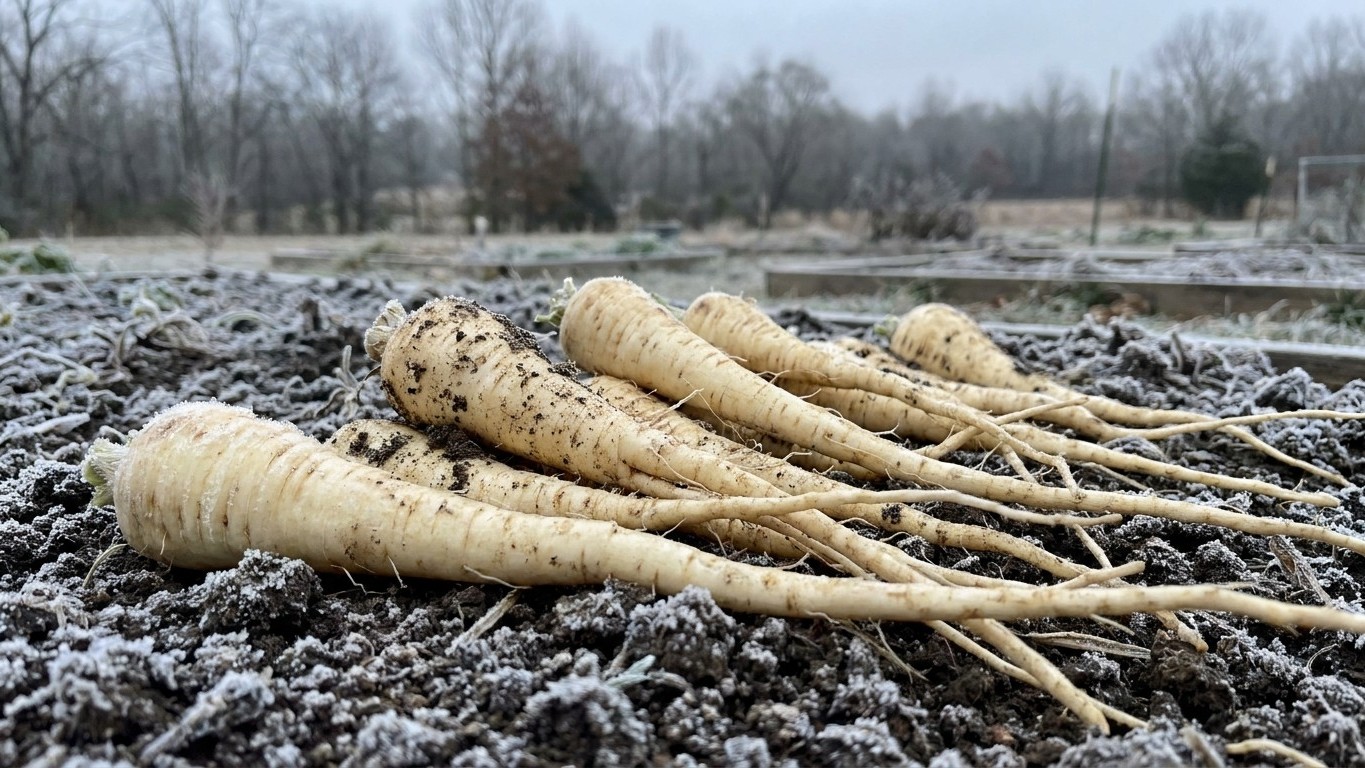

Yes, most years. Billings averages a mean minimum of 17.9°F in its coldest month, cold enough to hand parsnip roots several genuine frosty weeks before the ground locks up, and that cold is what turns stored starch into sugar. The 100-to-120-day season fits inside the region’s frost-free window without much strain. Mountain valleys elsewhere in the state complicate that math, since some of them can frost in any month of the year.
The short answer
The question that decides whether parsnips sweeten in a given place isn’t which hardiness zone shows up on a map. It’s how many weeks of real, sustained frost the ground gets before a gardener pulls the roots. Frost exposure, not zone number, is what converts starch to sugar inside a parsnip root, and Montana, at least around Billings, delivers plenty of it.
NOAA’s 1991-2020 Climate Normals put the mean daily minimum temperature for the coldest month at Billings at 17.9°F. That’s not a record low pulled from one unusually brutal week. It’s the average low across the entire coldest month, meaning nights in the high teens are the norm, not the exception, for weeks at a stretch. A parsnip left in the ground after it reaches maturity sits through cold that repeats, night after night, long enough to trigger the starch-to-sugar conversion Utah State University Extension describes as the payoff of “several weeks of cool, frosty weather.”
Compare that to a coastal or low-desert garden where winter lows hover just under freezing for a handful of nights and then bounce back into the 50s. Roots there might survive the winter fine and still taste starchy and flat, because survival and sweetening aren’t the same test. A plant can be hardy enough for a zone and still never get the sustained cold it needs to turn sugary. That’s the trap of reading a hardiness zone map and assuming it answers the sweetening question. It answers a different question, whether the plant lives. Billings’s 17.9°F average minimum answers the sweetening question directly, because it describes a stretch of weeks, not a single dip.
So the short answer for Montana growers near Billings: parsnips grown here, left in the ground through the first hard cold rather than pulled at the first frost, will sweeten. They won’t just survive the season, they’ll get the sustained, repeated frost exposure the crop needs to taste like something worth digging for. Gardeners farther out in Montana’s mountain valleys, where winters run colder still, likely see the same result, maybe with an even sharper sweetening, though the tradeoff there is a shorter and less predictable growing season to get the roots to maturity before that cold arrives, which the next section works through.
Does the season fit?
- Start with the last spring frost. Around Billings, that window runs April 29 to May 10, based on the 30 to 70 percent probability band for a 32°F freeze in NOAA’s 1991-2020 Climate Normals.
- Parsnip seed goes into the ground 2 to 3 weeks before that last frost date, which places the sowing window somewhere around April 8 to April 26 for this area.
- Germination is slow. Parsnip seed takes 14 to 21 days to come up, so a gardener who sows in mid-April shouldn’t expect visible seedlings until late April or into May, and shouldn’t dig around in the bed to check on them before then.
- From that same seeding date, Utah State University Extension puts full maturity at 100 to 120 days, not from when the seedlings emerge, but from when the seed went in. That lands the roots at harvestable size somewhere between mid-July and late August.
- The first fall frost around Billings arrives October 1 to October 14, per the same NOAA data.
- Line those dates up and there’s a gap of roughly five to seven weeks between “roots are mature” and “first frost hits.” That gap is slack, not a deadline. It’s time the roots can spend sitting in the ground doing nothing more than waiting for the cold that sweetens them.
- The verdict for the Billings area: the season fits comfortably. There’s enough runway to sow on schedule, wait out germination, reach maturity well before the first frost, and still leave the crop in place afterward to pick up the frost exposure that makes it sweet.
That comfortable fit is specific to milder valleys like Billings. Gardeners at higher elevation or farther into Montana’s mountain valleys should expect that same arithmetic to tighten, sometimes sharply, since a later last frost or an earlier first frost eats directly into that five-to-seven-week buffer.
What goes wrong here
- Forked roots from heavy or stony ground. A parsnip taproot pushes straight down, and it splits into two or three legs the moment it meets a rock, a clay lens, or compacted soil. Utah State University Extension recommends deep, sandy soil for this reason, and says heavy soil has to be double dug before sowing, loosened well beyond the top few inches, so the root has a clear, stone-free path down.
- Forked roots from overwatering. This is a separate cause from soil texture, and the two get lumped together too often. Too much water, especially inconsistent watering that swings from soggy to dry, encourages the root to branch instead of running straight. Even a well-prepped, sandy bed can produce forked roots if it’s kept waterlogged. The fix is steady, moderate moisture, not a heavy hand with the hose.
- A season that runs out in colder pockets. The comfortable timeline described above belongs to milder valleys like Billings. In a mountain valley with a later last frost and an earlier first frost, that five-to-seven-week buffer shrinks or disappears, and roots can still be small when the ground freezes hard. Sowing at the very front of the local frost-free window, and choosing the earliest end of the 100-to-120-day range for harvest expectations, buys back some of that lost time.
- A winter too mild to sweeten. This isn’t the typical Montana problem, but it can show up in an unusually sheltered microclimate, or when roots get pulled at the very first light frost instead of being left through several harder ones. Sweetening needs repeated, sustained cold, not one nip. Leaving the roots in the ground, mulched so they stay accessible for digging, through more than one hard frost is what finishes the job.
Handling parsnip tops and roots carries a hazard that has nothing to do with taste or timing. According to NC State Extension’s Plant Toolbox entry for Pastinaca sativa, “All parts of this plant contain furocoumarins which can make skin sensitive to light causing burns so be sure to wear gloves, long sleeves and long pants when dealing with it.”
The word “burns” isn’t exaggeration, and the mechanism is what makes this catch gardeners off guard. Furocoumarins don’t burn skin on contact. They need sunlight to activate. Sap gets on skin while pulling tops or digging roots on a bright afternoon, sunlight hits that sap-coated patch of skin, and the reaction shows up hours later, sometimes not until the next day, as a burn in the exact shape of where the sap touched. That delay is why the harvest job and the mark on the arm rarely get connected right away.
It also explains why the fix is prevention rather than cleanup. Washing exposed skin after the fact doesn’t undo a reaction that sunlight has already set in motion. Gloves, long sleeves, and long pants during harvest, especially on a clear day, are the real protection, and that covers every part of the plant, not just the leafy tops, since the warning applies to all parts.
Checking this against your own county
Billings sits in one of Montana’s milder valleys, and every frost date and cold-month average above comes from that single reference station. Montana’s actual growing conditions swing hard from one county to the next. A garden up near Kalispell, in the Bitterroot Valley, or out along the Hi-Line can see a last frost weeks later and a first frost weeks earlier than what’s documented here, and mountain valleys elsewhere in the state can freeze in any month of the year.
The most reliable next step is Montana State University Extension, which runs county offices across the state and can supply frost dates, soil guidance, and planting timing specific to a given elevation and valley. Extension staff work from local weather station records rather than a single statewide figure, which matters given how much Montana’s terrain shifts between a Billings backyard and a garden set against the Rockies.
Common questions
Do parsnips need to be transplanted, or sown directly in Montana gardens?
Parsnips are sown directly in place, not started indoors and transplanted. The 100-to-120-day maturity window that Utah State University Extension describes runs from the date the seed goes into the garden bed, not from any later transplant date.
How long does parsnip seed take to germinate?
Expect 14 to 21 days before seedlings show above the soil. That’s a long, quiet stretch, and it’s worth marking the sowing date somewhere visible so the bed doesn’t get disturbed or re-sown before the seedlings have had time to come up.
What kind of soil do parsnips need in Montana gardens?
Deep, sandy soil is the starting point Utah State University Extension recommends. Heavier ground doesn’t rule parsnips out, but it needs to be double dug first, loosened well below the surface, so the taproot has a clear path down instead of splitting around rocks or compacted clay.
Does washing sap off my skin prevent a burn from parsnip tops?
No. The burn described by NC State Extension comes from sap combined with sunlight, and once sunlight has activated that reaction, washing afterward doesn’t reverse it. Gloves, long sleeves, and long pants during harvest are the actual protection, not cleanup after the fact.