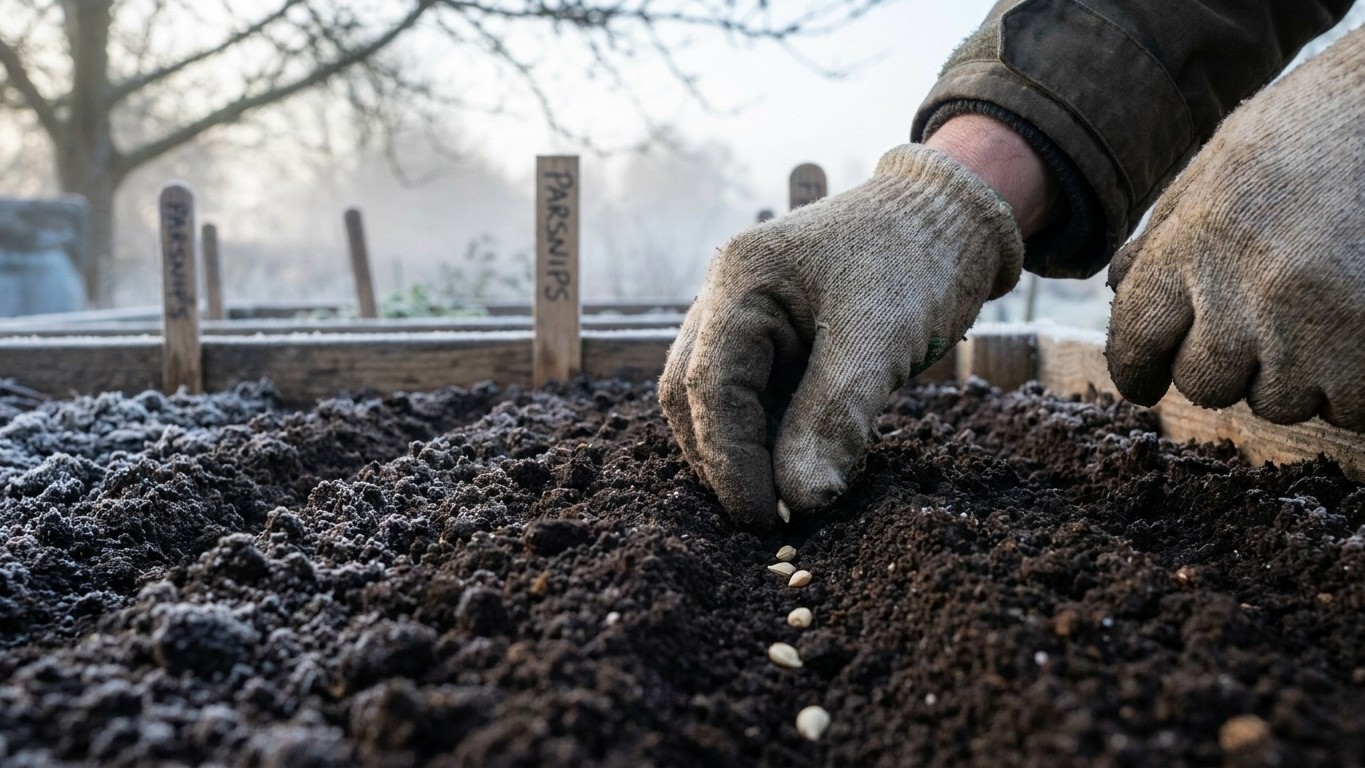

Sow parsnip seed directly in the garden in mid-to-late May in Newfoundland and Labrador, roughly two to three weeks ahead of the region’s average last spring frost of May 30. Leave the roots in the ground through several fall frosts before digging, since that cold exposure is what turns the crop’s stored starch into sugar.
The short answer
Frost exposure, not the hardiness zone, is what settles this question, and the reference station at St. John’s gives a clear number: the mean daily minimum of the coldest month sits at 16.4°F. That’s roughly 15.6 degrees below freezing, night after night, averaged across the coldest stretch of winter. A climate that runs that cold on average isn’t flirting with the occasional light frost. It’s producing sustained, genuine cold for weeks at a stretch.
That distinction matters because a parsnip can grow perfectly well in a mild, frost-light climate and still taste flat. The sweetening reaction depends on the roots sitting in cold soil while frost repeatedly hits the ground above them, not on whether the region is rated for hardy perennials. A comfortable hardiness zone tells you almost nothing about whether a parsnip will convert its starch to sugar. Only actual frost exposure does that.
Given a coldest-month mean minimum of 16.4°F, Newfoundland and Labrador clears that bar without much doubt. This isn’t a borderline maritime climate where frost shows up once or twice and disappears. It’s a climate built around real winter cold, which means a parsnip left in the ground here after it matures gets the repeated frost cycling the crop needs. The practical answer, then, is that parsnips grown on this schedule in this territory should sweeten, not merely grow to size and stop there.
One caveat is worth stating plainly: the St. John’s reference station describes one point on the map, and the province is not one climate. Sheltered coastal pockets on the Avalon Peninsula can run milder in early winter than the reference figures suggest, while interior and upland districts run colder and reach hard frost sooner. A gardener working a warm, sheltered dooryard bed near the coast should watch local conditions rather than assume the St. John’s numbers apply exactly, but the broad pattern, several frosty weeks arriving reliably before deep winter locks up the ground, holds across most of the province.
Does the season fit?
Parsnip needs 100 to 120 days from the day the seed goes into the ground to reach maturity, and because the crop is sown in place rather than transplanted, that clock starts at seeding, not at any later date. Laid against Newfoundland and Labrador’s frost dates, the arithmetic works out with room to spare.
- Start the clock at the last spring frost mean of May 30, and sow directly in the garden two to three weeks earlier, once the soil can be worked, putting the sowing window around May 9 to May 16.
- Expect nothing to show above ground right away: parsnip seed takes 14 to 21 days to germinate even in favorable conditions, so seedlings may not appear until late May or early June.
- Count 100 to 120 days forward from the sowing date. A May 9 sowing reaches day 100 around August 17 and day 120 around September 6. A May 16 sowing reaches day 100 around August 24 and day 120 around September 13.
- Set that maturity window against the first fall frost mean of October 17. Even the latest of those maturity dates, September 13, lands roughly five weeks before frost arrives on average.
- Remember that October 17 is a mean date, not a guarantee: in about half of all years, the first frost falls later than that, which widens the safety margin further rather than narrowing it.
- Once the roots reach maturity, resist pulling them right away. Leaving them in the ground through the first several frosts is what sweetens them, and the calendar here allows for that without pushing the harvest dangerously late.
Put together, the season fits comfortably rather than tightly. There’s slack built into the schedule even on the slow end of the germination and maturity ranges, and the frost date arriving in mid-October, on average, gives the crop time to mature and then sit through cold weather before the ground becomes unworkable.
What goes wrong here
- Forked or branched roots in heavy or stony native ground. Much of the province’s soil is rocky and dense, and a taproot forced to push through that resistance splits rather than growing straight down. Double dig the bed or build a raised bed filled with deep, stone-free sandy loam before sowing, since parsnip does best in loose, well-worked ground.
- Forked roots caused by overwatering, a separate problem from soil texture. Uneven or excessive moisture makes the young taproot branch as it searches for oxygen in waterlogged ground, even in soil that’s otherwise loose and stone-free. Water steadily and moderately instead of soaking heavily on an irregular schedule.
- A season that runs out in cooler, inland or upland districts. The frost dates used here come from the St. John’s reference station, and areas farther from the coast, at higher elevation, or deeper inland typically see a later last frost and an earlier first fall frost, shrinking the window. Sow at the very start of the recommended range and choose the warmest, most sheltered spot available if you’re gardening away from the immediate coast.
- Poor or patchy germination in cold, slow-to-warm spring soil. Parsnip seed already germinates slowly, at 14 to 21 days under good conditions, and cool spring soil common across the province can stretch that further or cause uneven crusting that blocks seedlings from breaking through. Keep the seedbed consistently moist through that whole window, and a light row cover can help nudge soil temperature up enough to even out germination.
Common questions
Can I transplant parsnip seedlings instead of sowing in place?
No. Parsnip is a direct-seeded crop, and the 100 to 120 day maturity count runs from the seeding date, not from a later transplant. The taproot doesn’t recover well from disturbance, which is why the crop goes straight into its final bed.
How long before parsnip seed actually sprouts here?
Plan on 14 to 21 days, which is longer than most root vegetables need. Cool spring soil across much of Newfoundland and Labrador can push germination toward the longer end of that range, so don’t assume a failed sowing until at least three weeks have passed.
Should I dig parsnips before the ground freezes solid?
Leaving roots in place through several frosts is what sweetens them, so many gardeners in the province dig only what they need through fall and into early winter, mulching the rest to keep the ground workable a bit longer. Get the remaining roots out before the ground locks up hard for the season.
Does the hardiness zone tell me if parsnips will taste sweet?
No. A hardiness zone rating measures whether a perennial plant can survive winter cold, which has nothing to do with whether an annual root crop like parsnip gets enough frost exposure before harvest. That answer comes from actual frost data, such as the coldest month’s mean minimum and the average first fall frost date, not from a zone number.
The Moon calendar is a separate, older custom: see when to plant parsnips by the moon, written as tradition rather than fact.