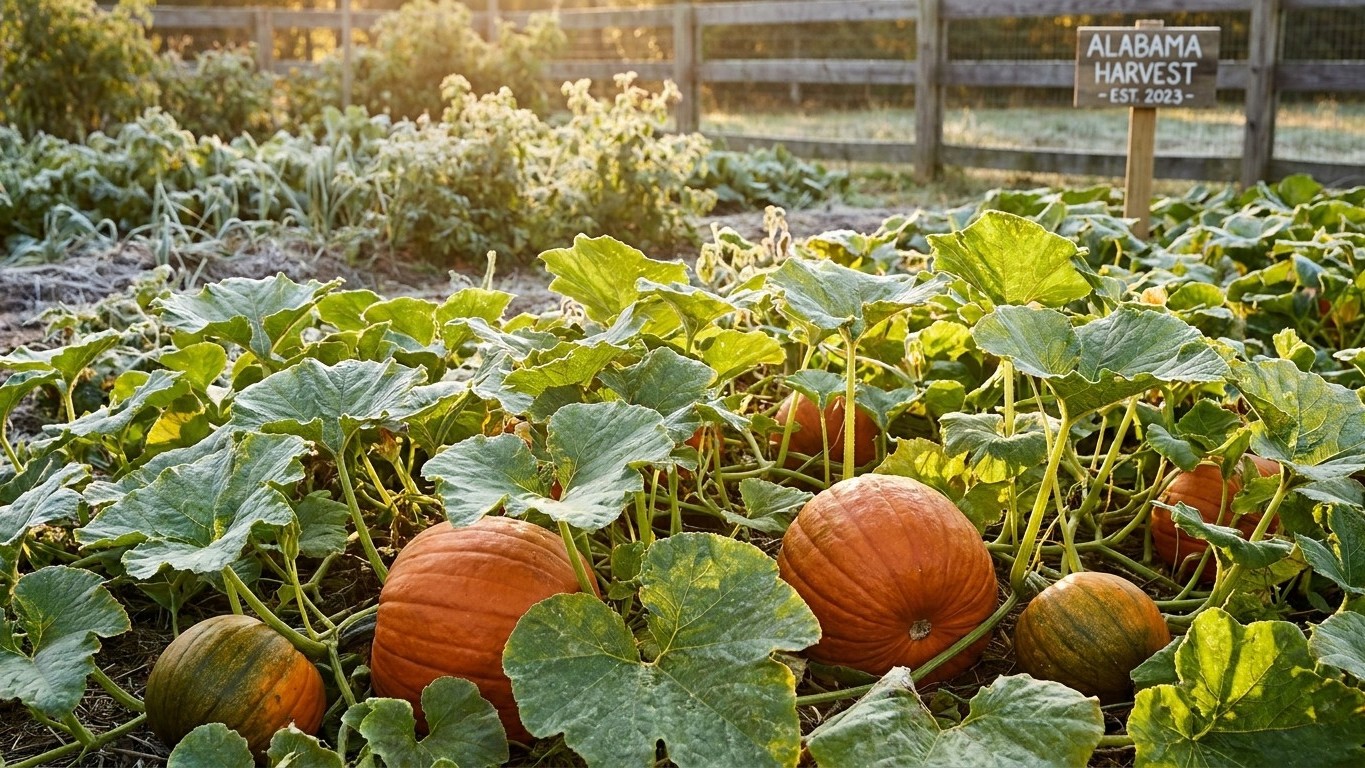

In Nova Scotia, the honest answer is: sometimes, and it depends more on your flowering date than your calendar. With an average first fall frost of October 18, a pumpkin flower needs to open between roughly August 25 and September 3 to reach the 45 to 55 days it needs to mature. Miss that window and you’re gambling on a mild fall.
The short answer
Work the math backward from frost, not forward from planting. Halifax Stanfield’s climate normals put the average first fall frost at October 18. Utah State University Extension’s guidance on pumpkin maturity says a flower needs 45 to 55 days from the moment it opens, not from the day the seed goes in the ground, to produce a pumpkin with hardened, fully colored skin. Subtract 45 days from October 18 and you land on September 3. Subtract 55 days and you land on August 25. That gives you the real target: for a pumpkin to have a fighting chance at ripening before frost, its flowers need to be open and pollinated somewhere between August 25 and September 3.
Notice what that means in practice. A vine that’s still throwing new blossoms in mid-September isn’t just running late, it’s already out of time. Any fruit set from those late flowers is going to be caught green when the frost arrives, because the clock started the day the flower opened, not the day you’ll wish it had.
Here’s the part growers in Nova Scotia often miss: October 18 is a mean date, not a guarantee. Environment and Climate Change Canada’s normals are calculated over a thirty-year period, which means in roughly half of all years, frost arrives later than October 18, and in the other half, it arrives earlier. Treat that date as the midpoint of a window, not a line you can plan right up against. If you’re growing near the Bay of Fundy uplands, in the Annapolis Valley’s cooler pockets, or anywhere inland and elevated compared to the Halifax airport station, your actual frost risk likely runs earlier than the provincial average, sometimes by a couple of weeks. A province this size isn’t one climate zone, and the station behind this normal sits on the coast, where marine air moderates temperature swings that inland gardens don’t get.
So the practical answer for most home gardens in the province: yes, pumpkins can ripen before frost, but only if flowering happens in that last week of August into the first days of September. Anything later, and you’re relying on a frost that arrives later than average, which happens, but isn’t something to plan a harvest around.
When to sow here
The mistake most gardeners make is treating the last spring frost date as their green light to plant pumpkin seed. It isn’t. Pumpkins need soil at 65 F to germinate reliably, and soil warms weeks behind the air. Here’s the sequence that actually matters:
- Start from the last spring frost average, May 7. This is a mean too, so treat it the same way as the fall figure: in half of all years, frost comes after May 7, sometimes well after, especially inland.
- Wait for the soil, not the air. Soil temperature lags behind air temperature through spring, often by several weeks, because the ground has to absorb and hold heat rather than just reflect a warm afternoon. A calendar that says “frost-free” doesn’t mean the soil six inches down has caught up. Check with a soil thermometer rather than guessing from the air temperature on the forecast.
- Use row covers to buy time. Clear or fabric row covers trap solar heat and can push soil warming forward by about two weeks compared to bare, exposed ground. That’s often the difference between sowing in late May and sowing in mid-June in a cool Nova Scotia spring.
- Sow once soil reads 65 F, not before. Seed sown into colder soil germinates slowly, unevenly, or not at all, and a slow start at the seedling stage pushes every later stage back, including the flowering window that has to land by early September.
- Count forward with the fall window in mind. Every week soil takes to reach 65 F is a week pushed off the flowering target of August 25 to September 3. If your soil warms late, row covers and a warm microclimate (a south-facing slope, a spot against a wall) become the difference between a ripe pumpkin and a green one.
The takeaway: 65 F soil and May 7 frost are not the same milestone. Treating them as interchangeable is the single most common planning error behind pumpkins that never quite finish in this climate.
What goes wrong here
- A late flower that never colours. When the first strong female flowers don’t open until mid-September, the fruit that sets has no realistic path to 45 days of growth before frost. The remedy is upstream: get soil to 65 F as early as row covers and a warm site allow, and choose a planting date that gives flowering a real shot at landing before September 3, not after it.
- A fruit caught by frost while still green. This happens when flowering did land in the target window, but a wetter, cooler August slowed the plant’s overall pace, so the 45 to 55 day clock ran long. The remedy here is harvest timing: watch the fruit closely as the window closes, and if frost threatens before the skin has fully hardened, harvest with the stem attached and move it somewhere it will not freeze, rather than leaving it on the vine hoping for another week.
- A vine that dies back before the skin hardens. Pumpkin foliage is frost-tender well before the fruit itself is damaged, and a hard frost that kills the leaves stops the plant from feeding the fruit any further, even if the pumpkin itself survives a light touch of cold. The remedy is protection at the edges of the season: covering vines overnight when frost is forecast can buy the fruit another few days of skin-hardening time, which matters most for pumpkins that set fruit right at the tail end of the safe window.
All three failures trace back to the same arithmetic: flowering date plus 45 to 55 days measured against a frost date that itself only holds true in about half of all years. Gardeners dealing with squash bugs or cucumber beetles on top of a tight season should treat pest pressure as a separate problem with its own timeline and remedies, not something to solve at the same time as the ripening clock.
Common questions
Can I speed up ripening on a pumpkin that’s still green in late September?
Not meaningfully. Once a frost threat is close, the more reliable move is to harvest with the stem attached and store the fruit somewhere it will not freeze, rather than counting on extra vine time that the season no longer has.
Does the May 7 last frost date mean it’s safe to plant pumpkin seed outdoors that day?
No. Seed germination depends on soil reaching 65 F, which happens well after the air stops frosting. Planting on the frost date itself usually means sowing into soil that’s still too cold for reliable germination.
Is October 18 a safe date to assume my pumpkins are done growing?
Treat it as a midpoint, not a deadline. Environment and Climate Change Canada’s normal is a thirty-year average, meaning frost arrives later than October 18 in roughly half of all years, and earlier in the other half, especially away from the coastal Halifax Stanfield station.
Do row covers help at the fall end of the season too, not just spring?
The Utah State University Extension guidance addresses spring soil warming and harvest timing, not fall frost protection specifically, so no figure for that use is published here. What is documented is harvesting with the stem attached before frost and storing fruit where it will not freeze.