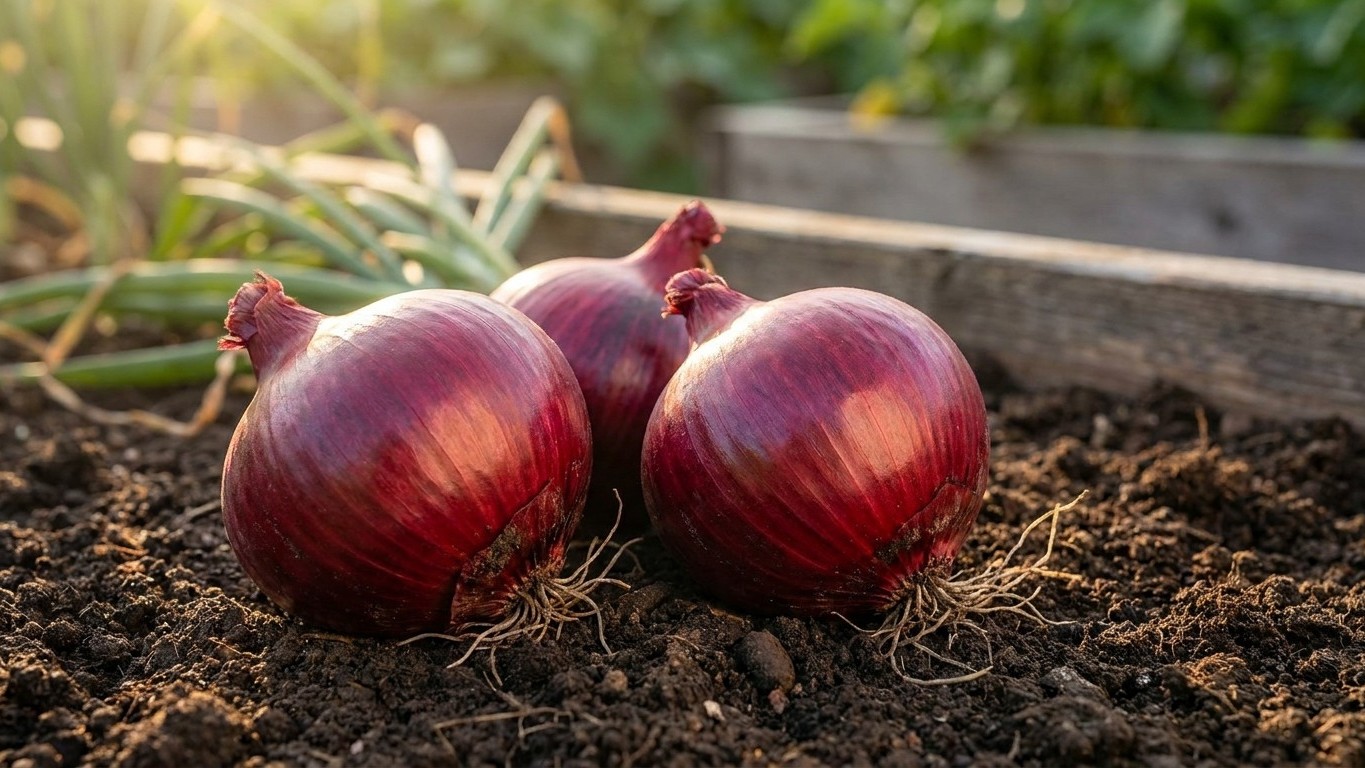

Of the ten insects most often cited for gardens in this part of Atlantic Canada, only one is actually documented as an onion feeder. It doesn’t chew leaves or bore into bulbs the way the pests that trouble squash or lilies nearby do. It goes after the planted seed itself, tunneling in before a seedling ever breaks the surface, or attacking the tender base of a sprout days after it emerges. The window is short and closes once the plant toughens up.
Which pests attack onion in Nova Scotia

University of Maine Cooperative Extension, the nearest source that documents insect pests for this shared Gulf of Maine and Bay of Fundy climate, lists ten species relevant to home gardens across the wider region: browntail moth, cabbage maggot, Colorado potato beetle, emerald ash borer, lily leaf beetle, seedcorn maggot, spotted wing drosophila, squash vine borer, striped cucumber beetle, and winter moth.
Run that list against a bed of onion and most of it drops out fast. Browntail moth caterpillars feed on oak and fruit tree foliage, not vegetable rows, and their main claim to fame is the skin rash they cause, not crop damage. Emerald ash borer is a wood-boring beetle with a single host, ash trees, and has no reason to visit a garden bed at all. Winter moth caterpillars strip buds and leaves off trees and shrubs in early spring, an entirely different habitat than a row of onion sets. Lily leaf beetle is a specialist too, but its target is true lilies and fritillaries, ornamental plants that share no family ties with onion despite the similar-sounding common name.
Colorado potato beetle sticks to potato, eggplant, and tomato foliage, plants in the nightshade family that have nothing to do with an allium. Squash vine borer and striped cucumber beetle are both cucurbit specialists, drawn to squash, cucumber, and melon vines and largely indifferent to anything else in the garden. Spotted wing drosophila targets soft, thin-skinned fruit like berries and cherries, a texture an onion bulb simply doesn’t offer. Cabbage maggot is the closest relative on this list, a root feeder in the same fly family, but it’s tied to brassicas: cabbage, broccoli, radish, and their kin, not onion.
That leaves seedcorn maggot, Delia platura, as the one species on this list with a documented appetite for onion. Treat this list as fixed and skip treating an onion bed for anything not documented here, since the rest of these insects simply have no business in that part of the garden.
When each one shows up, and what it does first
Onion goes into the ground here as sets, transplants, or direct seed once the soil has shed its late-season chill, and that stretch is exactly when seedcorn maggot flies are most active. The adult fly lays eggs in cool, moist soil, drawn especially to ground that still carries fresh organic matter or manure from a recent amendment. Larvae then tunnel into the planted seed before it can germinate, or bore into the base of a seedling within days of it breaking the surface.
What a gardener actually notices first is rarely the maggot. It shows up as a gap in the row where a seed should have sprouted and never did, or as a seedling that yellows and wilts, then lifts free of the soil with almost no root left when it’s tugged. Because the larvae work below the soil line, the visible sign always lags behind the real damage by several days, sometimes longer if the spring stays cold.
Slow, cold germination widens this window rather than closing it. A seed sitting in chilly, saturated soil for an extra week gives the larvae that much longer to find it before a seedling gets big enough to shrug off the damage. Halifax sits at 44.88 degrees north, and as day length climbs toward the region’s peak of 15 hours and 25 minutes on the longest day, onion shifts out of pure leaf growth and into bulb formation. By the time that shift is underway, stems and roots have thickened well past the stage this maggot can exploit, which is why the real risk sits almost entirely in the first few weeks after seeding, not later in the season.
Telling the damage apart from everything else
A gap in the row or a wilting seedling has more than one possible cause, and guessing wrong wastes a season. The table below lines up what a seedcorn maggot problem looks like against the things gardeners commonly mistake for it.
| What you see | Possible cause | What tells them apart |
|---|---|---|
| Seed never sprouts at all | Seedcorn maggot inside the seed, or seed rot from cold, waterlogged soil | A maggot leaves a visible feeding tunnel through the seed; rotted seed is simply mushy with no tunnel |
| Seedling wilts and lifts free with little root | Seedcorn maggot feeding at the stem base | Roots and stem tissue look gnawed or hollowed, not just short from dry soil |
| Older leaves yellow evenly, growth stalls across the bed | Nitrogen deficiency | Yellowing is uniform across the row rather than showing up in scattered gaps |
| Seedling clipped clean at the soil line, toppled but otherwise intact | Cutworm, a mechanical feeder, not a maggot | The stem is severed cleanly, not hollowed, and a curled caterpillar is often nearby just under the surface |
The one habit that saves the most guesswork is simple: dig gently at the base of a struggling seedling before assuming disease or drought. A maggot or its feeding tunnel settles the question in seconds, while a wrong guess based on the leaves alone can send a gardener chasing a fungal problem that was never there. When the cause still isn’t clear, that’s a job for a local extension office, not a forum post.
What actually works here, and what is a waste of time
Because the damage happens underground before any symptom shows, treating a bed after wilting appears is mostly too late. The larvae have already done their work by the time a gardener notices a gap in the row. What actually changes the outcome is timing and soil handling done before the flies ever lay an egg.
Working fresh manure or a heavy load of undecomposed organic matter into the soil right before seeding is one of the strongest draws for egg-laying adults, so spacing that amendment out well ahead of planting removes a lot of the temptation. A physical barrier over the row does the rest: cover the row right after seeding, not after seedlings appear, since the goal is to keep the adult fly from ever reaching the soil surface to lay eggs in the first place. Rotating onion away from a bed that just grew beans or sweet corn also helps, since seedcorn maggot isn’t picky about its host and builds up wherever decomposing matter and cool, damp soil coincide.
What doesn’t help is reacting once wilting starts. By then the larvae are finishing their feeding or have already moved on, and there’s no reversing a hollowed-out seedling. Extension services are the right place to confirm what’s registered for use in a home garden if a heavy infestation shows up year after year, since that answer changes by product and by season and isn’t something to guess at from a garden forum.
Where to check this for your own county
University of Maine Cooperative Extension is the source this whole page draws from, and it’s the nearest publicly documented reference for insect pests across this shared climate zone. Reaching out to a county office there, or to whatever agricultural extension resource serves a specific part of Nova Scotia, is the right next move for anyone seeing damage that doesn’t match the description here.
A documented list at the scale of a state or region never guarantees what’s actually present in one garden. Soil type, what grew in that bed the year before, and how close it sits to a farm field all shift the odds. A backyard a few miles from a cabbage or bean field may carry more root maggot pressure than one surrounded by lawn, regardless of what’s published for the wider territory.
The most useful habit is asking before there’s a problem rather than after: call the extension office before planting season starts, not after the damage is already done. That’s the point where timing advice, current pressure reports, and rotation guidance can still change what happens in the bed, instead of just explaining what already went wrong.