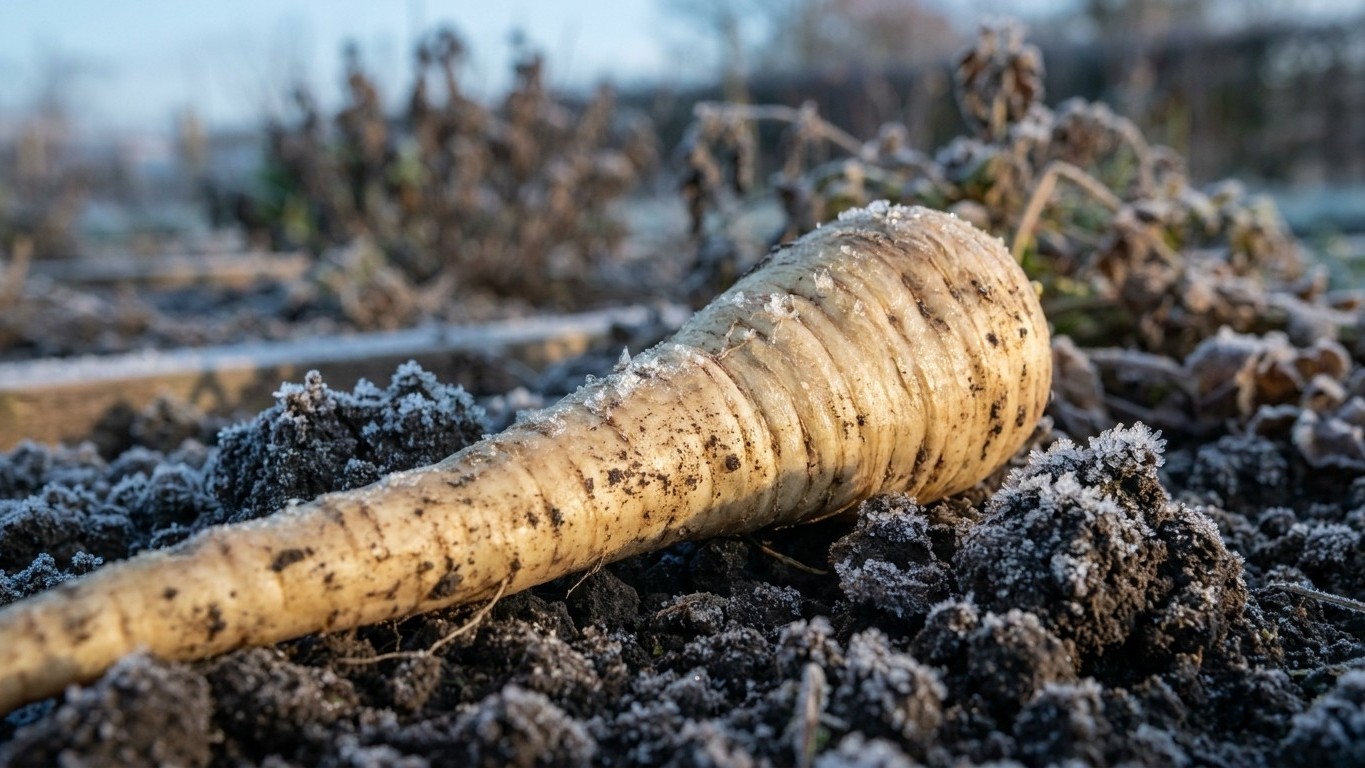

University of Maine Cooperative Extension documents ten insect pests for this region, and only one of them, seedcorn maggot, has any real business in a parsnip bed. It strikes during germination, the slowest stage of any common vegetable, in cool wet soil close to the last spring frost. The other nine pests on that list target trees, brassicas, cucurbits, or nightshades, not root crops sown for a Nova Scotia harvest.
Which pests attack parsnip in Nova Scotia
University of Maine Cooperative Extension, whose service area shares climate and cropping patterns with Nova Scotia, documents ten pests for this region: Browntail moth (Euproctis chrysorrhoea), Cabbage maggot, Colorado potato beetle, Emerald ash borer, Lily leaf beetle (Lilioceris lilii), Seedcorn maggot (Delia platura), Spotted wing drosophila, Squash vine borer, Striped cucumber beetle, and Winter moth.
Most of that list has nothing to do with a parsnip row. Browntail moth caterpillars feed on oak and other hardwood leaves, not vegetables. Emerald ash borer only tunnels into ash trees. Winter moth strips foliage from trees and shrubs early in the season. Lily leaf beetle feeds on true lilies and related ornamentals. Colorado potato beetle sticks to the nightshade family: potato, tomato, eggplant. Cabbage maggot targets brassica roots, cabbage, broccoli, turnip, not carrot-family crops. Squash vine borer and striped cucumber beetle are cucurbit specialists, going after squash, cucumber, and melon vines. Spotted wing drosophila lays eggs in soft-skinned fruit like berries, and a root vegetable simply isn’t on its menu.
That leaves seedcorn maggot, and its name is misleading, since the larvae attack seeds and seedlings of a wide range of vegetables, not just corn. Parsnip is one of the slowest garden vegetables to germinate, needing 14 to 21 days underground before a seedling breaks the surface. That long window is exactly what makes a seedbed vulnerable: the adult fly lays eggs near decaying organic matter and germinating seed in cool, damp soil, and the maggot feeds on the seed or the young root before it ever gets the chance to establish.
When each one shows up, and what it does first
Nova Scotia’s growing season runs on a frost calendar, not a set of months. Environment and Climate Change Canada puts the average last spring frost, at the Halifax Stanfield station, at May 7, and the average first fall frost at October 18, and both are mean dates: in one year out of two, frost arrives later than that. Parsnip seed goes into the ground two to three weeks before that average last frost, and the seedcorn maggot’s window opens at the same time, because the fly is active whenever soil stays cool and wet in spring.
The first sign isn’t a visible insect. It’s a gap. Rows that should show a steady line of seedlings have bare patches instead, or seeds that never come up at all. Dig at one of those gaps during the germination window and there may be small, yellowish-white maggots in the soil around the seed or inside it. Seedlings that do emerge sometimes wilt and collapse within days, because the maggot has already fed on the young taproot below the soil line.
Risk drops once seedlings push past that fragile stage and grow true leaves; an established parsnip root isn’t a target for the rest of the season. A second generation of the fly can appear later, but by then the plants are usually past the vulnerable point, so the real risk window is the three weeks or so around germination, not the whole summer. That narrow timing is also why replanting a failed row right away often runs into the same problem: the soil conditions that drew the first generation haven’t changed.
Telling the damage apart from everything else
A gap in the row doesn’t always mean an insect. Cold, waterlogged soil can rot parsnip seed outright before it germinates, birds and mice lift newly sown seed, and old seed simply fails at a higher rate since parsnip seed loses viability faster than most vegetables. None of that is seedcorn maggot, and none of it needs any pest response.
| What you see | Likely cause | What tells them apart |
|---|---|---|
| Bare patches, no seedlings | Seedcorn maggot, or cold/wet soil rotting the seed, or birds | Dig at the gap during the germination window and look for small maggots in or near the seed |
| Forked or split roots | Heavy or stony soil, or overwatering | Neither is insect damage; check soil texture first, then irrigation habits |
| Pale, stunted seedlings | Low fertility or poor drainage | Uniform paling across the row points to soil, not a pest feeding in patches |
| Bitter or woody roots at harvest | Not enough frosty weeks before digging | A timing issue with the sweetening process, not damage at all |
A forked root is worth a second look on its own, because it has two separate causes that often get lumped together. Heavy or stony ground splits a taproot as it grows around an obstruction, while overwatering, especially early on, encourages the same kind of branching by keeping the topsoil consistently wetter than the subsoil below it. Neither one is a pest problem, and neither responds to anything aimed at seedcorn maggot.
When the cause genuinely isn’t clear, a local extension contact can look at a photo or a sample and identify what’s actually happening, which beats guessing from a description alone.
What actually works here, and what is a waste of time
A floating row cover, laid down right after sowing and sealed at the edges with soil or pins, keeps the adult fly from ever reaching the seedbed to lay eggs. Leave it on through the germination window and past early seedling growth, since that’s the entire period the crop is at risk. This is the single most reliable step against this pest, and it costs a roll of fabric rather than a chemical decision.
Timing the sowing itself matters almost as much. Parsnip needs 100 to 120 days from seeding to a usable root, and with an average first fall frost of October 18, sowing too late leaves no margin for the crop to size up, let alone sit through the cool weeks afterward that turn stored starch to sugar. Sowing near the edge of the frost window, rather than delaying to dodge cool wet soil, is usually the better trade, since a row cover handles the maggot risk anyway.
Working fresh manure or a heavy load of undecomposed organic matter into the bed right before sowing is worth avoiding, since that’s exactly the kind of decaying material that draws egg-laying flies to a row in the first place. Broadcast soil treatments without a confirmed pest, and repeated replanting in the same spot after a failed row, are both a waste of effort here: one treats a problem that may not exist, the other puts new seed into the same conditions that caused the first failure. Beyond a row cover and reasonable timing, anything more specific belongs with an extension contact who knows what’s registered for use locally.
Where to check this for your own county
The pest list on this page comes from University of Maine Cooperative Extension, which serves a region just south of Nova Scotia with a broadly similar climate. It’s the closest documented reference available, but it’s a Maine document, not a Nova Scotia one, and pest pressure shifts across a border the same way it shifts across a county line. A garden in coastal Maine and one further inland don’t see identical seedcorn maggot pressure in a given year, and the same holds true from one part of Nova Scotia to another.
What that means in practice: treat this list as a starting point, not a local guarantee. Soil type, how wet a spring runs, and how much organic matter went into a bed the previous fall all shift the actual risk in a given garden, and none of that shows up in a province-wide or state-wide list. A plot on heavy clay near the coast and one on light sandy loam inland can have very different experiences with the same documented pest.
Nova Scotia’s own agricultural extension resources, along with a local garden center or county-level agricultural office, can confirm what’s actually being seen in a given area this season, and can speak to what’s registered for use locally, which a page like this one can’t do. The next practical step is straightforward: check a suspected gap or seedling loss against the table above, and if it still doesn’t match, bring a sample or a clear photo to a local extension contact rather than guessing from a symptom list alone.
Common questions
Does seedcorn maggot affect parsnip every year?
No. It depends on how cool and wet the soil stays right after sowing, and on how much decaying organic matter sits nearby. Some years, and some gardens, see none of it.
Can I sow parsnip earlier to dodge the risk?
Sowing earlier usually means colder, wetter soil, which favors the fly rather than avoiding it. A row cover placed at sowing does more than shifting the calendar does.
Do the other nine pests on the Maine list ever show up in a parsnip garden?
They can show up in a mixed garden, since a Colorado potato beetle doesn’t care that a parsnip bed sits next to the potatoes. But none of them feed on parsnip itself, so finding one nearby isn’t evidence of parsnip damage.
Is a forked parsnip root safe to eat?
Yes. A forked root is a growing condition, from heavy soil or overwatering, not pest or disease damage, and it doesn’t affect whether the root is fine to eat.