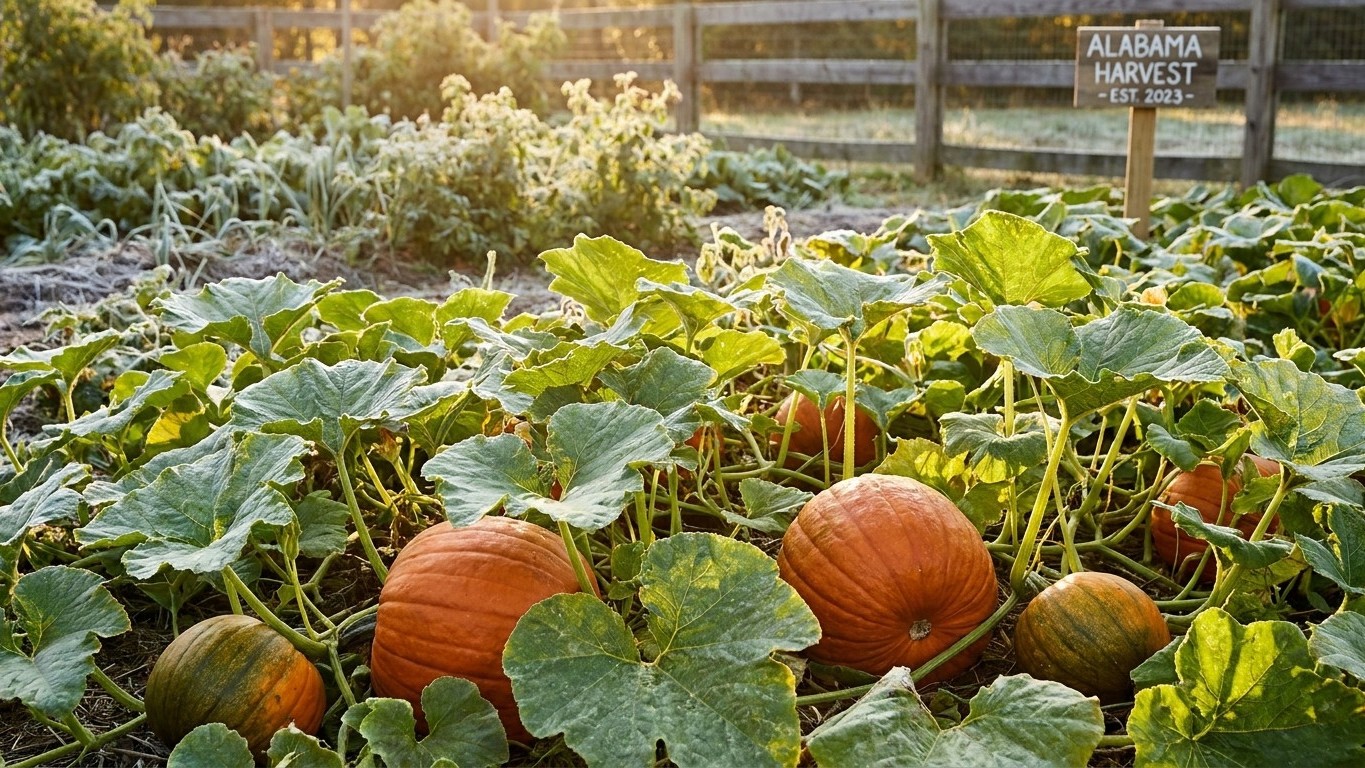

Yes, but the timing is tight. In Ohio’s zone 6a, first fall frost typically lands between October 5 and October 15, and pumpkins need 45 to 55 days from flowering, not from seeding, to reach full color. Work backward from that frost window and the flowers on a healthy vine need to open sometime in the second half of August. Miss that window and the vine runs out of season before the fruit does.
The short answer
Start with the frost window Ohio State University Extension publishes for zone 6a: October 5 to October 15. That’s the range, not a fixed day, because frost arrival shifts year to year with weather patterns nobody can pin down in spring. Now subtract the maturation clock Utah State University Extension gives for pumpkins: 45 to 55 days after flowering. Do the arithmetic against the early end of frost, October 5, and 45 days back lands on August 21; 55 days back lands on August 11. Do it against the late end, October 15, and 45 days back lands on August 31; 55 days back lands on August 21. Stack those two calculations together and the safe flowering window for Ohio growers runs roughly from August 11 to August 31.
That’s the number the whole page exists to explain: a flower that opens after the last week of August is racing a fruit that may still be green, or barely turning, when frost arrives. A flower that opens by mid-August has the full 45 to 55 days to work with even in a year when frost comes early.
Two things stretch or shrink that window without changing the arithmetic itself. First, the 45-to-55-day spread isn’t arbitrary; it reflects real variation between seed lots and how a given vine is growing that season, not a fixed number every pumpkin obeys. Second, frost dates are a range for a reason, and a grower banking on the late end of that window (October 15) is betting on a milder-than-average fall. The clock runs the same whether the vine is a Jack O’Lantern, a Sugar Pie, a Big Max, a Connecticut Field, a Cinderella, an Atlantic Giant, a Casper, a Baby Bear, or a Long Island Cheese pumpkin. None of those names move the 45-to-55-day figure; only the seed packet’s own maturity estimate does, and that’s a separate number from the frost math above.
What actually changes the answer for a given garden isn’t the variety name, it’s when the vine gets around to flowering, and that traces straight back to when the seed went into ground warm enough to grow it.
When to sow here
- Last spring frost in Ohio’s zone 6a runs May 5 to May 15, according to Ohio State University Extension’s Ohio Gardening Calendar. That date marks when the air is safe for tender plants, but it says nothing about the ground itself.
- Pumpkin seed doesn’t respond to air temperature. It needs soil at 65 F, per Utah State University Extension, and seed sitting in cooler dirt just stalls or rots rather than germinating faster once the weather warms.
- Soil lags air by weeks, not days. A sunny afternoon can push the thermometer well past frost-safe while the ground six inches down is still cold from a wet spring, so counting from the last frost date alone tells a grower nothing reliable about when to drop seed.
- In practice, that gap pushes direct sowing in most of zone 6a into late May or well into June, later still in a spring that stays cool and wet longer than usual.
- A grower who wants to move earlier can warm the soil ahead of the sun’s own schedule. Black plastic mulch or a floating row cover laid down before sowing buys roughly two weeks over bare ground left to warm on its own.
- Whatever week the seed actually goes in, count forward from there. Flowering follows sowing by roughly a month on a normally growing vine, and that flowering date is the one that has to land inside the safe window worked out above, not the sowing date itself.
The two-week head start from plastic or row cover isn’t cosmetic. In a season where the safe flowering window closes by August 31, sowing two weeks earlier can be the difference between a vine that flowers in mid-August, comfortably inside the window, and one that flowers in early September, already racing frost.
What goes wrong here
- A late flower that never colors. A vine sown late, or slowed by a cool wet June, pushes its flowering past the safe window worked out above. The fruit sets, grows to size, but frost arrives before the 45-to-55-day clock runs out, leaving a full-sized pumpkin that’s still green or pale under the rind. The remedy is upstream: sow as early as 65 F soil allows, use plastic or row cover to get there sooner, and track the actual flowering date on the vine rather than assuming it based on the calendar.
- A fruit caught by frost. Even a pumpkin that flowered on time can be lost if a grower waits too long to cut it, hoping for one more shade of orange. Utah State University Extension is specific on this point: harvest with the stem attached, before frost hits, rather than after. A fruit sitting in the field on the night of the first hard frost can suffer skin and flesh damage regardless of how close it was to full color.
- A vine that dies back before the skin hardens. Frost kills foliage fast, and a pumpkin still needs a period of hardening rind after the fruit stops growing in size. If the vine collapses too early, from frost, disease, or insect pressure, the fruit is cut off from the plant’s support before that hardening finishes, leaving a soft-skinned pumpkin that won’t keep. Vines already weakened by squash bugs or cucumber beetles are especially prone to collapsing early, well before the season’s actual frost date arrives. On a night when frost is forecast but the fruit still needs time, covering vines with blankets or tarps can buy a few more days of hardening before the plant finally gives out.
Common questions
Can I still get a ripe pumpkin if my vine only flowered in September?
It’s a long shot in Ohio’s zone 6a. A flower opening in early September needs 45 to 55 days to finish, which runs past even the late end of the October 5 to October 15 frost window. The fruit may reach size but is likely to still be green or unhardened when frost arrives.
Does the 65 F soil threshold apply to transplants too?
Utah State University Extension states the 65 F figure for pumpkin sowing generally, without separating direct-seeded plants from transplants. Either way, cold soil slows root establishment, so the underlying caution, that soil lags air temperature by weeks, applies regardless of how the seed got into the ground.
How should I store pumpkins after harvest?
Utah State University Extension doesn’t publish a specific storage temperature, humidity level, or keeping time for pumpkins. Their guidance is limited to keeping harvested fruit somewhere it won’t freeze, which is worth following literally rather than borrowing a number from another crop’s storage chart.
What if frost hits before my pumpkins finish hardening?
Harvest with the stem attached as soon as frost threatens rather than waiting for a better color. A pumpkin cut before a hard frost, even slightly underripe, generally keeps better than one left on a vine that’s been killed back by cold.