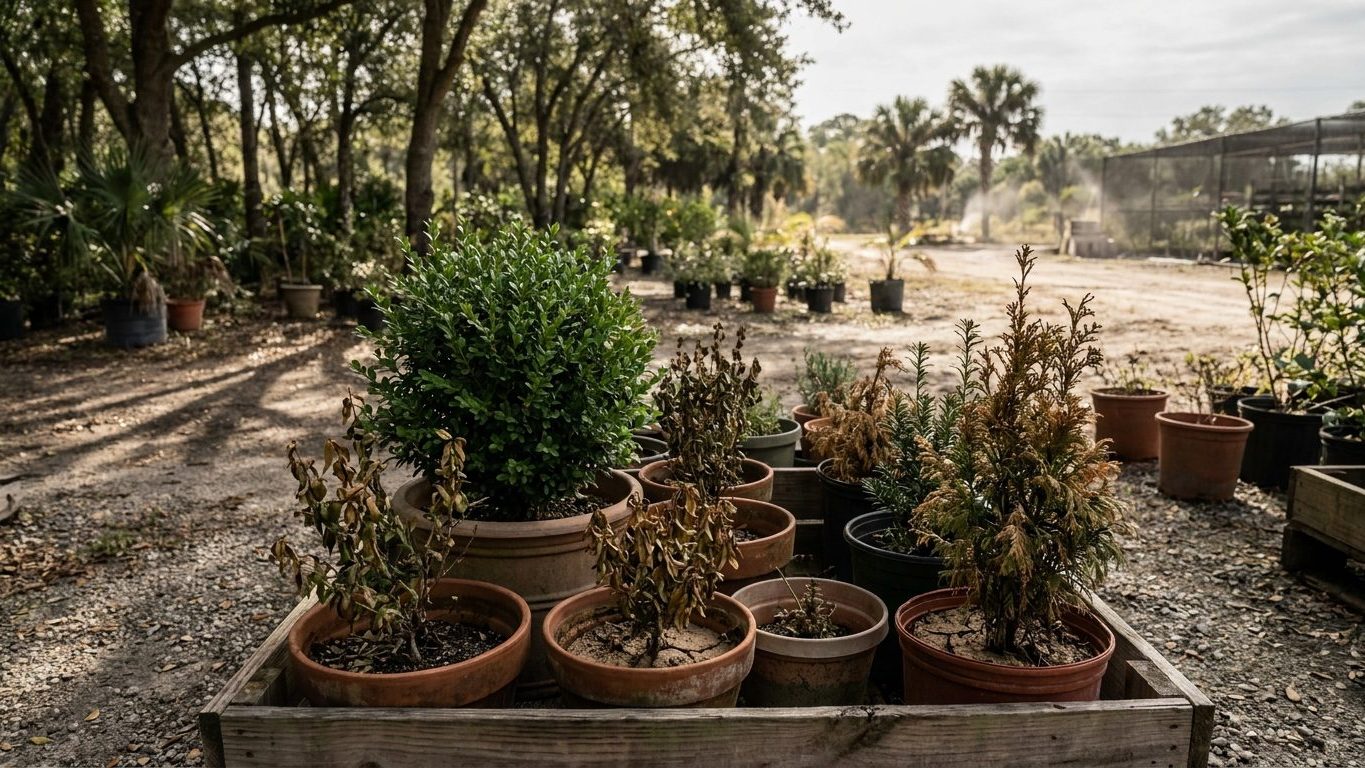

Ten of the twelve hedge species documented on this site hold across all of Ohio, which the USDA Plant Hardiness Zone Map 2023 places in zones 5b to 6b. Two, Leyland cypress and cherry laurel, hold only in 6a and 6b. Nothing fails everywhere. The bigger trap is a different one: three of the hardy plants can never be cut back to size once they outgrow the spot.
What actually holds in Ohio
The two that need a zone, not a yes
Start with what can fail. Leyland cypress (x Hesperotropsis leylandii) is hardy here only in zones 6a and 6b. It is a fast grower at 3 to 4 feet a year and reaches 15 to 25 feet as a screen, which is exactly why people plant it. In a 5b pocket of the state it is a gamble with a very expensive downside, because a dead row of 20-footers is not a small problem. Cherry laurel (Prunus laurocerasus) has the same limit, 6a and 6b only. It is slower, at 1 to 2 feet a year, and settles at 6 to 15 feet as a hedge.
Ohio’s range is a statewide spread, and this page doesn’t map it county by county. Look up your own ZIP code on the USDA map before buying either plant. The zone system rests on one variable, the average annual extreme minimum temperature, and each half-zone step is a matter of a few degrees.
The ten that hold everywhere
Across the whole 5b to 6b range, these are hardy: boxwood, American hornbeam, inkberry holly, winterberry holly, Eastern red cedar, privet, yew, arborvitae, Eastern hemlock and arrowwood viburnum. The two hollies are worth separating, because the names suggest a pair. Inkberry (Ilex glabra) is evergreen, while winterberry (Ilex verticillata) loses its leaves in winter. Same genus, very different January view.
Read “holds” as “survives.” The hardiness ranges behind this page are cold limits, and a zone number says nothing about how a plant looks after a wet summer or a hot one. The upper end of a plant’s range is often a heat limit, and this page doesn’t carry heat data. A hedge that survives can still look tired, so treat a good zone match as the entry ticket, not the verdict.
One date matters right now. For zone 6a, Ohio State University Extension’s Ohio Gardening Calendar gives a first fall frost of October 5 to October 15 and a last spring frost of May 5 to May 15. Those are 6a figures only, and colder or milder parts of the state run on different calendars.
The hedges you can never cut back down
Three plants in the hardy list share one flaw: they do not regrow from old wood. Cut into the bare, leafless interior and they stay bare. Leyland cypress, Eastern red cedar and arborvitae all fall in this group, and all three are evergreen conifers, which is no coincidence. Many needled evergreens simply don’t push new growth from wood that has lost its foliage.
Take Leyland cypress first. At 3 to 4 feet a year, five seasons of neglect adds 15 to 20 feet, which is already the full screen height. Its pruning window runs from late spring to midsummer, and the plan has to be regular trimming from the start, since a hard cut later is not an option. The mistake with a fast conifer is planting it as a small hedge and hoping to hold it there. It will be a screen, and it should be planted as one.
Eastern red cedar grows 12 to 24 inches a year and reaches 8 to 20 feet as a screen. Its prune note is blunt: late winter, light cuts only. Arborvitae (Thuja occidentalis) is slower at 6 to 9 inches a year and sits at 4 to 15 feet as a hedge, with pruning in late winter before growth starts, or in midsummer. Slow does not mean forgiving. A homeowner who lets arborvitae reach 15 feet and then wants it at 6 is looking at a replacement, not a haircut.
Compare that with the plants that do regrow from old wood: boxwood, American hornbeam, both hollies, privet, yew, hemlock, arrowwood viburnum and cherry laurel. If you already know a hedge will be a battle over size, or you are inheriting a neglected one, pick from this second group. Yew, for example, gets pruned in late spring after the new growth hardens, and it can be brought back after years of neglect.
Hemlock is a special case. It does regrow from old wood, but its note reads late spring, light cuts only. Regrowth possible is not the same as regrowth encouraged, so treat it as a plant to shape gently rather than restore.
Matching the plant to the job
Start from the height you want, not from the plant you like. A hedge that grows 3 to 6 inches a year needs very little trimming, while one that grows 2 to 3 feet a year needs it twice a season. Privet is the clear example: its calendar says twice a season, in spring and midsummer. That is a lot of Saturdays.
| Plant | Ohio zones | Growth a year | Height | Prune | Regrows from old wood |
|---|---|---|---|---|---|
| Boxwood | 5b-6b | 3 to 6 in | 2 to 6 ft | Late spring, after last frost | Yes |
| Yew | 5b-6b | 6 to 12 in | 3 to 8 ft | Late spring, after new growth hardens | Yes |
| Arborvitae | 5b-6b | 6 to 9 in | 4 to 15 ft | Late winter, or midsummer | No |
| Privet | 5b-6b | 2 to 3 ft | 4 to 12 ft | Spring and midsummer | Yes |
| Inkberry holly | 5b-6b | 6 to 12 in | 5 to 15 ft | Late winter | Yes |
| Winterberry holly | 5b-6b | 6 to 12 in | 5 to 15 ft | Late winter | Yes |
| American hornbeam | 5b-6b | 12 in | 6 to 15 ft | Midsummer, after first flush | Yes |
| Arrowwood viburnum | 5b-6b | 12 to 24 in | 6 to 10 ft | Right after flowering | Yes |
| Eastern red cedar | 5b-6b | 12 to 24 in | 8 to 20 ft | Late winter, light cuts only | No |
| Eastern hemlock | 5b-6b | 12 to 24 in | 10 to 20 ft | Late spring, light cuts only | Yes |
| Cherry laurel | 6a-6b only | 1 to 2 ft | 6 to 15 ft | Late spring, after flowering | Yes |
| Leyland cypress | 6a-6b only | 3 to 4 ft | 15 to 25 ft | Late spring to midsummer | No |
For a low, formal hedge of 6 feet or under, boxwood and yew are the slow, tidy options, and both regrow if you fall behind. Boxwood pruning comes after the last frost, which in zone 6a means waiting past the May 5 to May 15 window. For a tall screen, hemlock, red cedar and Leyland cypress reach the highest numbers, but only hemlock gives you a second chance with the shears.
Berries and bare winter branches are a design choice, and winterberry is the one deciduous holly here. Arrowwood viburnum has a precise rule that catches people out: prune right after flowering, because cutting later removes next year’s blooms. That is the general logic behind most of these dates, so the calendar in the table is worth more than a guess.
The ground you are planting into
USDA lists the Miamian series, an Alfisol, as Ohio’s representative state soil. It is a forest soil of moderate fertility that holds nutrients reasonably well. Its surface horizon averages 26 percent sand, 20 percent clay and 53 percent silt, which makes it a loam to silt, with organic matter of about 2.0 percent, a surface pH of about 6.5 (slightly acid), and good drainage. Those numbers come from USDA NRCS Soil Data Access, representative values across 401 mapped components, queried 2026-08-29.
That is a state soil, not your soil. A state spans hundreds of series, and river bottoms, hill country, and any lot a builder has scraped or filled will differ completely. The pH of about 6.5 is a record for the mapped surface of one series, and it should never be read as your pH. Read the profile as a tendency: ground like this drains rather than pools, and it is a reasonable place for most of the hardy plants above. Silt-heavy ground can still compact, particularly under construction traffic, which is worth remembering if the hedge line runs along a driveway or a new build.
The useful step is a soil test before any plant goes in. The state’s land-grant Extension service, Ohio State University Extension, is the place to start for test guidance and local advice. With the first fall frost window for zone 6a opening in about a week, testing now costs nothing in planting time and makes the buying decision cleaner.
For a broader view of how hedge choices are organized across states, see Hedges. Neighboring Pennsylvania has its own zone spread, laid out in Hedge Plants for Pennsylvania: What Holds, and What Only Looks Hardy, and warmer ground is covered in Hedge Plants for Georgia: What Holds, and What Only Looks Hardy.
Common questions
Will Leyland cypress survive in northern Ohio?
It holds only in zones 6a and 6b, so it depends on where your address falls on the USDA map. This page doesn’t sort counties into zones. If you sit in 5b, choose from the ten plants that hold across the whole state.
Can I cut an overgrown arborvitae back hard?
No. Arborvitae does not regrow from old wood, and neither do Leyland cypress or Eastern red cedar. Cutting into bare interior leaves permanent gaps. If you need a hedge you can restore, yew and boxwood do regrow.
Which hedge is the safest choice anywhere in Ohio?
Any of the ten that hold across zones 5b to 6b. Yew, boxwood and inkberry holly are slow growers that regrow from old wood, which makes them the forgiving picks. Surviving the winter is only the baseline, so still match the plant to your soil and sun.
When should I prune?
It depends on the plant, and the table above lists each window. Boxwood waits until after the last frost, which in zone 6a runs May 5 to May 15. Inkberry, winterberry and red cedar are late-winter jobs, and arrowwood viburnum is pruned right after it flowers. The frost dates for other zones are not published here.