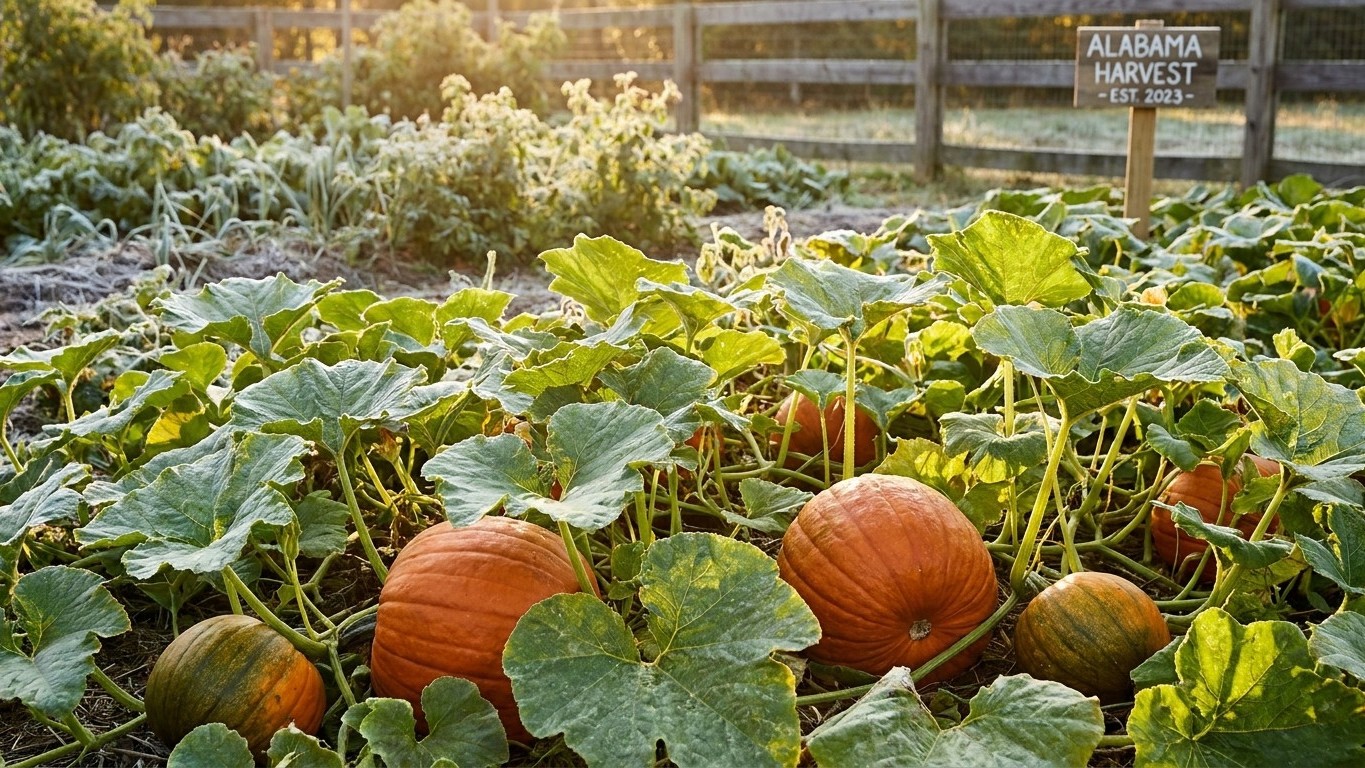

Yes, but only if the flowers opened early enough. In Ontario, using the Toronto Pearson averages, a pumpkin flower needs to open by roughly late August to have a realistic shot at a fully coloured, hard-skinned fruit before the season’s first frost. Miss that window and you’re gambling on a mild fall to finish the job.
The short answer
Start with the frost date itself. At the Toronto Lester B. Pearson International Airport station, Environment and Climate Change Canada’s 1981-2010 Climate Normals put the average first fall frost at October 16. That’s not a guarantee. It’s a midpoint. In roughly half of all years on record, frost at that station arrived later than October 16, and in the other half, it came sooner. Treat it as the center of a window, not a line you can plan around with confidence.
Now work backwards. Utah State University Extension’s guidance on pumpkins states that fruit needs 45 to 55 days after flowering to mature, with harvest happening before frost and the stem left attached. Count back 45 days from October 16 and you land on roughly September 1. Count back the full 55 days and you land closer to August 22. That gives a flowering window of late August, roughly August 22 through September 1, as the latest point a female flower can open and still have a realistic shot at a ripe, hard-skinned pumpkin by the average frost date.
A flower that opens after that window doesn’t automatically fail, but it’s racing a calendar that isn’t on its side. If frost arrives on schedule or early, a fruit that started forming in mid-September is still green-shouldered and soft-skinned when the cold hits. If fall runs mild, that same fruit might scrape by. The problem is you don’t know which fall you’re getting until it’s too late to do anything about it.
This also isn’t uniform across the province. The October 16 figure comes from one station near Toronto’s airport, in the warmer, lake-moderated part of southern Ontario. Move north into cottage country, up toward Algonquin, or into the higher ground east of Georgian Bay, and frost typically shows up weeks earlier than that. A grower in those areas needs to push their flowering deadline back accordingly, not treat the Pearson date as their own.
The honest takeaway: if your pumpkin vines had female flowers open by the last days of August, you’re working with the full 45-to-55-day runway before an average frost. If flowering slipped into mid-September, you’re relying on a frost that arrives later than the norm, which happens, but isn’t something to count on.
When to sow here
The sowing date and the frost date are two different questions, and mixing them up is where a lot of the trouble starts. The last spring frost at the Toronto Pearson station averages April 30, but pumpkin seed doesn’t care about air temperature. It cares about soil temperature, and Utah State University Extension is specific that seed should go in once soil reaches 65°F, not on the last frost date itself. Soil lags air by real time, not by a day or two. Here’s how the arithmetic works out through the season:
- Set the frost baseline. April 30 is the average last spring frost. That date tells you when the air is done risking a freeze, on average, but it says nothing about the ground.
- Add the soil lag. Bare soil warms more slowly than the air above it, especially in a spring that’s cool or wet, which pushes the date soil actually holds at 65°F well past that April 30 frost line, often into mid or late May in a typical Ontario spring.
- Check with a thermometer, not a calendar. Since no fixed number of days after frost reliably predicts 65°F soil, the only accurate way to know is to push a soil thermometer a few inches down and read it directly, ideally over a few consecutive mornings.
- Use row covers to buy back time. Utah State University Extension notes that row covers buy roughly two weeks. Laid over the bed, they trap heat and can bring your effective sowing date about two weeks earlier than waiting on bare, uncovered soil to hit 65°F on its own.
- Work the total backwards from frost. Once you know your soil-ready date, whether natural or covered, add the 45 to 55 days from flowering (not sowing) plus the several weeks a vine needs from seed to first female flower, and check the total against the October 16 average frost. If the math is tight, the row cover’s two weeks can be the difference between a ripe pumpkin and a green one.
The two-week cushion from row covers matters most in a province where the growing season is already working with a fairly firm ceiling on one end. It doesn’t change soil chemistry or fix a cold, wet spring, but it does move the whole calendar earlier without doing anything to the actual frost dates.
What goes wrong here
Ontario’s compressed window between a soil that’s slow to warm and a frost that can arrive ahead of schedule creates a handful of predictable failure points. None of them are mysterious once you see the pattern.
- A late flower that never colours. When female flowers open in mid-September instead of late August, the fruit is still small and pale-skinned when cold weather closes in, because it never got its full 45 to 55 days. The remedy is upstream: get seed into 65°F soil as early as that soil allows, use row covers to buy the two weeks, and choose plants that aren’t still setting new flowers into September. Pinching back the vine tips in late summer can also redirect the plant’s energy into finishing existing fruit instead of starting new ones that have no chance.
- A fruit caught by frost before it finishes. Because October 16 is only an average, a frost that arrives early can catch a pumpkin that was on track and just a week or two short. Watch the forecast closely once you’re inside that late-September window, and if a frost is predicted before a promising fruit is fully coloured and hard-skinned, cover it overnight with a blanket or tarp rather than betting on the average holding.
- A vine that dies back before the skin hardens. Foliage loss from pests or disease late in the season can shut down the plant before the fruit has a chance to cure a hard rind, even if frost itself hasn’t arrived yet. Ontario growers dealing with this should check for the usual late-season culprits, including squash bugs and cucumber beetles, since keeping the vine alive and photosynthesizing longer is what lets the fruit finish properly.
In every case above, the fix comes down to timing decisions made weeks earlier, not anything you can do once frost is already in the forecast. Harvest, when the fruit is ready, should happen with the stem attached and the fruit moved to a spot where it won’t freeze, which is the only storage guidance Utah State University Extension provides. No specific storage temperature or humidity figure is published in that source, so beyond keeping pumpkins away from freezing conditions, this page doesn’t have a number to hand you.
Common questions
Can a pumpkin ripen off the vine after a light frost hits it?
The Utah State University Extension guidance covers harvest before frost and storage away from freezing temperatures, but it doesn’t publish anything about ripening fruit after it’s already been touched by frost. Rather than guess, the safer approach is to harvest ahead of any forecast frost whenever the fruit is close to ready.
Is October 16 the date I should plan my harvest around in Ontario?
Treat it as a midpoint, not a target. It’s the average first fall frost from the Toronto Pearson station’s 1981-2010 climate normals, meaning frost arrives later than that in roughly half of all years and earlier in the other half. Planning for a date several days ahead of it gives more room for error.
Why does the 45-to-55-day figure not match how long my pumpkin has been in the ground?
Because that count starts at flowering, not at sowing or transplanting. A vine can spend several weeks growing before it produces its first female flower, and none of that time counts toward the 45 to 55 days needed to mature the fruit.
Does the frost date change much across Ontario?
It does. The October 16 figure comes from a single station near Toronto’s airport, in one of the province’s milder, lake-influenced corners. Areas farther north or at higher elevation typically see frost arrive earlier, so growers there should shift their flowering deadline back rather than relying on the Pearson-station date.