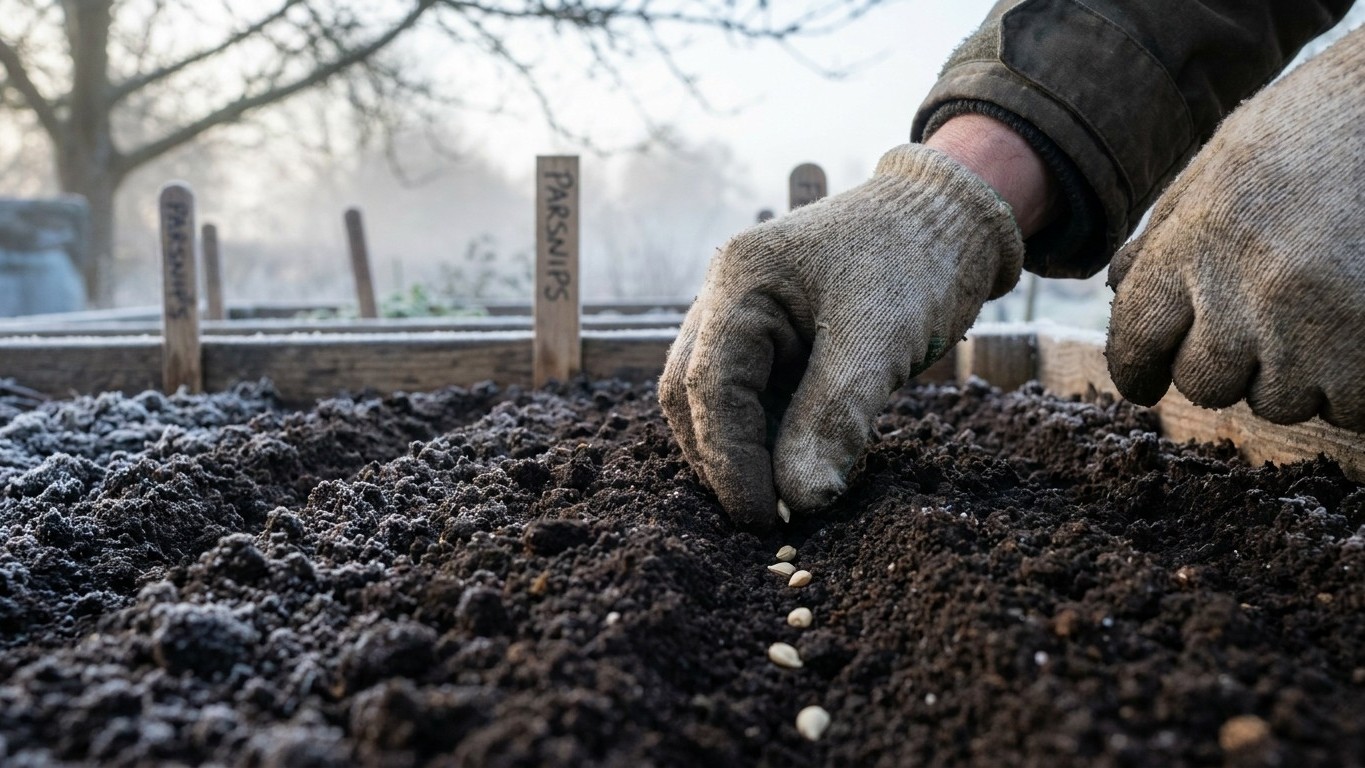

Sow parsnips in Quebec between mid-April and the first days of May, timing the seed to land two to three weeks ahead of the average last spring frost of May 6. That single choice sets up everything that follows: whether the roots reach full size before fall, and whether the province’s cold actually turns them sweet once they’re in the ground.
The short answer
The question that decides whether parsnips are worth growing here isn’t the sowing date. It’s whether the territory delivers several weeks of real frost, because that’s what converts the starch stored in the root into sugar. Quebec answers that question loudly. At the reference station in Montreal, the mean daily minimum for the coldest month sits at 6.7°F, a figure from Environment and Climate Change Canada’s 1981-2010 normals. That’s not a record low pulled from one bad winter. It’s the average nightly floor across the coldest month, which means deep, sustained cold is the rule here, not the exception.
That number matters more than a hardiness zone rating ever could for this crop. A zone tells you whether a perennial plant survives winter in the ground. Parsnips grown as an annual root crop don’t need to survive winter at all, at least not for the purpose of producing next year’s plant. What they need is exposure to frost while they’re mature and still in the soil, so the cold can do its chemical work. A comfortable zone with mild nights would let a parsnip grow to full size and look fine on the outside, but it would never develop the sweetness the crop is known for, because that sweetness comes specifically from sustained frost exposure, not from surviving a mild winter.
Quebec doesn’t have that problem. With coldest-month nights averaging well below freezing, a parsnip left in the ground after it reaches maturity gets far more than a token frost. It gets weeks of it. That’s the mechanism described by Utah State University Extension: parsnips taste best after several weeks of cool, frosty weather, because that cold converts stored starch to sugar. In a territory where the coldest month barely dips below freezing, a gardener might dig a technically mature parsnip that never gets that treatment. In Quebec, the climate does the work on its own, provided the roots are still in the ground when the cold arrives and the gardener doesn’t rush the harvest the moment the top growth looks done.
So the short answer is this: yes, a parsnip grown in Quebec will sweeten, not merely grow, because the coldest month here runs cold enough and long enough to deliver the frost exposure the crop depends on. The sowing date exists to make sure the plant actually reaches that point before the ground shuts down for the season.
Does the season fit?
Parsnips need 100 to 120 days from seeding, sown directly in place rather than transplanted, and that window has to fit inside the frost-free stretch of the year or the roots never finish sizing up. Here’s how the arithmetic works out using Quebec’s own frost averages.
- Fix the sowing date first. Two to three weeks before the average last spring frost of May 6 puts seeding somewhere between roughly April 15 and April 22, while the soil is still cool but workable.
- Expect a slow start. Parsnip seed takes 14 to 21 days to germinate, one of the slower vegetables in the garden, so seedlings won’t break the surface until late April at the earliest and sometimes not until the second week of May. Digging up the row and re-sowing during that wait is the single most common mistake, and it’s unnecessary.
- Count 100 to 120 days from the sowing date itself, not from germination, since that’s how Utah State University Extension frames the timeline. From an April 15 to April 22 sowing, that lands maturity somewhere between late July and mid-August.
- Set that maturity window against the average first fall frost of October 5. The gap runs roughly six to ten weeks, plenty of room for the several frosty weeks parsnips need to convert their starch to sugar, whether that frost exposure happens while the roots finish sizing up or after they’re already mature and simply waiting in the ground.
- Treat both dates as midpoints, not guarantees. Both May 6 and October 5 come from Environment and Climate Change Canada’s 1981-2010 normals for the Montreal/St-Hubert A station, and by definition, half of all years see the last spring frost arrive later than May 6, and half see the first fall frost arrive later than October 5. Districts north of Montreal or at higher elevation should expect that window to run even tighter.
Worked out this way, the season fits comfortably in most of southern Quebec, with real margin to spare, but that margin shrinks fast if sowing slips into late May or if a gardener waits for soil to fully warm before planting instead of following the frost-date math.
What goes wrong here
- Forked roots from heavy or stony ground. Quebec’s clay-heavy soils resist the long, straight taproot a parsnip wants to grow. Double dig the bed to at least the depth of a full-grown root, or remove stones by hand, before sowing.
- Forked roots from overwatering. This is a separate cause from heavy soil, not a variation on it. Excess moisture encourages the root to split and branch as it searches for air pockets. Water evenly and let the top inch of soil dry slightly between waterings rather than keeping the bed saturated.
- A season that runs out. Sowing after the April window pushes the 100-to-120-day maturity mark uncomfortably close to, or past, the average October 5 first frost, especially in a year where spring frost lingers past May 6. Sow promptly within the two-to-three-week pre-frost window rather than waiting for warmer soil.
- Harvesting before the frost has done its work. Pulling parsnips as soon as the tops look mature skips the sweetening step entirely. Leave the roots in the ground once they’ve sized up so they catch several weeks of the frosty weather Quebec’s cold winters reliably provide.
- Giving up on germination too soon. Parsnip seed can take a full three weeks to sprout. Mark the row, keep the soil consistently moist, and resist re-sowing over bare-looking soil before that window has passed.
Common questions
What is the best time of year to Sow Parsnips in Quebec?
Mid-April to early May, aiming for two to three weeks before the average last spring frost of May 6 at the Montreal/St-Hubert A station. That date is an average, so treat it as a midpoint rather than a fixed safe day, especially outside the Montreal area.
Why haven’t my parsnip seeds sprouted after two weeks?
That’s normal. Parsnip germination takes 14 to 21 days, slower than most garden vegetables, so a bare-looking row at two weeks doesn’t mean the sowing failed.
Do parsnips actually need frost to taste good?
Yes. Utah State University Extension notes that parsnips taste best after several weeks of cool, frosty weather, which converts the root’s stored starch into sugar. A parsnip harvested before that exposure will look fully grown but won’t have the sweetness the crop is known for.
My soil is heavy clay. Can I still grow parsnips in Quebec?
Yes, but the soil needs help first. Utah State University Extension recommends double digging heavy soil so the root has room to grow straight down. Skipping that step in dense ground is one of the main causes of forked or stunted roots.