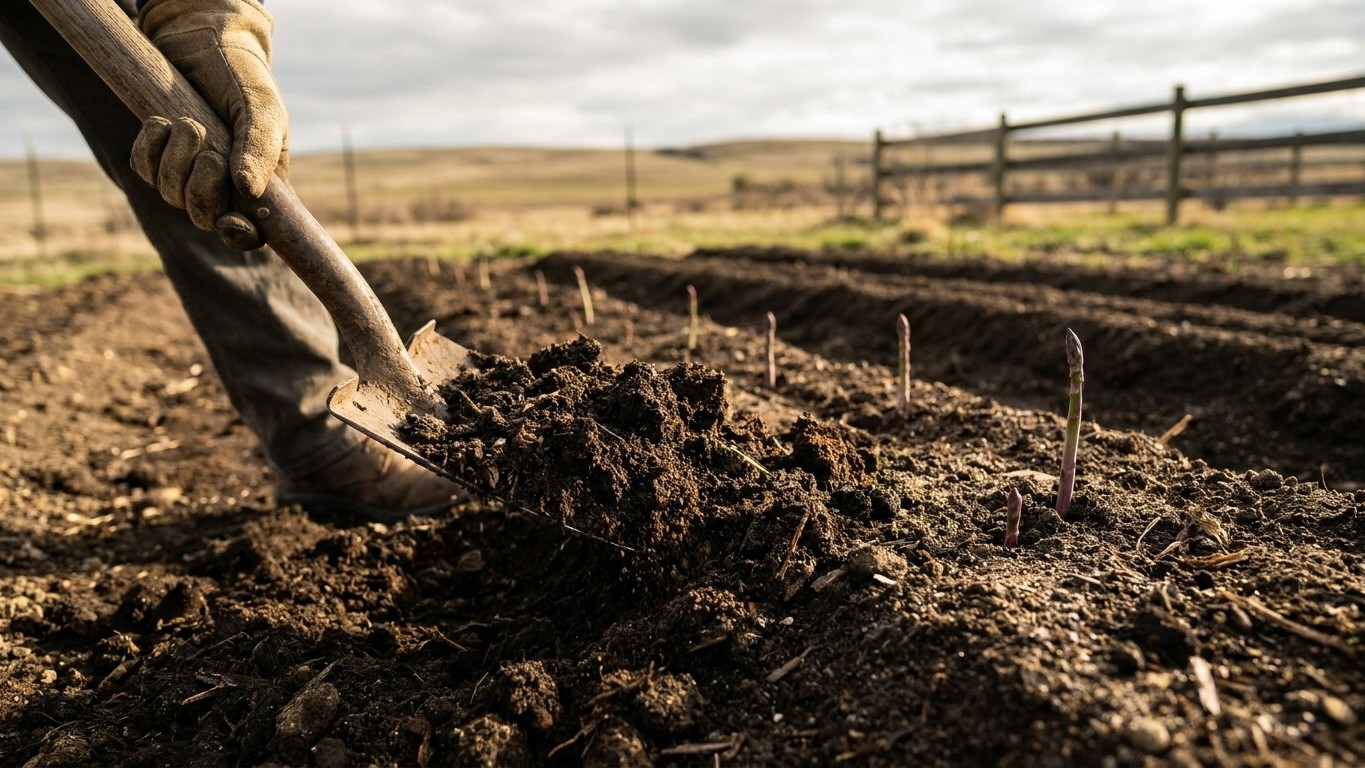

Connecticut can grow a productive asparagus bed for a decade and a half, but only if the ground you choose drains well before you ever set a crown in it. The rest of the timeline, from first planting to last harvest, follows a schedule that doesn’t bend much for weather or soil type. Here’s what actually decides whether that fifteen-year commitment pays off.
The short answer
Connecticut’s representative soil, the Windsor series, is about as far from a drainage problem as a soil gets. It’s an Entisol, meaning it’s young and has barely developed a soil profile at all, and USDA NRCS records put it at 82 percent sand, 2 percent clay, and 16 percent silt in the surface horizon, with a surface pH around 5.1. That combination of sand and near-absent clay makes it excessively drained, water moves through it fast, which is exactly the condition asparagus crowns need to avoid rotting in their first two seasons in the ground.
One number in that same dataset needs a caution attached before anyone reads too much into it. The organic matter figure for this series runs close to 95 percent in the surface horizon, which is not a number you’d expect from a worked garden bed. An organic-matter reading that high on a mapped soil series usually means the surface layer sampled was a natural organic layer, something like forest litter or peat, not a tilled vegetable bed. A gardener’s actual bed, once dug, amended, and planted, will read nothing like that figure. The state soil is a starting point for understanding what the region’s ground tends to do, not a diagnosis of the dirt in any one backyard.
For asparagus, the only requirement the source consulted for this piece actually states is that the soil be well drained. Most soils will do, provided they meet that one condition. If your ground is closer to the sandy, fast-draining Windsor profile, you’re in the position most of this territory starts from, and you likely don’t need to do much beyond working in compost before planting. If instead you’re dealing with a heavier, slow-draining patch, low ground that stays soggy after rain, or soil that’s been compacted by construction, that’s a different situation entirely, and it matters more here than it would with an annual crop. A tomato bed with poor drainage is a nuisance you can amend every spring. Will Connecticut Soil Hold an Asparagus Bed for Fifteen Years? The answer depends entirely on drainage, since an asparagus bed with poor drainage is a problem you’re stuck with for ten to fifteen years, because moving established crowns isn’t a realistic option once they’re producing.
The fix, if a soil test or a season of watching puddles form tells you drainage is marginal, is to raise the bed rather than fight the native soil. Building up eight to ten inches of well-draining, amended soil above grade gives the crowns the environment they need without depending on what’s underneath. It’s a one-time project, done before the crowns go in, and it’s cheaper than discovering the problem three years into a bed you can’t easily replant. Getting the drainage work done in time also means paying attention to When to Plant Asparagus Crowns in Connecticut, since the raised bed needs to be ready before that window opens.
Will the summer here water it for you?
The watering schedule for asparagus doesn’t change with geography, only the amount of rain that shows up to meet it does. Here’s how the two figures line up.
- What the bed asks for. A newly planted bed needs 1 to 2 inches of water every other week through its first two growing seasons, while the crowns are establishing a root system deep enough to survive on their own. Once the bed matures, that requirement eases to roughly the same 1 to 2 inches, but only every three weeks.
- What June actually delivers. NOAA’s 1991-2020 climate normals for the reference station used here put June rainfall at 3.77 inches for the month, which works out to a bit under an inch a week on average, close to what a young bed wants on its own, without much room to spare if a week runs dry.
- What July actually delivers. July is the driest of the three summer months at 3.32 inches, and it’s also typically the hottest, which means higher evaporation on top of lower rainfall. This is the month most likely to leave a new bed short, especially if the rain falls in one or two heavy storms rather than spread evenly across the weeks.
- What August actually delivers. August comes back up slightly to 3.98 inches, bringing the three-month summer total to about 11.1 inches. Averaged out, that’s close to what an established, three-year-old-or-older bed needs, but it’s cutting it thin for a bed still in its first two seasons.
- What that means for a hose. Rainfall totals are averages over three decades at one station, not a guarantee for any single July on any single property. A rain gauge staked next to the bed is the only way to know, in real time, whether a given two-week stretch met the 1-to-2-inch mark, and a new bed in a dry July is the stretch most likely to need supplemental watering.
When to put the crowns in
Asparagus crowns go into the ground in early spring, set into furrows about 8 inches deep. Connecticut’s mean last spring frost, based on NOAA’s 1991-2020 normals for the reference coastal station, falls around April 2 to April 12, and that window is a reasonable anchor for timing the planting, since a mean date is an average and not a promise about any single year. That same station sits on Long Island Sound, the mildest part of the state, so inland and northwest Connecticut should expect frost to linger later into spring than this range suggests.
The furrow doesn’t get filled in all at once. Backfilling happens gradually across the year, adding about 2 inches of soil back into the furrow every other month as the young shoots grow, rather than covering the crowns completely on planting day. It’s a slower process than most vegetable planting, and skipping ahead to fill the trench in one pass isn’t how the method works.
Growing from seed is the other route in, though it’s a slower path to the same bed, and the source consulted for this piece addresses crown planting specifically rather than seed timing, so no seed-specific schedule is offered here. Most home gardeners choose crowns for that reason: it’s the documented, faster-to-establish option.
Patience matters more with this crop than with almost anything else grown in a home garden. The bed is not harvested at all in its first two years, and the first cutting doesn’t happen until year three, when harvest runs for about four weeks. The following year stretches to six weeks, and the year after that to eight, after which the bed settles into its full harvest season for the rest of its ten-to-fifteen-year life. Within any given season, the rule for When to Stop Cutting isn’t a date on the calendar, it’s a visual one: stop once most of the spears coming up are thinner than a pencil, a sign the plant needs to put its energy into foliage rather than more spears.
Crowns are sold under a handful of named varieties, and what’s actually published about them is limited to which sex the plants are. Jersey Giant and Jersey Knight are all-male varieties, while UC 157 F1 and Purple Passion are male-and-female. No flavor comparison, yield figure, or reason to prefer one over another is published by the source used here, so this piece won’t invent one.
Checking this against your own county
Everything above describes a coastal reference station and a soil series chosen to represent the state as a whole, not any particular yard. Connecticut spans a lot of ground between the Sound and the northwest hills, and both frost timing and drainage shift noticeably over that distance. Before committing a spot to fifteen years of asparagus, it’s worth running a soil test on the actual bed site and checking local frost history against the wider range this piece uses as a starting point.
The University of Connecticut’s Cooperative Extension System, reachable at extension.uconn.edu, is the land-grant extension service for the state and covers county-level offices that can walk through both of those questions with local data rather than a statewide average. That’s the better source for a final decision on a specific property.
Common questions
Can asparagus grow in heavy clay soil in Connecticut?
The source used here requires only that the soil drain well, without specifying a soil type by name. Clay-heavy ground that stays wet is the kind of situation that calls for a raised bed built up with amended soil, since asparagus crowns are prone to rot in standing water over the years they need to establish.
How long until you can actually harvest asparagus after planting?
No harvest happens in the first two years at all. The first cutting comes in year three and runs about four weeks, followed by six weeks the next year and eight weeks the year after, before the bed reaches its full ongoing harvest season.
Does Connecticut’s soil need lime for asparagus?
The source used for asparagus’s growing requirements doesn’t address soil pH, so no pH target is given here. The state’s representative Windsor series does run acidic at a surface pH around 5.1, but that figure describes a statewide reference soil, not a reading of any individual garden, so a soil test is the way to find out what a specific bed actually needs.
Which asparagus variety is best for a Connecticut garden?
What’s published names four varieties by sex only: Jersey Giant and Jersey Knight are all-male, UC 157 F1 and Purple Passion are male-and-female. No comparison of flavor, yield, or regional suitability is available from the source used here.