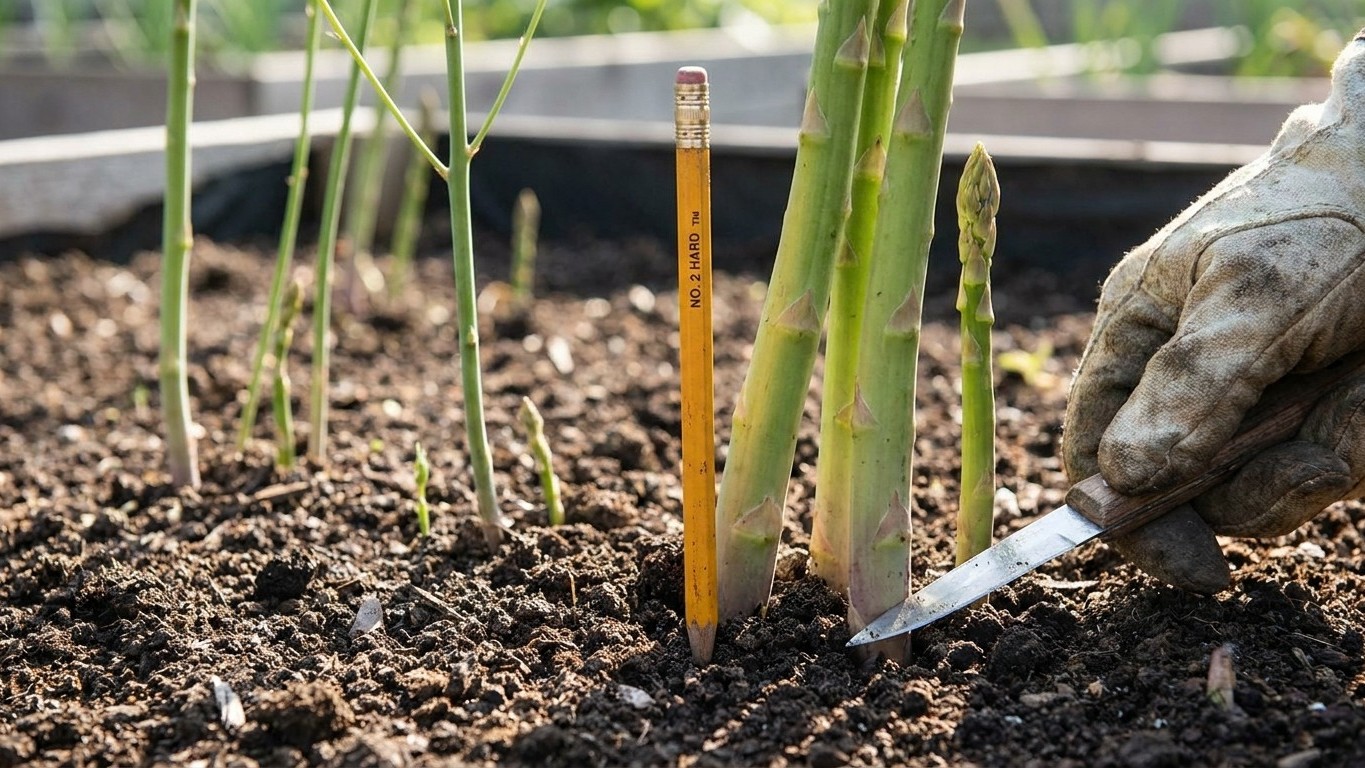

Stop cutting when most of the spears coming up are thinner than a standard pencil. That’s the rule, straight from Utah State University Extension, and it has nothing to do with the calendar. A bed planted in cool weather might hit that point earlier or later than one across town, which is exactly why the extension service built its guidance around the spear itself instead of a date on the wall.
The short answer
Utah State University Extension is blunt about the first hurdle: do not harvest asparagus until year 3 after planting. That’s not a suggestion to go easy on the bed. It’s a flat instruction to leave the crowns alone while they build the root mass that will feed every spear you eventually cut.
Once year three arrives, the harvest window opens, but only a little. Plants may be harvested for up to 4 weeks in that first cutting year, with spears taken at 9 inches tall and cut at ground level. Year four stretches that window to 6 weeks. From year five onward, a bed in full production can be harvested for up to 8 weeks. Notice the pattern: the plant earns a longer harvest as it matures, and the extension service never frames this as optional. Skip year three’s restraint and you’re borrowing against years four and five.
None of those week counts, though, is the signal that tells you when to actually put the knife down in any given season. That’s where the pencil rule takes over. Utah State University Extension states it plainly: stop harvesting when the majority of spears are smaller than a pencil in diameter. Not the thickest spear in the bed, not the first thin one you notice, the majority. A few skinny spears early in the harvest window don’t mean much. When most of what’s coming up looks more like a wire than a stalk, the bed is telling you it’s spent.
The payoff for getting this right, according to the same source, is longevity: a well-managed planting can be expected to produce spears for 10 to 15 years. That’s a return on a vegetable that most gardeners plant once and then harvest for a decade or more without replanting, provided the crowns aren’t pushed past what they can recover from each season.
What actually decides it
Reserve rebuilding, not the calendar
Asparagus doesn’t grow spears out of thin air. Every stalk you cut in spring came from sugars the crown stored the previous summer and fall, built up through photosynthesis in the tall, ferny growth that follows harvest. Clemson Extension describes the stopping point the same way Utah State does: stop harvesting when the diameter of the spears has been reduced to pencil-size and allow the spear to grow to full height. Thin spears mean the crown’s stored energy is running low. Forcing more cuts at that point doesn’t get you more asparagus, it just drains the reserves the plant needs to rebuild for next year.
Root establishment before any cutting begins
The reason year three is a hard line rather than a guideline traces back to how the bed was started. Clemson Extension recommends setting the crowns 15 to 18 inches apart and 6 to 8 inches deep, but not all at once. The crown sits in an open trench at planting, and soil is pulled over it gradually, about 2 inches every two to three weeks, until the trench is filled and the crown finally sits 6 to 8 inches deep. A crown buried at full depth on day one struggles to push through that much soil and can fail before it ever gets established. That slow burial is what gives the root system time to spread before it’s asked to support a harvest.
Sex of the plant, though not much else is published
Home growers often plant one of four named varieties, and the only attribute consistently identified is sex: Jersey Giant and Jersey Knight are all-male selections, while UC 157 F1 and Purple Passion are male/female types. No flavor comparison, yield figure, or reason to prefer one over another appears in the extension guidance. If a catalog or neighbor tells you one variety is definitively better, that claim isn’t coming from the source material.
How to do it
- Dig a planting trench and set the crowns 15 to 18 inches apart, starting the trench at 6 to 8 inches deep.
- Leave the trench open rather than filling it immediately, letting the crown sit shallow at first.
- Pull soil over the crowns gradually, about 2 inches every two to three weeks, until the trench is filled and the crowns reach their full 6 to 8 inch depth.
- Do not harvest any spears in the first year or the second. Let the fern grow, die back, and rebuild the crown undisturbed.
- In year three, begin harvesting, cutting 9 inch tall spears at ground level, and limit the total harvest window to 4 weeks.
- In year four, extend the harvest window to 6 weeks, following the same cutting method.
- From year five onward, harvest for up to 8 weeks per season as the bed reaches full maturity.
- Each season, watch spear diameter rather than counting days. When the majority of spears coming up are thinner than a pencil, stop cutting immediately.
- Let the remaining and subsequent spears grow to full height, forming fern that will photosynthesize and restock the crown’s reserves for next year’s harvest.
What goes wrong
- Harvesting before year three. Cutting spears from a one- or two-year-old planting robs the crown of the growth it needs to establish. The remedy is patience: leave the bed completely unharvested until year three, no matter how tempting those first spears look.
- Judging the stop point by a single thin spear. One skinny stalk in an otherwise healthy flush doesn’t mean the bed is exhausted. The remedy is to look at the majority of spears across the bed, not the outlier, before deciding to stop.
- Burying the crown at full depth immediately. Filling the trench to 6 to 8 inches on planting day buries the crown before it can establish and can kill it outright. The remedy is the gradual approach: about 2 inches of backfill every two to three weeks until the trench is full.
- Cutting past the pencil-thin signal because the harvest week count “should” allow more. The week ranges for years three, four, and five describe how long a mature bed can typically sustain harvest, not a guarantee that every spear in that window is fit to cut. The remedy is to let spear diameter override the calendar every time the two disagree.
- Assuming a particular variety changes the stopping signal. Whether the bed is an all-male type like Jersey Giant or Jersey Knight, or a male/female type like UC 157 F1 or Purple Passion, the pencil-diameter signal works the same way. No variety-specific exception is published.
Common questions
Can I harvest a little in year one or two if the spears look strong?
No. Utah State University Extension states plainly not to harvest until year three after planting, without exception for vigorous-looking spears.
What if my spears never get as thin as a pencil during the harvest window?
Then keep harvesting within the week limits for that year’s maturity level, since the pencil rule is the signal to stop, not a requirement that it must occur every season by a certain point.
Does the harvest window length change based on soil type or climate?
That isn’t addressed in the available guidance. The published figures are the week counts for years three, four, and five, and the pencil-diameter signal for when to stop within any of those windows.
How long will my asparagus bed keep producing overall?
Expect the plant to produce spears for 10 to 15 years, according to Utah State University Extension, assuming the harvest rules for each year and the pencil-thin stopping point are followed.