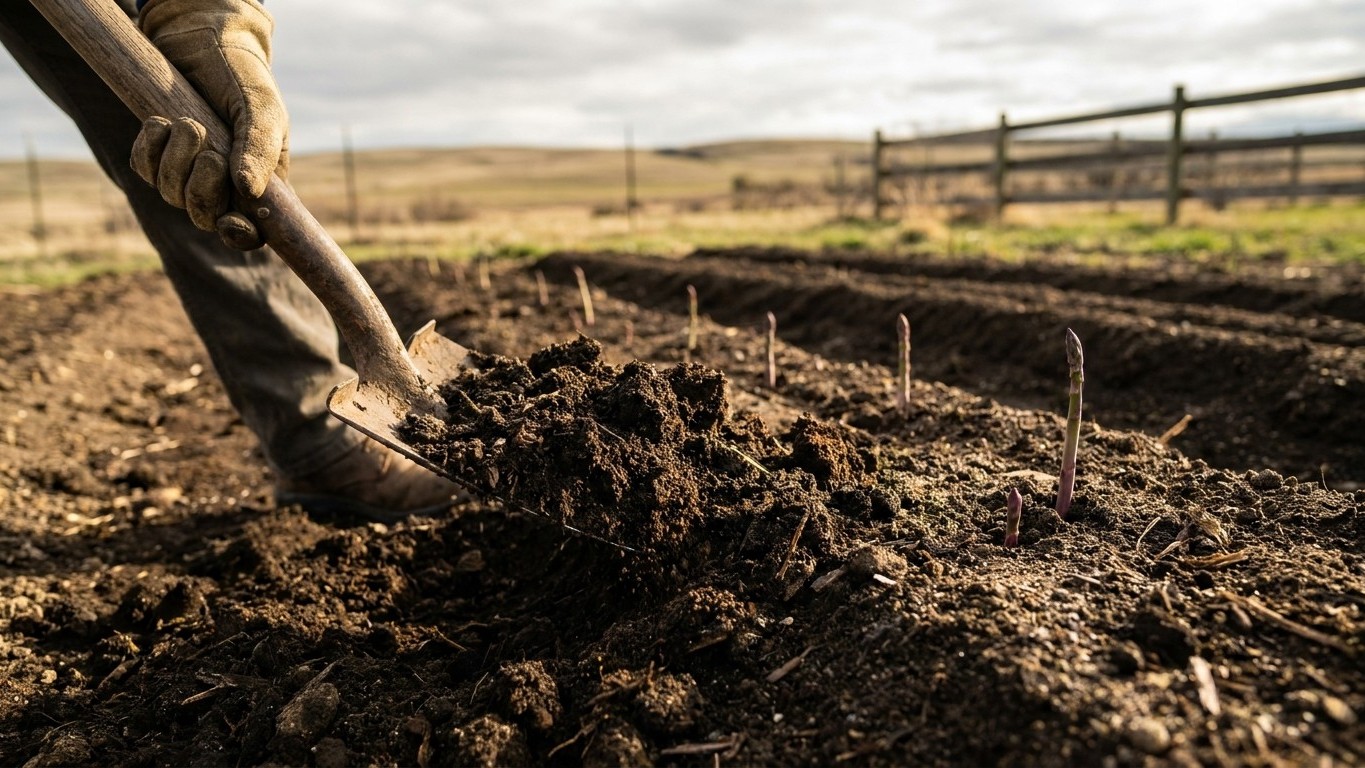

Fifteen years is the commitment: an Asparagus Bed planted in the Northwest Territories today will still be feeding a household long after most vegetable rotations have been dug up and replanted a dozen times over. The dominant ground here, a Cryosol built on loam-to-silt parent material, is recorded as well drained. That single word decides whether this crop belongs in your yard at all, or whether it needs a raised bed to work around what the ground actually does.
The short answer
Ninety-nine percent of the mapped agricultural surface in the Northwest Territories falls into one soil order: Cryosol, ground that carries permafrost somewhere in its profile and thaws only to a shallow active layer each summer. The remaining sliver is Regosolic. Below that top layer, the mapped texture runs 55 percent sand, 6 percent clay and 39 percent silt, a loam-to-silt mix, with organic matter sitting around 2.4 percent. No median pH is published for this surface, so nobody should guess at one; a real number only comes from a soil test pulled on the actual plot.
The drainage rating attached to this soil is well drained, and that matches the one soil requirement Utah State University Extension attaches to asparagus: the ground must drain, full stop, with no preference stated for texture or acidity. On paper, then, the province’s typical agricultural soil clears the bar. But a Cryosol is not an ordinary well-drained loam behaving the way a Midwestern silt loam does. The active layer, the portion that actually thaws each summer, sits above permafrost that never lets go. Water moving down through that thawed layer can hit the frozen ground beneath it and back up, especially in a wet stretch or in a low corner of a yard, even while the soil survey still calls the broader profile well drained.
That gap between a provincial average and a single backyard is exactly why this fact comes with a caution attached: the dominant profile describes what the region’s ground tends to do, not what any one garden does. River bottoms, muskeg edges and anywhere a builder has scraped or filled the topsoil will behave differently, sometimes completely differently, than the mapped median. Before committing a spot to a bed that will occupy that ground for a decade and a half, dig a test hole after a rain and watch how long standing water takes to disappear, since the real test of Will Northwest Territories Soil Hold an Asparagus Bed for Fifteen Years? happens on that specific patch of ground, not on a soil map. If it lingers more than a few hours, the fix is not to abandon the crop but to raise the bed, building the crown trench up rather than down so the roots stay above the perched water rather than sitting in it. Given how long this planting stays put, that half day of testing before planting is worth far more than it costs, and it pairs well with knowing When to Plant Asparagus Crowns in Northwest Territories so the bed is ready before the crowns go in.
Will the summer here water it for you?
Asparagus roots want 1 to 2 inches of water every other week through the first two growing seasons, then the schedule loosens to roughly every three weeks once the crowns are established. Measured against what Yellowknife’s climate normals actually deliver, that target and the local summer don’t line up especially well.
- The summer total falls short. June, July and August together bring about 4.3 inches of rain, out of 11.4 inches for the whole year. Spread across three months, that’s not much of a cushion for a crop asking for up to 2 inches every two weeks on its own.
- June is the thin month. At 1.14 inches, June is the driest of the three summer months, and it’s also the stretch right after spring planting when new crowns need water most reliably.
- July and August improve slightly but don’t close the gap. July brings 1.61 inches and August 1.55 inches, both better than June but still short of the roughly 2 to 4 inches per month the bed’s every-other-week schedule implies.
- The practical takeaway is supplemental watering, not occasional watering. In most summers here, rainfall alone won’t stretch to cover a newly planted bed for its first two seasons, so a hose or drip line filling the difference is the default plan, not a backup one.
- A rain gauge on the actual plot settles it faster than any normal can. These are long-term averages for one reference station; a particular yard, especially anywhere sheltered or shaded differently than the airport station the data comes from, can run wetter or drier than the average in any given stretch.
When to put the crowns in
Crowns go into the ground in early spring, set into furrows about 8 inches deep. In the Northwest Territories, early spring has to be read against a frost record that runs later than most of the country’s: the average last spring frost at the Yellowknife A station lands around May 25. That date is a mean, not a guarantee, which means that in roughly one year out of two, frost actually arrives after it. Treat May 25 as the middle of a window rather than a green light, and lean toward the later side of “early spring” rather than rushing crowns into ground that could still see a hard freeze.
The alternative to crowns is starting from seed, which the same source lists as workable for asparagus generally, though it isn’t the route most home gardeners take. Seed-grown plants need an extra season of growth before they’re the size of a purchased crown, which in a climate already tight on frost-free days pushes the harvest wait out even further. For most Northwest Territories gardeners, crowns remain the more practical starting point simply because they arrive at the 8-inch furrow already a year or more ahead of a seedling.
Variety options
Utah State University Extension names four asparagus varieties, and in every case the only detail published is which plants carry which flowers. No flavor comparison, no yield figure and no reason to prefer one over another appears in that source, so none should be invented here.
| Variety | Flower type |
|---|---|
| Jersey Giant | All-male |
| Jersey Knight | All-male |
| UC 157 F1 | Male and female |
| Purple Passion | Male and female |
All-male varieties tend to be favored where growers want to avoid volunteer seedlings competing with the established crowns, but that preference isn’t something the source itself states as a recommendation; it’s simply what the male/female split implies. The furrow itself isn’t filled in one motion either: soil gets pulled back in gradually, about 2 inches every other month across the season, rather than backfilled all at once at planting time.
Checking this against your own county
Everything above describes a provincial average and a single climate station. Neither one is a substitute for a soil test pulled from the actual bed site or a conversation with someone who tracks conditions closer to home. The Northwest Territories’ Department of Industry, Tourism and Investment runs an agriculture program that can point toward local frost patterns, soil test options and planting guidance specific to a given district, and it’s worth a call before committing a spot to fifteen years of asparagus. Find it at the Northwest Territories agriculture services page. A five-minute conversation now costs a lot less than discovering three years in that the bed sits in a spot that never quite drains.
Common questions
Can I harvest asparagus the first year after planting crowns?
No. The plant needs to build its root system before any cutting happens; harvest doesn’t start until the bed’s third year, and taking spears earlier weakens the crowns for the years that follow.
How long does the harvest window last once it starts?
It builds gradually: about 4 weeks of cutting in the first harvest year, then 6 weeks, then 8 weeks in following years. The signal to stop each season isn’t a date but a look at the spears themselves: once most of them come up thinner than a pencil, harvest ends for the year regardless of the calendar.
Does the soil pH matter for asparagus in this region?
No pH figure is published for the Northwest Territories’ dominant mapped soil, and the asparagus source itself is silent on pH preference too. Rather than guess at a number, a soil test taken from the actual bed site is the only way to know where a given yard actually sits.
What if my yard doesn’t drain well even though the regional soil is rated well drained?
Build up rather than dig down. A raised bed lifts the crowns above whatever perched water sits over the permafrost-influenced layer beneath, letting the planting meet the crop’s one real requirement even where the ground underneath doesn’t cooperate on its own.