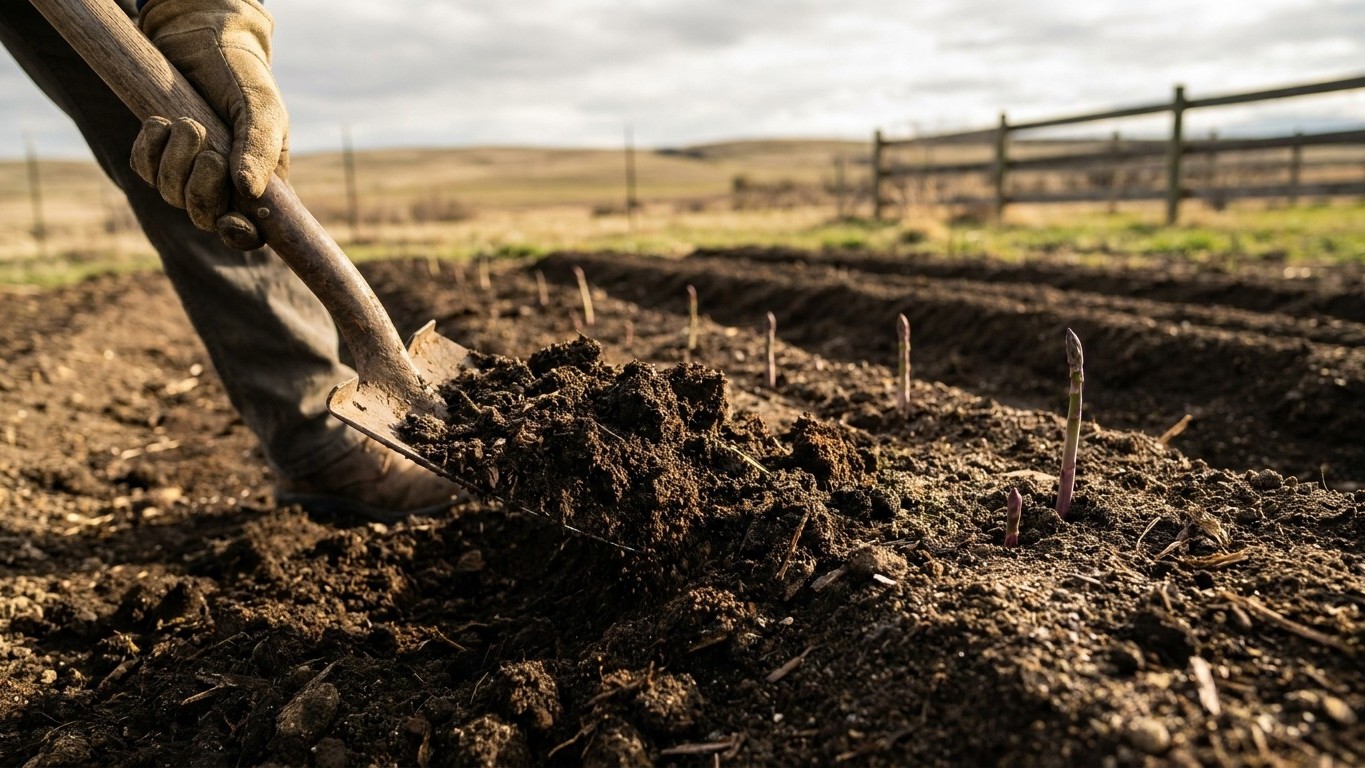

A Delaware asparagus bed outlives the fence you might build around it. Plant crowns this spring and you’re still cutting spears from that same patch of ground well into the following decade, provided the one thing asparagus actually asks for is true of your soil: that it drains. Get that answer right before you dig, because a bed you can’t move is a bed you’d better place correctly the first time.
The short answer
Asparagus crowns go into 8-inch furrows and, once established, keep producing for 10 to 15 years. That’s the timeline according to Utah State University Extension, and it’s the number that should govern every decision here, more than any single season’s weather or any one year’s soil test. You’re not picking a spot for this year’s garden. You’re picking a spot for the next decade and a half, which makes getting the timing right from the start worth the extra attention: When to Plant Asparagus Crowns in Delaware.
The good news for Delaware gardeners starts with the ground itself. The state’s official soil, the Greenwich series, is classified as well drained. It’s an Ultisol, an old and heavily weathered soil type, naturally acid and short on nutrients, but on the drainage question that matters most for asparagus, it checks the box. USDA soil survey data puts the surface texture at roughly 48 percent sand, 9 percent clay, and 43 percent silt, a loam-to-silt blend with organic matter around 1.7 percent and a surface pH near 6.0. Sandy-silty ground like that tends to let water move through rather than sit on top of the roots, which is exactly the behavior a 15-year crop needs.
None of that is a guarantee for your particular yard, though. The Greenwich series is what USDA records as representative of Delaware at a state level, built from measurements across eleven mapped soil components, not a reading from any individual garden bed. Plenty of Delaware properties sit on ground that looks nothing like it: river bottoms near the Delaware Bay hold water longer, some inland clay pockets compact hard after rain, and any lot where a builder graded, scraped, or filled the topsoil during construction can behave in ways no state-level average predicts. Treat the state soil as a starting point that tells you what the region tends to do, not a verdict on the specific 25 square feet you’re about to commit to for the next fifteen years, which is really the question worth asking yourself: Will Delaware Soil Hold an Asparagus Bed for Fifteen Years?
If your own ground holds water after a rain instead of shedding it, the fix isn’t to skip asparagus. It’s to raise the bed. A mounded row or a framed raised bed built up 8 to 12 inches above grade gives roots the drainage the crop needs even where the native soil underneath can’t provide it on its own. Test this the simple way: dig a hole about a foot deep, fill it with water, and see how long it takes to disappear. Slow drainage there means build up, not down.
Will the summer here water it for you?
Utah State University Extension’s guidance is specific on watering: young beds want 1 to 2 inches of water every other week for the first two years, then the interval stretches to every three weeks once the plant is established. That’s the target. Whether Delaware’s summer sky delivers it without help is a separate question, and the numbers say mostly not.
- Total the summer rainfall. NOAA’s 1991-2020 climate normals for the reference station show about 13.1 inches falling across June, July, and August combined, broken down as 4.67 inches in June, 4.41 in July, and 3.98 in August, the driest of the three.
- Compare that to the asparagus schedule. Spread evenly, 13.1 inches across roughly thirteen weeks of summer works out to close to 1 inch a week, which lines up reasonably with the every-other-week target for an established bed. But rain doesn’t arrive evenly. A single thunderstorm can dump an inch in an afternoon and then leave the bed dry for two weeks straight.
- Weight August more heavily. At 3.98 inches, August is the leanest month of the three and the hottest stretch of the growing season, which means it’s also when evaporation from soil and foliage runs highest. A bed that looked fine in June can be stressed by mid-August even with the same rain gauge reading.
- Factor in your own soil’s texture. Sandy, well-drained ground, the kind the state soil represents, sheds water fast, which is good for the crown but bad for moisture retention between storms. A sandy bed in a dry stretch of August may need supplemental watering even in a summer with normal rainfall totals.
- Keep a rain gauge on the actual bed. Climate normals describe what a region can usually expect over three decades, not what falls on your particular rows this particular summer. A gauge at ground level, checked weekly, is the only tool that tells you whether you’re short of that 1-to-2-inch target and need to run a hose.
When to put the crowns in
Crowns go into the ground in early spring, and in Delaware that window sits around the last spring frost date, which NOAA’s 1991-2020 climate normals put between April 3 and April 14 for the reference station. That’s a mean date built from three decades of freeze probabilities, not a guarantee stamped on a calendar, so treat it as a general marker rather than a hard line. Suburban and rural gardens away from the airport station where these readings are taken often see frost linger later into spring, sometimes by a week or two, so a gardener a few counties inland or at slightly higher ground would be wise to watch local conditions rather than plant strictly by this date alone.
The planting method itself is straightforward on paper, even if the patience it demands is not. Crowns sit in furrows dug about 8 inches deep, and the furrow gets backfilled gradually across the season, roughly 2 inches of soil added back every other month rather than all at once. That slow fill lets the crown push up through loose soil instead of fighting its way through a dense, freshly packed trench.
Then comes the part every new asparagus grower underestimates: there is no harvest in year one, none in year two, and the first cutting doesn’t happen until year three. Even then it’s a modest start, about four weeks of harvest that first cutting year, stretching to six weeks the year after, and eight weeks once the bed is fully mature. The stopping point each season isn’t a date on a calendar either. It’s a visual cue: when most of the spears coming up are thinner than a pencil, harvest stops for the year and the plant is left to grow into fern, which rebuilds the root system for next season’s crop.
Seed is the alternative to crowns, though it adds real time to an already long timeline, since seedlings need a season to grow into something worth transplanting before the multi-year cycle above even begins. On variety, Utah State University Extension names four options by their sex alone: Jersey Giant and Jersey Knight are all-male varieties, while UC 157 F1 and Purple Passion are male-female. No flavor comparison, yield figure, or recommendation for one over another appears in that source, so none is offered here either.
Checking this against your own county
Everything above comes from state-level soil data and a single reference weather station, useful for setting expectations but not a substitute for what’s actually happening in your own dirt. Delaware’s county-level guidance runs through the University of Delaware’s Cooperative Extension, which works directly with home gardeners on soil testing, planting timing, and local frost patterns that a statewide average can’t capture. Their office is reachable through the university’s Cooperative Extension site.
A soil test through that office will tell you the actual pH and drainage character of your specific bed, numbers the state soil series can’t give you. Given that an asparagus bed is a fifteen-year commitment, that test is a small cost against a long decision.
Common questions
How long before I can harvest asparagus in Delaware?
No harvest happens in the first two years after planting. The first cutting comes in year three, and even then it’s limited to about four weeks before you stop and let the plant grow into fern for the rest of the season.
Does Delaware’s soil work for asparagus without amendment?
The state’s representative soil, the Greenwich series, is classified as well drained, which is the one requirement Utah State University Extension attaches to asparagus. That said, the state soil describes a regional tendency, not your specific yard. A simple drainage test, filling a foot-deep hole with water and timing how fast it empties, tells you more about your own bed than any statewide figure can.
Which asparagus variety grows best in Delaware?
Utah State University Extension names four varieties by sex only: Jersey Giant and Jersey Knight as all-male, UC 157 F1 and Purple Passion as male-female. That source does not publish a flavor ranking, yield comparison, or regional recommendation, so no variety can honestly be called the best choice for Delaware based on it.
How much should I water asparagus in a Delaware summer?
Established beds want 1 to 2 inches every three weeks, while beds in their first two years need that same range every other week. Delaware’s summer normals put total rainfall around 13.1 inches across June, July, and August, which roughly covers the target on average, but August runs driest at 3.98 inches and hottest, so that’s the month most likely to need a hose to fill the gap.