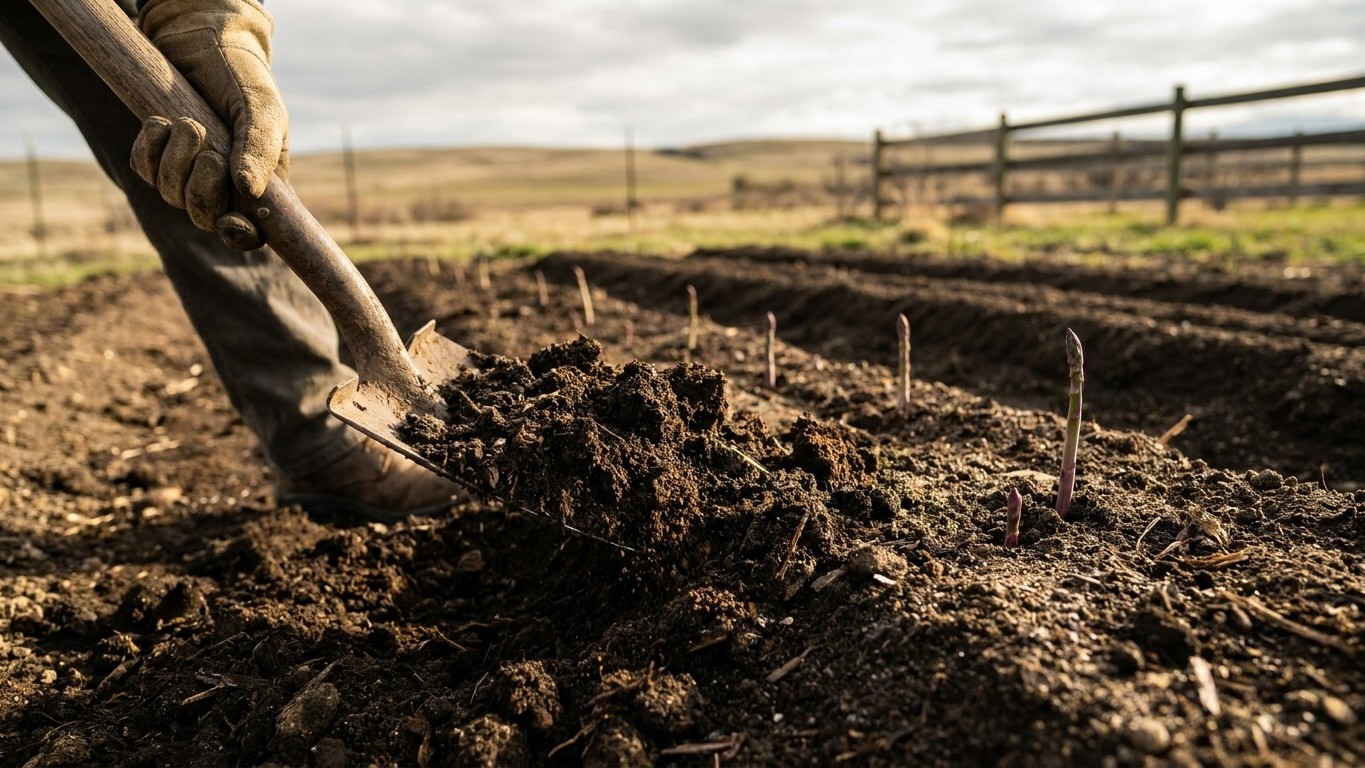

Yes, asparagus grows in Nova Scotia, but the decision about which spot to pick is not a one-season call. Crowns go into the ground once, and that same bed keeps producing for 10 to 15 years afterward, provided the ground drains. When to Plant Asparagus Crowns in Nova Scotia comes down to early spring, then waiting out two full seasons before cutting a single spear, and finally looking forward to a harvest window that runs several weeks each year for a decade or more, if the drainage checks out first.
The short answer
Fifteen years is a long time to commit a corner of a yard to one crop, and asparagus only asks for one thing in return: soil that drains. That is the entire requirement published by Utah State University Extension for this plant, no mention of pH, no mention of a chilling period through winter, just a well-drained spot and patience. Everything else about the bed, the shape of the furrow, the spacing, the years of waiting, matters less than whether water moves through that ground instead of sitting in it.
Nova Scotia’s dominant mapped soil is a Podzol, the acid, leached profile that forms under conifer cover once rain has stripped the bases out of the surface layer. It covers 53 percent of the province’s mapped agricultural surface, with a median pH around 5.2, a texture that runs 52 percent sand, 10 percent clay and 38 percent silt, and organic matter near 2.1 percent. The Canadian Soil Information Service classes it as imperfectly drained, not the answer a fifteen-year crop wants to hear.
Imperfectly drained does not mean waterlogged, but it does mean water lingers in the surface longer than a free-draining loam would allow. On a bed that gets dug up and replanted every year, that is a nuisance you manage with a fork and some patience each spring. On a bed meant to sit undisturbed for a decade and a half, it is closer to a structural decision. A gardener working this kind of ground does well to build the row up, four to six inches above grade, so gravity does some of the draining work the native soil will not. Working compost or coarse sand into that raised strip loosens the texture further, and choosing the highest, driest corner of the yard over the low one matters more here than it would with a crop that gets rotated out next year.
None of this is a verdict on any one garden. The province spans hundreds of distinct soils, and a Podzol on a hillside behaves nothing like a Gleysol in a low, wet field two properties over. What the provincial figures give a gardener is a starting expectation, not a lab result for their own dirt. Will Nova Scotia Soil Hold an Asparagus Bed for Fifteen Years? depends on that individual plot, and a simple test, watching how fast a filled hole drains after a heavy rain, tells more about one particular yard than any provincial average ever will.
Will the summer here water it for you?
Utah State’s guidance gives a specific target: 1 to 2 inches of water every other week through the plant’s first two years while roots are establishing, easing back to about an inch every three weeks once the bed matures. Nova Scotia’s own summer rainfall gets partway there on its own, but not automatically, and not evenly. Here is how the numbers stack up.
- Start with the target. A newly planted bed wants 1 to 2 inches every two weeks, which works out to roughly half an inch to an inch of water per week on average during those first two seasons.
- Compare that against Halifax Stanfield’s long-term summer normal: about 11.2 inches of rain across June, July and August combined, broken down as 3.79 inches in June, 3.76 in July and 3.68 in August, the driest of the three months.
- Spread across roughly thirteen summer weeks, that averages out to close to 1.7 inches every two weeks, which lands inside the range the crop is asking for, at least on paper.
- The catch is distribution. Rain off the Atlantic tends to arrive as fronts rather than a steady drip, so a two-week stretch can run nearly dry before one soaking day resets the average, and on imperfectly drained ground that single heavy day does not soak in as evenly as it would on a sandy loam.
- August is the month most likely to come up short, since it posts the lowest total of the three and often carries the driest stretches of the season.
- After the second year, the bar drops to about an inch every three weeks, a target the province’s summer normal clears with room to spare in most years.
None of these are the numbers for one particular backyard. A rain gauge sitting next to the asparagus bed for a full summer tells a gardener far more than a thirty-year airport average ever could, and it is the only way to know, in real time, whether the hose needs to come out.
When to put the crowns in
Crowns go into the ground in early spring, set into furrows about 8 inches deep. In Nova Scotia, that timing lines up with the frost calendar around Halifax Stanfield, where the mean date of the last spring frost sits around May 7. That word “around” matters: a mean date is an average of decades, not a guarantee, and by definition frost falls later than that average roughly one year in two. Gardeners working farther inland or at higher elevation than the airport station should expect their own last frost to run later still, sometimes by weeks.
Once the crowns are in the furrow, the covering does not happen all at once. The trench gets backfilled gradually across the season, adding about two inches of soil every other month rather than filling the whole 8 inches in a single afternoon. That staged fill lets the emerging spears push through loose soil instead of fighting their way up through a deep, compacted layer, and it gives roots time to establish at each depth before the next layer goes on top.
Seed is the other route into an Asparagus Bed, and it exists as a real alternative to crowns for growers willing to trade convenience for a longer runway. Starting from seed means raising the plant to transplant size before it ever reaches that 8-inch furrow, which adds time on the front end of a timeline that already runs three years before the first cutting. For most home gardeners, crowns purchased ready to plant remain the faster path to a producing bed, but seed keeps a spot in the picture for anyone starting from scratch or wanting more control over which plants make it into the row.
Either way, the calendar target is the same: get the crowns or seedlings into the ground once the soil has warmed and the risk of a hard freeze has passed its statistical peak, which in this province means treating that early-May mean date as the middle of a window, not the starting gun.
Checking this against your own county
Every number above comes from a provincial average or a single airport weather station, and neither one knows what is actually happening in a particular backyard in Kings County or Colchester County. Soil drainage changes from one side of a road to the other, and frost settles into low ground long after it has cleared a hillside a mile away.
The Nova Scotia Department of Agriculture, through its agriculture services at novascotia.ca/agri, is the resource built for that kind of local check. Reaching out before committing a corner of the yard for the next fifteen years is a cheap step compared to relocating a bed after the third or fourth season, once the roots have already spread.
Common questions
Which asparagus variety should I plant in Nova Scotia?
Utah State University Extension names four options and identifies each by sex only: Jersey Giant and Jersey Knight are all-male varieties, while UC 157 F1 and Purple Passion are male-female mixes. No flavor comparison, yield figure or regional recommendation is published for any of them, so the choice comes down to what a local supplier carries rather than a documented reason to prefer one over another.
How do I know when to stop harvesting each year?
There is no fixed calendar cutoff. The rule is a visual one: stop cutting spears once most of them are coming up thinner than a pencil. That signals the plant needs to redirect its energy into growing ferns for the rest of the season rather than continuing to push up spears for the table.
How long until I get a full harvest, and how long does the season last once it starts?
Nothing gets cut in the first two years while the crown establishes. Year three brings the first harvest, typically around four weeks of cutting, extending to about six weeks the following year and roughly eight weeks in the years after that, always bounded by the pencil-thickness rule rather than a fixed date.
Does Nova Scotia’s acidic soil matter for asparagus?
The province’s mapped agricultural soil runs a median pH near 5.2, on the acidic side, but the Utah State University Extension guidance on asparagus is silent on any pH requirement or preference for the crop. Rather than guess at a target, a soil test on the specific planting site is the only way to know what, if anything, needs adjusting before the crowns go in.