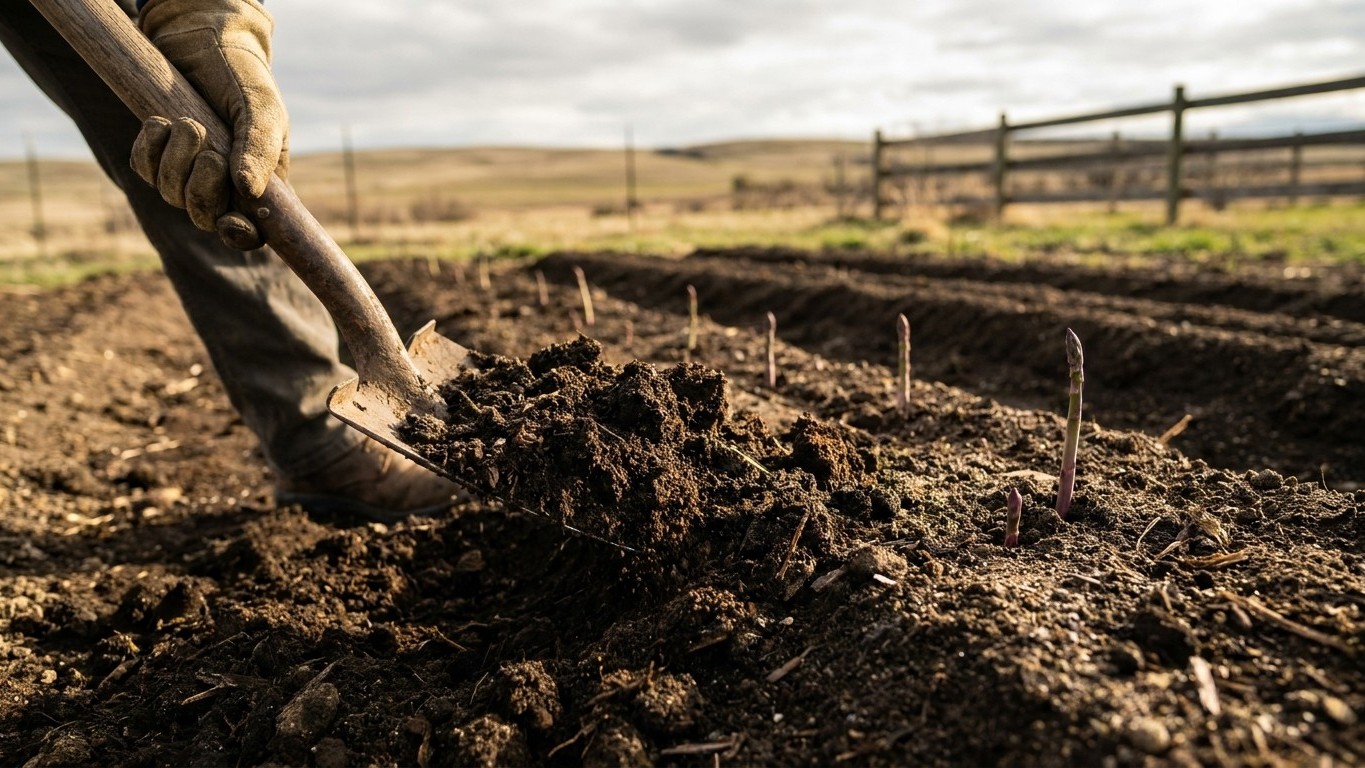

A one-time decision that follows you for over a decade: that’s what planting asparagus in Illinois really means. The crop settles into a bed for ten to fifteen years, so the ground you choose now is the ground you’re committed to through more election cycles than you’d probably like to count. Will Illinois Soil Hold an Asparagus Bed for Fifteen Years? Illinois’ most common soil, the Drummer series, is prized for its depth and fertility, but it’s officially classified as poorly drained. That single detail should weigh more heavily on where you dig than almost anything else in this decision.
The short answer
Utah State University Extension puts it plainly: asparagus will grow in most soils, provided they drain. That’s the entire requirement published on the subject. No pH target, no fussy nutrient chart, just water movement. And that’s exactly where a state built on the Drummer series has to pause before breaking ground.
The Drummer series is Illinois’ official state soil, a deep, dark Mollisol that built the Corn Belt’s reputation. Sampled across 106 representative components, its surface horizon runs about 8 percent sand, 31 percent clay, and 61 percent silt, with organic matter around 5.5 percent and a surface pH near 6.7. That’s rich, productive ground by almost any measure. But USDA’s own classification lists it as poorly drained, meaning water tends to linger rather than move through.
For a crop harvested once a year for two to three weeks, that lingering water might be a minor annoyance. For a crop that occupies the same eight inches of furrow for over a decade, it’s a structural problem. Standing water around dormant crowns in late winter, or a spring thaw that leaves the bed soggy for days, invites rot in a plant you can’t simply replant next season without starting the three-year wait all over again. That’s why knowing When to Plant Asparagus Crowns in Illinois matters just as much as choosing the right soil.
None of this means every Illinois garden is off-limits. The state soil describes what the region’s ground tends to do, not what sits under any one particular yard. A river bottom, a hillside, or a lot that’s been graded and filled by a builder can behave completely differently from the mapped Drummer surface. The only way to know your own plot is a simple check: dig a hole about a foot deep, fill it with water, and watch how long it takes to drain. If water’s still sitting there after several hours, that’s your answer.
Where drainage is doubtful, the fix isn’t complicated. Raised beds or mounded rows lift the crowns above the saturated zone, and working in coarse organic matter loosens a clay-heavy surface enough to let water move through instead of pooling. What the source doesn’t supply is a pH target or a chilling requirement, so don’t chase either one. Drainage is the one condition that’s actually published, and it’s the one worth solving before the crowns ever go in the ground.
Will the summer here water it for you?
Asparagus asks for a specific watering rhythm, and Illinois summers deliver rain on their own schedule, not the plant’s. Lining the two up shows where a garden hose actually has to step in.
- What the bed needs early on. For the first two years, while roots are establishing, the bed wants 1 to 2 inches of water every other week. That’s a modest ask, roughly half an inch to an inch per week on average.
- What a mature bed needs. Once established, the schedule relaxes to 1 to 2 inches every three weeks, which averages out to well under half an inch weekly.
- What the region’s summer actually brings. Reference-station normals for the area show June at 4.1 inches, July at 3.71 inches (the driest of the three), and August at 4.25 inches, for a June-through-August total of about 12.1 inches. Spread over roughly thirteen weeks, that averages to nearly an inch of rain per week, comfortably above what either the young or mature bed technically requires.
- Why the average doesn’t settle the question. Rain rarely arrives evenly. A summer thunderstorm can dump most of a week’s worth of water in twenty minutes, and on a clay-heavy surface much of that runs off before it soaks in rather than reaching root depth. July, the driest month on the calendar, is also often the hottest, which pushes evaporation up right when rainfall is lowest.
- What that means for the hose. The math suggests Illinois summers can, on paper, cover asparagus’s needs without supplemental watering. In practice, a stretch of dry, hot weeks, especially in July, can leave a bed short even in a wet-on-average year. A rain gauge staked next to the bed is the only way to know whether last week’s storm actually delivered an inch where it counts, or just ran down the driveway.
When to put the crowns in
Crowns go into the ground in early spring, set into furrows about 8 inches deep. Around Illinois’ central reference station, the last spring frost typically falls somewhere between April 11 and April 22, a window drawn from thirty years of freeze-probability data rather than a fixed calendar date. “Around” is the operative word here: it’s a mean, not a guarantee, and gardens outside the immediate reference area, particularly rural and suburban lots away from the airport station the figure comes from, often see their last frost run a week or two later. Waiting until the ground has clearly warmed and that frost risk has passed is the safer bet over planting to a date on paper.
Once the crowns sit in that furrow, the trench isn’t filled in one pass. Backfilling happens gradually across the year, adding about two inches of soil every other month as the emerging shoots grow, rather than covering the crowns completely on planting day. That staged approach lets the developing buds push through loose soil instead of fighting their way up through a deep, packed furrow all at once.
Seed is the other route in, for gardeners willing to trade time for a lower up-front cost. Starting from seed adds a year or more before the planting is even at crown stage, stretching the wait before that first light harvest even further out. For most home gardens, crowns remain the faster and more predictable path, which is why they’re the default recommendation.
Variety selection is one area where the published information stays narrow. Utah State University Extension names four varieties, distinguished only by their flower sex, with no data attached about flavor, yield, or a reason to prefer one over another.
| Variety | Sex |
|---|---|
| Jersey Giant | All-male |
| Jersey Knight | All-male |
| UC 157 F1 | Male/female |
| Purple Passion | Male/female |
All-male varieties tend to be favored in home plantings because they don’t spend energy on seed production, but that preference isn’t something the source itself weighs in on. It simply records which varieties fall into which category.
Checking this against your own county
Everything above is drawn from statewide soil data and a single reference weather station, useful for setting expectations but not a substitute for what’s happening in your own dirt. Illinois’ land-grant extension service, reachable at extension.illinois.edu, connects to county-level offices that can walk through a soil test result, confirm drainage concerns specific to your area, and adjust frost-date expectations for your exact location rather than the airport station used in the normals above.
That local call matters more for asparagus than for almost any other vegetable in the garden. A tomato bed that turns out to be a poor fit gets replanted somewhere else next spring with no real loss. An asparagus bed that turns out wrong is a mistake you live with for a decade or more. A conversation with a county office before the crowns go in the ground costs an afternoon; getting the spot wrong costs years.
Common questions
How long until asparagus can actually be harvested?
Not until year three. The first cutting season runs about four weeks, the second about six weeks, and by year four and beyond it stretches to roughly eight weeks. There’s no shortcut to an earlier taste; the plant needs those first two years to build root reserves undisturbed.
How do I know when to stop cutting each season?
Stop when most of the spears coming up are thinner than a pencil. That’s a signal about the plant’s energy, not a date on the calendar, and it can shift earlier or later from one year to the next depending on the season.
Does the pH of the Drummer soil matter for asparagus?
The published guidance for this crop doesn’t set a pH target at all, and the Drummer series’ surface pH of about 6.7 describes the state soil generally, not a specific garden. Treat drainage as the deciding factor here and leave pH out of the planting decision unless your own soil test flags a real extreme.
Is a raised bed necessary on heavier Illinois soils?
Not automatically, but it’s a reasonable safeguard where a percolation test shows water sitting for hours rather than draining. Given that this bed is meant to stay put for over a decade, a raised or mounded row is a modest investment against a much bigger long-term risk.