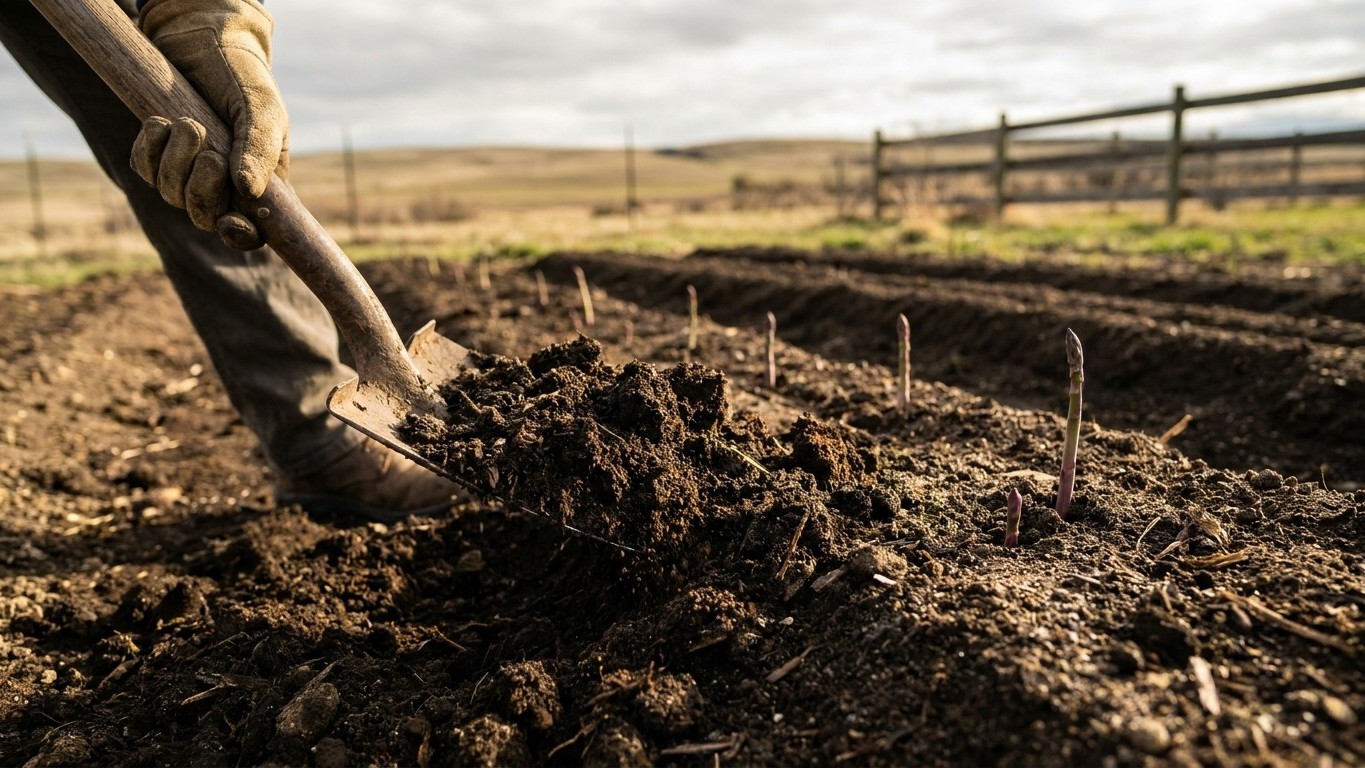

A bed of asparagus in Maine ties up one patch of ground for 10 to 15 years, so the real question isn’t whether the crop will grow here, it’s Will Maine Soil Hold an Asparagus Bed for Fifteen Years? Get the site right, and know When to Plant Asparagus Crowns in Maine, and you’re set for a generation of spring harvests; get it wrong and you’re digging out a waterlogged crown row in year six.
The short answer
Maine’s official state soil, the Chesuncook series, tells you something about what a lot of the state’s ground is doing under the surface, even if it doesn’t tell you a thing about your own yard. It’s a Spodosol, the kind of sandy, acid, heavily leached soil that forms under conifer stands across the northern part of the state. USDA NRCS records put the surface texture at 35 percent sand, 12 percent clay and 53 percent silt, with a surface pH around 5.1, strongly acid, and a listed organic-matter figure near 53 percent. That last number is worth pausing on: an organic-matter reading that high generally means the mapped surface is a natural forest litter or peat layer, not a worked garden bed, so it isn’t a stand-in for what your tilled soil will show on a home test. NRCS classifies the series as moderately well drained.
Asparagus, per Utah State University Extension, will grow in most soils on one condition only: they drain. Moderately well drained sits in the middle of the pack, better than a soil that ponds after every rain, short of one that never holds a puddle at all. In practice, that means a lot of Maine ground can support asparagus without heroic intervention, but “moderately well drained” is a state-level average, not a guarantee for the low corner of a particular lawn. If your own plot holds water 24 hours after a hard rain, or if you can dig a hole and watch it fill partway with groundwater, that ground isn’t ready for a crop you’re planting for over a decade.
The fix isn’t complicated. Raised beds or mounded rows lift the crowns above a wet subsoil without changing the soil chemistry underneath. Working in coarse sand or compost before planting loosens a tight, slow-draining spot. What doesn’t work is hoping a heavy soil will improve on its own once the plants are in the ground, because unlike an annual vegetable bed you get amended every spring, this one is set for the long haul. And the acid pH the state soil carries is its own number, not yours, so a home soil test, not the Chesuncook figure, should be the one that tells you whether lime is worth adding before the crowns go in.
Will the summer here water it for you?
Asparagus has a two-stage thirst. For the first two years after planting, the bed wants 1 to 2 inches of water every other week while the root system is still establishing. After that, once the plant is mature, the demand eases to roughly 1 to 2 inches every three weeks. Here’s how a Maine summer stacks up against that, using the 1991-2020 climate normals for the reference station that also anchors this region’s frost data.
- Total summer rainfall runs about 11.2 inches across June, July and August combined, spread unevenly across the three months rather than delivered in steady weekly doses.
- June averages 4.15 inches, which works out to close to an inch a week, comfortably inside the young bed’s every-other-week target on paper.
- July is the driest month at 3.43 inches, and this is the stretch where a first- or second-year bed is most likely to fall short if that rain arrives as one or two big storms rather than steady showers, since a downpour on dry ground often runs off instead of soaking in.
- August comes back up to 3.57 inches, roughly matching June’s pace and again landing near the bed’s stated need on a monthly average.
- For an established bed past year two, the lower every-three-weeks requirement is easy to cover with what a normal Maine summer delivers, even in a lean July.
- None of this replaces a rain gauge on your own property. These are 30-year averages for one reference station, not a forecast, and a single dry week during a young bed’s second summer can still call for a hose even in a state with reasonably generous rainfall on paper.
When to put the crowns in
Crowns go into the ground in early spring, set into furrows about 8 inches deep. In Maine, “early spring” lines up with the tail end of the frost window: the last spring freeze at 32°F typically falls somewhere around April 22 to May 1, based on NOAA’s 1991-2020 climate normals. That’s a mean date, not a guarantee, and it describes the mild, coastal end of the state. Inland counties and northern Maine routinely run later into spring and earlier into fall, so a grower in Aroostook County is working with a shorter, later-starting season than one near Portland.
Once the furrow is dug and the crowns are laid in, the trench isn’t filled all at once. Soil gets backfilled gradually over the course of the year, about 2 inches every other month, rather than dumped back in on planting day. That staged fill lets the emerging shoots push through loose soil instead of fighting their way up through a deep, compacted layer.
Seed is the other route in, for growers who don’t want to start with purchased crowns, though the specifics of that timeline (when to start seed indoors, when to set out seedlings) aren’t detailed in the source material used here. What is clear from the same source: no matter which way you start the bed, there’s no harvest at all in year one or two. The first cutting doesn’t happen until year three, and even then it’s staged, starting at around four weeks of harvest, then stretching to six, then eventually eight weeks in later years as the crowns mature. The cue to stop cutting each season isn’t a date on the calendar, it’s the spears themselves: once most of them are coming up thinner than a pencil, harvest for the year is done, regardless of what week it is.
Variety choice is narrower than most vegetable shopping. Utah State University Extension names four: two all-male types, Jersey Giant and Jersey Knight, and two male/female types, UC 157 F1 and Purple Passion. That’s the extent of what’s published, sex only.
| Variety | Sex type |
|---|---|
| Jersey Giant | All-male |
| Jersey Knight | All-male |
| UC 157 F1 | Male/female |
| Purple Passion | Male/female |
No flavor comparison, no yield figures, no stated reason to prefer one over another appear in that source, so treat variety choice as a sex-type decision rather than a taste test until you’ve checked further.
Checking this against your own county
Everything above describes tendencies for a state that runs from a mild coastline to a cold interior, and a soil series that’s meant to represent Maine broadly, not the particular ten feet of dirt where you’re planning to dig a furrow. The next real step is a call or visit to University of Maine Cooperative Extension, at extension.umaine.edu. County offices there can confirm local frost timing than a statewide average, walk through a soil test result for pH and drainage, and flag anything specific to your growing conditions that a broad, state-level picture can’t catch.
Common questions
Can I harvest any asparagus in the first or second year?
No. Utah State University Extension is clear that harvest doesn’t start until year three, regardless of how vigorous the plants look sooner. Cutting early weakens the root system the bed depends on for the next decade.
Does Maine’s acid soil need to be limed before planting?
That depends on your own soil test, not the state soil figure. The Chesuncook series reads around pH 5.1 at the surface, but that’s a representative value for a mapped forest soil, not a measurement of your garden. The published asparagus source is also silent on any preferred pH, so a home or extension test is the only way to know if lime is worth adding.
What if my yard sits low and holds water after rain?
Raise the bed. A mounded row or a raised frame lets water move away from the crowns even where the underlying soil is only moderately well drained, which describes much of Maine’s mapped ground.
Is there a winter chilling requirement to worry about?
Not one that’s published in the source used for this guide. Winter chilling and cold hardiness zones are separate questions from what’s documented here, so don’t assume a specific chilling number just because Maine winters are cold.