
The short answer: Maine’s growing season runs roughly five to six months, bookended by frost dates that are averages, not guarantees, and shaped by a hardiness range that spans nearly half the USDA zone chart. That single fact, more than any soil tip or plant list, decides what actually grows here.
How long your season really is

Start with three numbers. The USDA Plant Hardiness Zone Map (2023 edition, built on 1991-2020 normals) places Maine somewhere between zone 3b and zone 6a, depending on where in the state you’re standing. The average last spring frost, measured at the Portland reference station, falls between April 22 and May 1. The average first fall frost arrives between October 9 and October 21. Do the arithmetic on those two windows and you get a frost-free season somewhere between 161 and 182 days, depending on which end of each range applies to your particular spring and fall.
Call it roughly five and a half to six months. That’s the entire budget a Maine gardener has to work with, and it rules out more than it allows. Crops that need a long, warm run from seed to harvest, think full-season winter squash varieties, certain heirloom tomatoes bred for the Deep South, or okra grown the way it’s grown in Georgia, are working against the calendar from day one. Peppers and sweet corn fall into a similar category, needing a warm head start to make the most of the window, see Growing Peppers in Maine and Growing Sweet Corn in Maine for how to manage that timing. By contrast, cool-season staples like potatoes, beets, carrots, parsnips, and leafy greens fit this window comfortably, see Growing Potatoes in Maine, Growing Beets in Maine, Growing Carrots in Maine, Growing Parsnips in Maine, and Growing Spinach in Maine for how well-suited these crops are to the state’s short season. Hardy perennials like asparagus do even better, establishing once and returning each spring well within the frost-free window, see Growing Asparagus in Maine for how to get a bed started. Even a fall favorite like pumpkins needs careful timing, see Growing Pumpkins in Maine for the full planting timeline and When to Carve a Pumpkin in Maine for how the short season shapes that schedule. They’re not impossible, but they’re a bet, not a plan, and they only pay off with a head start indoors or under cover.
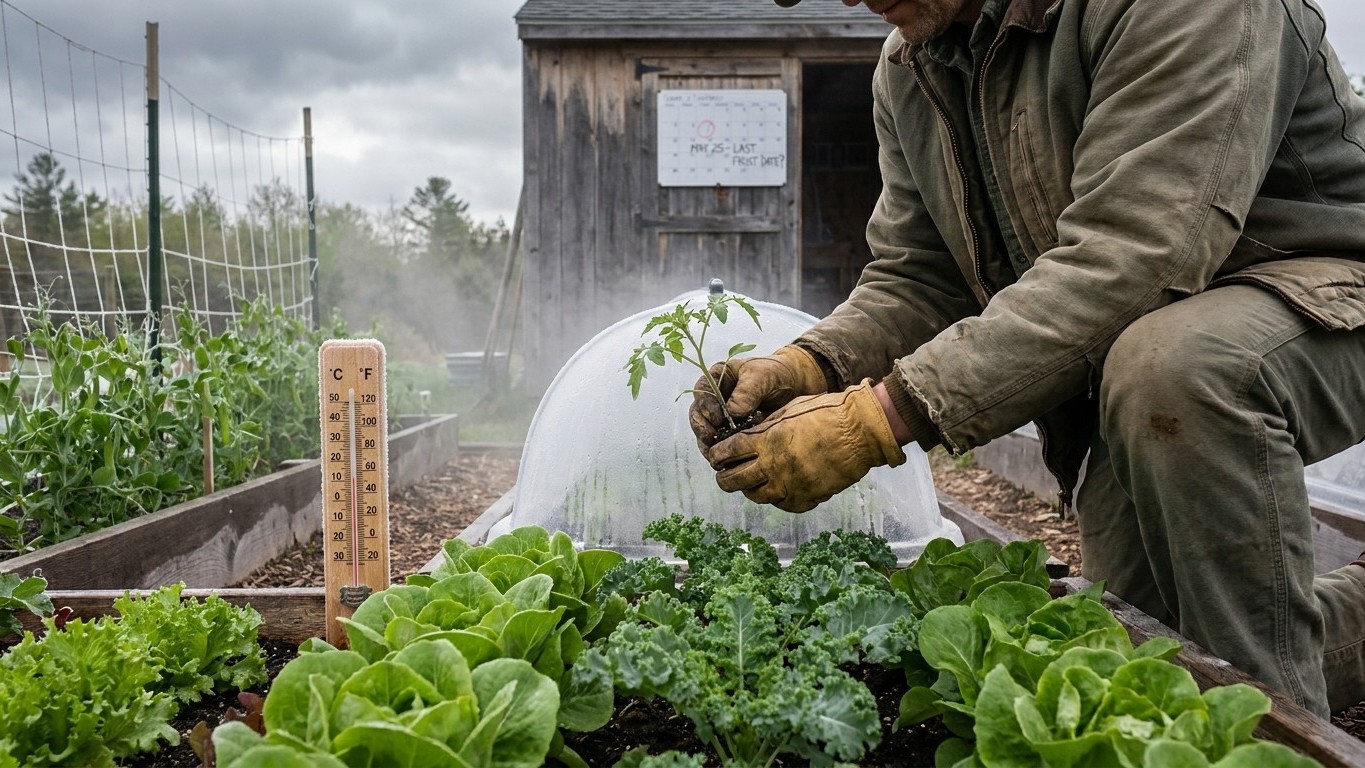
Here’s the part that trips people up: those frost dates are averages, not safe dates. An average last frost of April 22 to May 1 means, by definition, that roughly half of all years see frost after that window closes. Plant tender seedlings on the “average” date and you’re playing a coin flip with a hard freeze. Gardeners who’ve been burned by a mid-May cold snap in Maine aren’t unlucky, they’re just on the wrong side of a number that was always going to fail someone.
The practical move is to treat the average as the center of a range, not the edge of safety. Push tender crops a week or two later than the stated average if a late frost would wipe out real money in seedlings, and watch local forecasts rather than a calendar date alone as the window closes in fall. The zone range itself, 3b to 6a, tells the same story from a different angle: it’s a single-variable measurement of the coldest night of the year, and it’s wide enough that a gardener in one part of the state is working with a fundamentally different winter than a gardener two hours away.
What the summer does to a garden here
Maine doesn’t get punished by heat the way the Southeast does, but it isn’t immune either. The Portland reference station averages just 3.8 days a year above 90F. That’s a small number, and it matters precisely because it’s small: gardeners here rarely have to think about heat stress the way growers in Texas or Kansas do.
But “rarely” isn’t “never,” and even a handful of 90-degree days lands at the worst possible moment. Tomato flowers stop setting fruit once temperatures push much past 90F, the pollen essentially cooks before it can do its job. Lettuce and other cool-season greens bolt, throwing up a flower stalk and turning bitter, once heat builds in midsummer. So the few hot days Maine does get tend to cluster in July, right when a gardener expects steady production, and the result is a brief stall rather than a full-season heat problem.
The other number that shapes the whole calendar is the coldest month’s average daily minimum: 15.6F at the reference station. That’s the figure that decides whether a perennial, a shrub, or a fruit tree actually survives winter here, not the record low everyone remembers from one bad year, but the routine cold a plant has to shrug off every single winter. A plant rated for warmer zones might survive one mild January in Maine and die in the next, because 15.6F as a nightly average is a very different stress than an occasional cold snap.
Put those two numbers together and Maine’s growing year looks less like one long stretch and more like a spring push and a fall push, with a short, mild midsummer lull for anything cool-season sensitive. It’s not the brutal two-season split you’d see in the desert Southwest, but the logic is the same: know when your crop actually wants to be growing, and don’t assume July is automatically the best month for everything.
What tends to go wrong in Maine
University of Maine Cooperative Extension’s home and garden pest identification pages point to a handful of insects that show up often enough to earn their own fact sheets, and a Maine gardener is far more likely to meet one of these than something exotic.
The Colorado potato beetle is a midsummer regular on potatoes and related crops, both adults and their reddish larvae strip foliage fast enough to defoliate a young plant in days. The striped cucumber beetle arrives early, often right as cucumber and squash seedlings emerge, and beyond the direct feeding damage it spreads bacterial wilt, a disease that can take down a plant the beetle itself barely touched. Later in the season, the squash vine borer targets the base of squash and pumpkin vines, and its damage is often invisible until a healthy-looking plant collapses overnight because the stem has been hollowed out from within.
The lily leaf beetle, a bright red insect UMaine Extension has flagged with a dedicated bulletin, is less a food-garden problem and more an ornamental one, it can strip true lilies down to bare stems over a single season. And gardeners with fruit trees or hardwoods should know the browntail moth by name: its caterpillars carry hairs that cause a poison-ivy-like skin reaction in people, on top of the defoliation they cause to host trees.
None of this is a spray schedule, and it shouldn’t be treated as one here. Extension’s own identification pages exist precisely because timing, plant, and correct diagnosis all change what, if anything, a gardener should do, and that call belongs to the reader’s own county office, not a general list.
Where to check before you plant
Everything above is a state-level average, and Maine is not a small or uniform state. It stretches across several degrees of latitude, and its hardiness range alone, 3b to 6a, covers ground that in most states would be split across entirely different growing regions. A planting calendar tuned to the Portland reference station can run two to three weeks off for a garden near the Canadian border or well inland from the coast, in either direction depending on the season.
That’s exactly what the University of Maine Cooperative Extension exists to correct. As the state’s land-grant extension service, it publishes localized planting guidance and pest identification resources built specifically for Maine conditions, and its county offices can tell a gardener what the frost dates, heat load, and pest pressure actually look like on their own land, not just at a weather station miles away.
The numbers above frame what’s possible in Maine overall. The next step is a phone call or a visit to the county extension office before a single seed goes in the ground, especially for anyone gardening away from the coast, where the mild end of Maine’s range simply doesn’t apply.
Three Crops Worth Getting Right
Season length is one thing; what you actually plant into it is another, and Maine has a way of punishing guesswork on that front. Take growing garlic in Maine: skip the cold it needs and you dig up a single round bulb with no papery wrapper and no cloves to separate, not because of disease or a bad variety but because the chilling requirement never got met. The lawn asks a similar question in a different key — Maine lawn care covers why a Bermudagrass seed sown in a hopeful May can look green all summer, spread nicely, and simply not be there come April, killed by a winter low no warm-season grass was built to survive. And then there’s the frost date itself, which isn’t one number statewide. Growing tomatoes in Maine starts with the April 22 to May 1 window a coastal Portland gardener gets, and the quiet assumption that this window belongs to everyone — it doesn’t, and pushing inland changes the math fast. Each page works from the same premise as this one: the season allows what it allows, and the plant either fits that or it doesn’t.