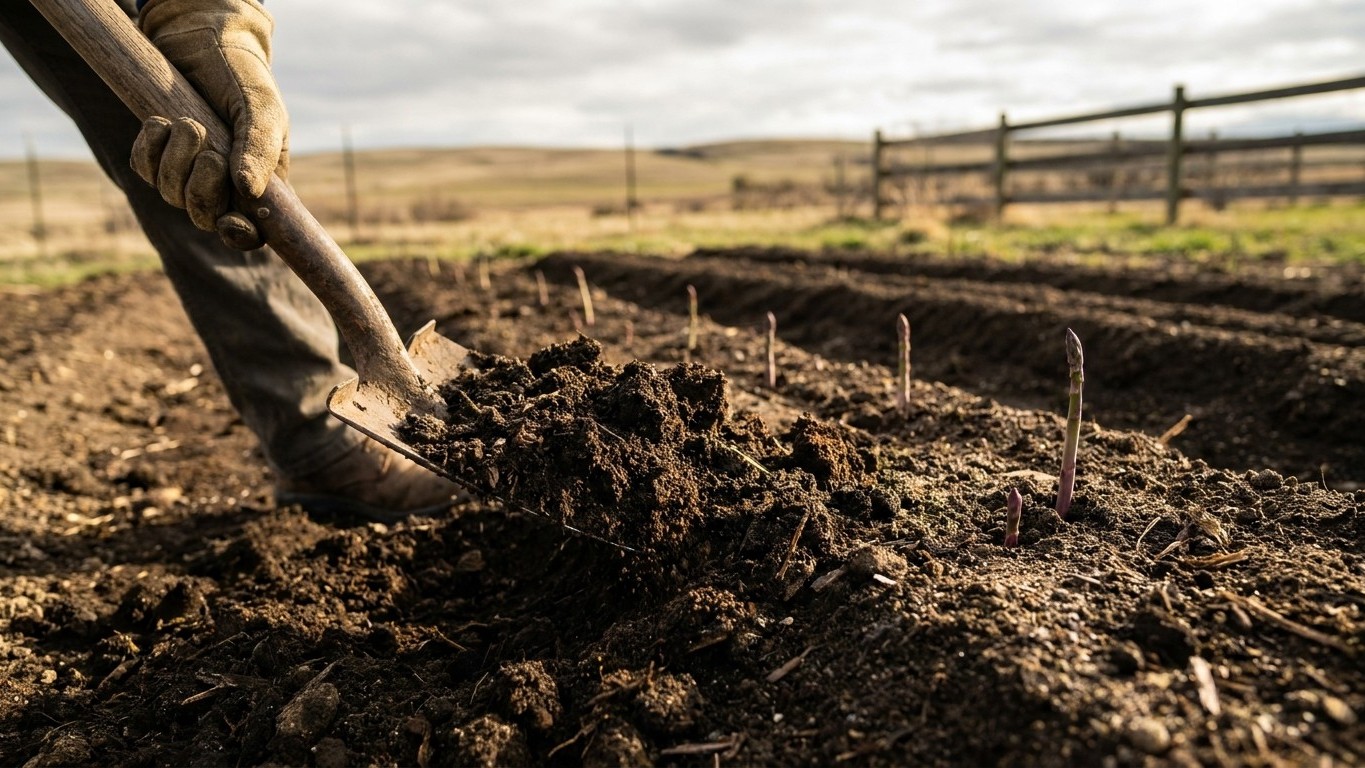

Massachusetts gardeners can absolutely commit a corner of the yard to asparagus for the long haul, but the decision hinges on one word: drainage. Will Massachusetts Soil Hold an Asparagus Bed for Fifteen Years? The state’s representative soil handles that well, though “representative” is doing a lot of work in that sentence. Summer rain won’t cover the bed’s needs on its own, and When to Plant Asparagus Crowns in Massachusetts centers on a planting window that opens around early April. Here’s what actually decides whether that ground holds up for a decade.
The short answer
Asparagus is one of the few vegetables where the planting decision isn’t really annual. Set crowns into a bed and, according to Utah State University Extension, that spot will keep producing for 10 to 15 years before it needs to be reworked. There’s no harvest at all in the first two seasons, and the plant doesn’t ask for much beyond one condition: the soil has to drain. Most soils will do, the extension notes, provided that single requirement is met.
Massachusetts happens to have an answer built into its own ground. The Paxton series, named the state’s official soil by state law, is what USDA soil surveyors record as representative of the region: a young Inceptisol, sandy at 61 percent sand against just 7 percent clay, with about 5.5 percent organic matter in the surface layer and a surface pH near 5.5. Critically for a fifteen-year bed, it’s classified as well drained. Sand doesn’t hold water the way clay does, so a garden built on ground resembling Paxton has a real head start.
The catch is that Paxton describes a survey composite, not the dirt under any one person’s shovel. Massachusetts holds hundreds of mapped soil series, and a garden on a filled lot, a river bottom, or a compacted patch left behind by a builder can behave nothing like the sandy, free-draining profile above. A bed that sits in standing water after a heavy rain, or where puddles linger for a day or more, is telling the gardener something the state soil survey can’t: that particular patch is not Paxton, whatever the county map says.
If that’s the case, the fix isn’t complicated, just necessary before crowns go in the ground. Raising the bed six inches or more, working in coarse organic matter to open up compacted layers, or simply choosing a different, higher spot in the yard all address the same problem: getting water to move through instead of sitting still. Given that this bed will still be in the same ground when today’s seedlings are mature trees, it’s worth solving drainage before planting rather than fighting it every spring after.
Will the summer here water it for you?
Rainfall alone rarely matches what an asparagus bed asks for, and Massachusetts summers illustrate why. NOAA’s 1991-2020 climate normals put total summer rainfall (June through August) at about 10.4 inches, with August running driest at 3.23 inches. Set that against what the bed actually needs and the gaps show up fast.
- Years one and two, the establishment phase: the bed wants 1 to 2 inches of water every other week. Over a two-week stretch, June’s normal of 3.89 inches would just about cover it on paper, but rain that arrives in one storm mostly runs off rather than soaking into the root zone, so gardeners shouldn’t assume a wet forecast means they can skip the hose.
- June, on paper: 3.89 inches sounds generous against a target of roughly 2 to 4 inches per two-week window. In practice this is the month least likely to need supplemental watering, though a dry June is not unheard of.
- July, the middle stretch: normals drop to 3.27 inches. Still workable, but the margin is thinner, and any run of hot, dry days will pull moisture out of a sandy Paxton-type soil faster than a clay one.
- August, the tight month: at 3.23 inches, this is when rainfall and target overlap least comfortably. A sandy bed that drains well in spring is the same bed that dries out fastest in August heat, so this is the month most likely to need a deliberate soak from a hose or drip line.
- Year three onward, established beds: the watering interval stretches to every three weeks. By this point the plant’s root system runs deeper, so it can ride out a dry week or two that would have stressed a first-year crown.
None of these normals substitute for a rain gauge on the actual property. A backyard on a slope, near a building, or in a different part of the state can see meaningfully different totals than the reference station these normals come from.
When to put the crowns in
Crowns go into the ground in early spring, and in Massachusetts that means timing the job around the last spring frost. NOAA’s 1991-2020 climate normals put that date, based on the 32°F freeze-probability threshold, at around April 1 to April 8. That’s an average window, not a guarantee, so a cold snap in mid-April is well within the range of normal rather than an exception to worry over.
Planting itself is a furrow job. Crowns are set into trenches roughly 8 inches deep, and the fill doesn’t happen all at once. Growers backfill gradually across the season, adding about 2 inches of soil back into the furrow every other month rather than covering the crowns in a single afternoon. That staged approach lets the emerging shoots keep pace with the soil level instead of getting buried before they’ve had a chance to grow.
Seed is the other route, though it’s the slower one. Instead of setting an already-established crown, the gardener starts from seed and waits for it to develop into a plantable crown before it ever goes into the permanent bed. It takes longer to reach the same starting point as a purchased crown, but it’s a legitimate option where crowns aren’t available or a gardener wants to grow a larger number of plants economically.
Whichever route gets the plant into the ground, patience is the real requirement afterward. There’s no harvest in year one or year two, full stop. Year three brings the first cutting, and even then it’s limited: about 4 weeks of harvest that first productive year, extending to 6 weeks the year after, and 8 weeks once the bed is fully mature. The stopping point each season isn’t a date on the calendar; it’s a visual cue. When most of the spears coming up are thinner than a pencil, harvest stops for the year and the plant is left to grow into ferny top growth that feeds the crown for next season.
Variety choice matters less for flavor than for plant sex, at least according to what Utah State University Extension actually publishes. The extension names four varieties by sex alone, without ranking them on taste or yield:
| Variety | Type |
|---|---|
| Jersey Giant | All-male |
| Jersey Knight | All-male |
| UC 157 F1 | Male/female |
| Purple Passion | Male/female |
All-male varieties tend to be favored in home gardens because they don’t put energy into seed production, but that’s a general horticultural point, not a claim Utah State’s guide makes about these specific four.
Checking this against your own county
A state soil, a single reference weather station, and a set of NOAA normals all describe averages across a wide territory. None of them describe the particular six-hundred-square-foot patch behind one house in western Massachusetts versus one on the South Shore. Before committing a bed to Fifteen Years in One Spot, it’s worth getting a local read, not just a statewide one.
UMass Extension, the state’s land-grant university extension service, is the named resource for that kind of local check. Its office can point to county-level soil information, help interpret a soil test result, and flag anything about a specific property, drainage patterns, frost pockets, or local pest pressure, that a statewide dataset simply can’t capture. Reach the service at ag.umass.edu.
A quick soil test before planting is the cheapest insurance available for a bed that’s meant to outlast most other decisions made in the same garden this year.
Common questions
What if my yard has heavy clay instead of sandy, well-drained soil?
Heavy clay holds water longer than a Paxton-type soil, which is a real problem for a plant whose only stated requirement is drainage. Raising the bed, working in coarse organic matter, or choosing a higher spot in the yard are the standard fixes; the goal is getting water to move through rather than pool around the crowns.
How long until the first harvest?
No cutting happens in year one or year two. The first harvest comes in year three, and even then it’s a short window, about 4 weeks, before the plant is left alone to build strength for the following season.
How do I know when to stop cutting each season?
Watch the spears, not the calendar. Once most of what’s coming up is thinner than a pencil, that’s the signal to stop harvesting for the year and let the remaining growth mature into fern.
Does it matter which variety I plant?
Utah State University Extension names Jersey Giant and Jersey Knight as all-male varieties, and UC 157 F1 and Purple Passion as male/female, without publishing any comparison of flavor or yield between them. The published distinction is sex, not performance.