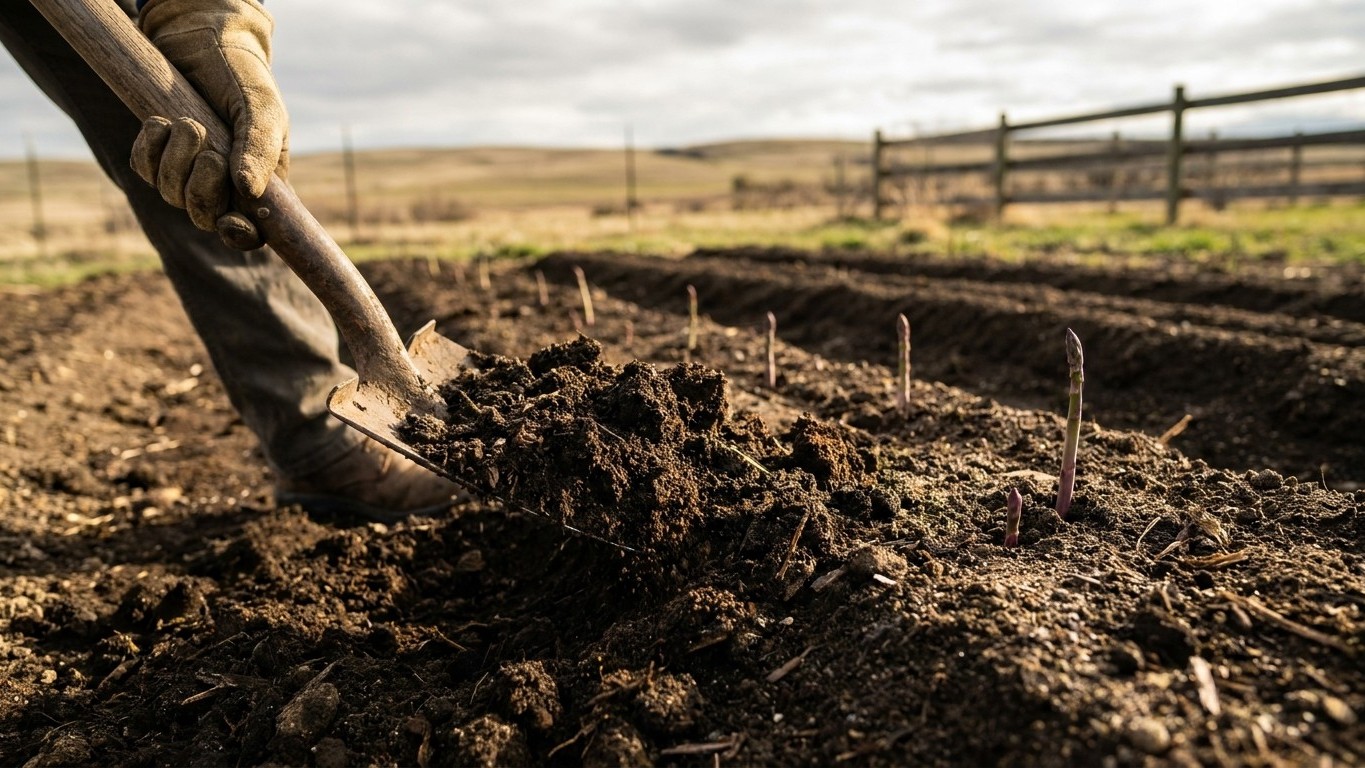

New Brunswick’s farmland runs mostly to Podzol, a soil that forms under conifer cover and drains well by definition, which happens to be the one thing a fifteen-year asparagus bed actually requires. If your own patch is different, that’s a five-minute shovel test, not a reason to give up on the crop.
The short answer
Asparagus is planted once, as crowns set into furrows, and then left to work for ten to fifteen years before the gardener even thinks about disturbing that ground again. Utah State University Extension is blunt about the tradeoff: no harvest at all in year one or two, and the bed doesn’t ask for much beyond one condition, which is that the soil drains. Nothing about pH, nothing about fertility beyond “most soils will do,” just drainage — which raises the practical question of When to Plant Asparagus Crowns in New Brunswick so that drainage condition is actually met.
That single requirement lines up well with what actually covers most of New Brunswick’s farmed ground. According to the Canadian Soil Information Service, the most common soil order across the province’s mapped agricultural land is Podzol, the acid, leached soil that develops under conifers as rain strips minerals out of the topsoil. The Canadian System of Soil Classification lists Podzols as well drained, and the median texture reads as a loam-to-silt mix, roughly 47 percent sand, 37 percent silt, and 16 percent clay, with organic matter around 3.4 percent. Surface pH runs strongly acid, at a median of about 4.7. That acidity isn’t addressed anywhere in the asparagus guidance, so there’s no published reason to treat it as a problem here; drainage is the only stated condition, and a Podzol by classification already clears that bar — which is really the crux of Will New Brunswick Soil Hold an Asparagus Bed for Fifteen Years?
If your own ground doesn’t drain
That provincial figure is a starting point, not a verdict on your yard. It’s a median drawn from 418 mapped soil components across the province’s agricultural regions, so the far north isn’t represented, and neither is the low spot along a river, a patch of muskeg, or the compacted fill behind a newer house. Any of those can sit wet long after a textbook Podzol has drained. Before committing a corner of the yard to fifteen years of asparagus, dig a hole about a foot deep, fill it with water, and watch how fast it disappears. If it’s still standing after several hours, the fix isn’t to abandon the crop but to build up: a raised bed, or a mounded row amended with compost, gets the crowns above the standing water without needing a different soil order underneath.
Will the summer here water it for you?
The bed’s water demand is stated plainly: 1 to 2 inches every other week through the first two growing seasons while roots are establishing, then a lighter 1 to 2 inches roughly every three weeks once the plants are settled in. Measuring that against what a New Brunswick summer typically delivers takes a few steps.
- The reference station at Moncton A recorded average summer rainfall, over the 1981-2010 period, of about 3.73 inches in June, 3.63 inches in July, and 3.18 inches in August, the driest of the three months.
- Add those up and summer arrives with roughly 10.5 inches of rain spread across the season, against 47.3 inches for the full year.
- Spread over roughly thirteen weeks of summer, that averages out to a bit under an inch of rain per week, which sits close to the bed’s stated need during the establishment years, at least on paper.
- The catch is that rain rarely arrives in tidy weekly installments. It comes as storms, sometimes with a dry stretch of ten or fourteen days between them, and August, the month asparagus ferns are working hardest to build root reserves for next year, is also the driest of the three.
- A sandy, well-drained Podzol lets that rain move through quickly rather than holding it in reserve, so a gardener on that kind of ground should expect to top up with a hose during any dry spell longer than a week or two, particularly in the first two seasons.
None of this replaces a rain gauge staked next to the bed. The Moncton figures are a regional average, not a reading from any one backyard, and a slope, a wind-exposed lot, or simply a different soil texture nearby can push actual conditions well off that norm.
When to put the crowns in
Crowns go into the ground in early spring, laid into furrows about 8 inches deep, and the furrow is filled back in gradually across the season rather than all at once, with about 2 inches of soil added back every couple of months as the shoots push up through it. New Brunswick’s own frost record gives a rough anchor for when “early spring” actually arrives here: the mean last spring frost at the Moncton station lands around May 23. That’s a mean, not a promise, and Environment and Climate Change Canada’s own normals mean that in roughly one year out of two, frost shows up later than that date. Treat May 23 as the middle of a window that can run later, not a green light printed on the calendar, and keep an eye on the local forecast before committing crowns to open furrows. Gardeners further inland or at higher elevation than the Moncton station should expect that window to run later still.
Crowns versus seed
Crowns are the route the source treats as standard, and they’re what gets a bed to its third-year harvest fastest. Seed is the alternative some gardeners choose instead, usually because crowns of a particular variety aren’t available locally, but the source used here doesn’t spell out a seed-starting timeline, so that detail isn’t given here. What the source does supply is a short, sex-only list of named varieties: Jersey Giant and Jersey Knight are all-male, while UC 157 F1 and Purple Passion are male-and-female types. Nothing is published about flavor, yield, or a reason to favor one over another, and no nursery is named as a source for any of them. The choice between them, on the evidence available, comes down to whether an all-male bed (which tends to skip self-seeding and volunteer seedlings) fits the gardener’s plans better than a mixed one.
Checking this against your own county
Provincial soil medians and a single climate station can only point a gardener in the right direction. The next step is local: a soil test through a proper lab, and a conversation with someone who tracks conditions closer to home. For New Brunswick, the provincial agriculture department’s own site currently blocks automated access, so the reliable starting point is the federal department instead, Agriculture and Agri-Food Canada, which can point toward provincial soil testing services and current guidance for the region. A local test will return an actual pH and drainage class for the exact spot being considered, rather than a provincial average, and that’s the number worth trusting before quantity of crowns get ordered for a bed meant to stay put for the next decade and a half.
Common questions
Can asparagus be harvested in its first or second year?
No. The source is explicit that harvest doesn’t begin until the third year after crowns go in. The first two seasons are entirely about letting roots establish; cutting spears before then weakens the plant’s ability to build the reserves it needs for the long run ahead.
Is New Brunswick’s acidic soil a problem for asparagus?
It isn’t addressed either way in the guidance used here. The only stated requirement is drainage, and the province’s dominant Podzol soil is classified as well drained, so on that single point it lines up with what the crop needs. No pH threshold is published for asparagus, so there’s no basis here for treating the region’s naturally acid ground as an obstacle.
Does the furrow get filled in all at once after planting?
No. It’s backfilled gradually over the season, with soil added back in stages, roughly 2 inches every other month, rather than burying the crowns completely at planting time.
How do I know when to stop harvesting each spring?
The rule isn’t a date on the calendar; it’s a look at the spears themselves. Harvest continues while spears are still coming up thick, and stops once most of them are thinner than a pencil, which signals the plant needs to shift its energy toward building fern growth for next year’s crop.