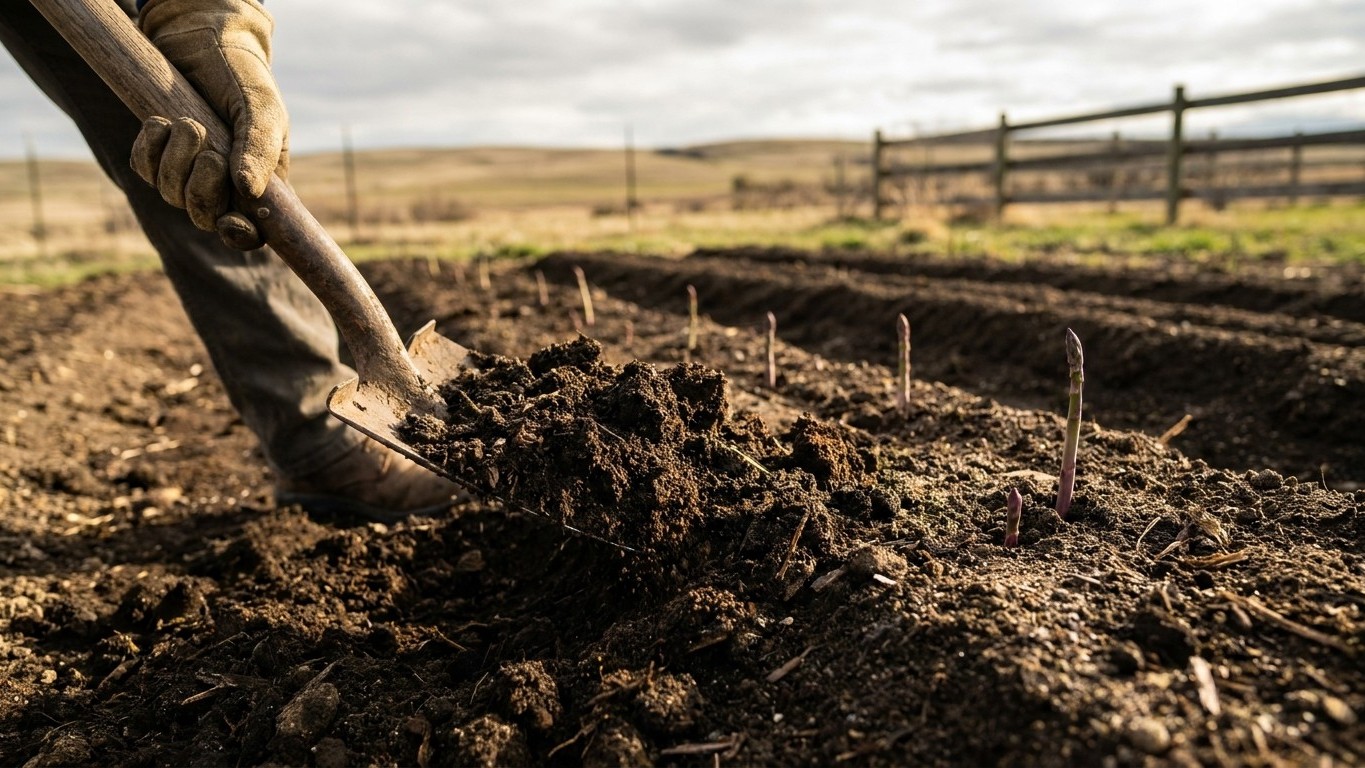

A bed that stays in the ground for a decade and a half is not a plant, it’s a decision. New Jersey’s soil, taken at the state level, drains well enough to support that decision without amendment. But “the state’s soil” and “your backyard” are two different things, and the gap between them is exactly where a fifteen-year bed either thrives or drowns.
The short answer
When to Plant Asparagus Crowns in New Jersey centers on 8-inch furrows in early spring, and from that point the clock runs long. There’s no harvest at all in the first two years. Year three brings four weeks of cutting. The year after that, six weeks. Then eight. After that, the rule stops being a calendar number and becomes a visual one: keep cutting each spring until most of the spears coming up are thinner than a pencil, then stop and let the fern grow. Do that faithfully and the same bed keeps producing for ten to fifteen years, according to Utah State University Extension, which lists exactly one soil requirement for all of that: drainage.
New Jersey’s representative soil, the Downer series, happens to be built for it. It’s an Ultisol, meaning it’s old, heavily weathered, and leached of a lot of what plants want, but its surface is 79 percent sand, 6 percent clay, and 15 percent silt, with organic matter around 1.2 percent and a surface pH near 6.3, according to USDA NRCS Soil Data Access. Sand at that proportion moves water through fast. That’s the trait asparagus actually needs, more than fertility, more than pH. A soil this loose rarely leaves a crown sitting in standing water, which is the failure mode that kills a bed before it ever produces.
That matters for one detail of planting that’s easy to miss: the furrow isn’t filled in all at once. Crowns go in at the bottom of that 8-inch trench, and the soil is backfilled gradually, about two inches every other month across the year, rather than buried immediately. On a soil that holds water at the bottom of a trench, that slow backfill is a rot risk every time it rains. On a soil built like Downer sand, water clears the furrow before the crown ever sits in it.
None of that is a diagnosis of your particular quarter-acre, which is really the question worth asking: Will New Jersey Soil Hold an Asparagus Bed for Fifteen Years? The Downer series is what USDA lists as representative of the state, not a survey of every yard in it. River-bottom ground, hill country, and anything a builder has scraped, filled, or compacted will drain differently, sometimes completely differently. If a spot holds water twenty-four hours after a hard rain, that’s the sign to work in organic matter, raise the bed six to eight inches, or move the planting site rather than fight a heavy soil for fifteen years straight.
Will the summer here water it for you?
The bed has its own watering schedule, and it doesn’t match the calendar most vegetables run on. For the first two seasons it wants 1 to 2 inches every other week. After that, once the crowns are established, the demand drops to roughly the same amount every three weeks. Here’s how that lines up against what a New Jersey summer actually delivers.
- The young-bed demand. Over a thirteen-week summer, watering every other week at 1 to 2 inches works out to roughly six or seven waterings, somewhere between 6 and 14 inches total across June, July, and August.
- What the sky provides. NOAA’s 1991-2020 climate normals for the reference station put summer rainfall at about 13.2 inches across those same three months: 4.34 in June, 4.66 in July, and 4.15 in August, the driest of the three, according to NOAA NCEI Monthly Climate Normals.
- Why the totals don’t tell the whole story. On paper, 13.2 inches sits comfortably inside that 6-to-14 window. But rain that falls as a single thunderstorm runs off a sandy surface fast rather than soaking in, and the Downer series is 79 percent sand at the surface. A wet month on the rain gauge can still leave a dry root zone by the following week.
- August is the pressure point. It’s the lowest-rainfall month of the three and the one where evaporation from summer heat is working hardest against whatever moisture is in the ground. That’s the stretch most likely to need a hose even in a year that finishes with average totals.
- After year two. Once the schedule drops to every three weeks, an established bed on well-drained ground is usually carried by natural rainfall most summers, with supplemental watering reserved for extended dry spells rather than a weekly habit.
The practical move is a rain gauge on the actual bed, not a regional average. A slope, a nearby building, or simple distance from the reference station can shift these numbers meaningfully, and the only number that settles it is the one sitting in your own yard after a storm.
When to put the crowns in
Crowns go into the ground in early spring, timed to soil that’s workable and past its worst frost risk. At the reference weather station, the last spring frost falls, on average, somewhere around March 29 to April 6, based on NOAA NCEI’s 1991-2020 freeze-probability normals. That’s a mean date built from thirty years of records, not a promise for any single spring, and suburban and rural gardens away from that airport station commonly see their last frost land one to two weeks later, more at higher elevation. “Around” is doing real work in that sentence.
Seed is the other route in, and it’s a slower one. Starting asparagus from seed adds roughly a year to the front end of the timeline before the plants reach crown size and are ready for transplanting into the permanent bed, which is why most home gardeners skip straight to buying crowns. The upside of seed is variety selection, since seed catalogs carry options that aren’t always available as ready-grown crowns.
Whichever route a gardener takes, the variety choice itself comes down to one published trait: sex.
| Variety | Sex type |
|---|---|
| Jersey Giant | All-male |
| Jersey Knight | All-male |
| UC 157 F1 | Male/female |
| Purple Passion | Male/female |
Utah State University Extension names those four and stops there. No flavor comparison is published, no yield ranking, no reason to prefer one over another beyond sex type, and all-male varieties skip seed production entirely, which keeps volunteer seedlings from crowding the row over the years. Anything beyond that distinction is a nursery’s marketing claim, not an extension finding, and it’s worth treating it that way.
Checking this against your own county
Everything above describes a representative soil series and a single reference weather station, not the specific dirt under a specific yard in Cape May or a hillside plot in the northwest corner of the state. The gap between those two things is exactly what a soil test closes.
Rutgers Cooperative Extension, at njaes.rutgers.edu, runs county offices across the state that can test a soil sample directly, and they’re the group positioned to say whether a particular county’s frost dates, drainage, and growing conditions line up with the statewide figures cited here or diverge from them. A phone call before the crowns arrive is cheaper than moving a fifteen-year bed after the fact.
Common questions
Can asparagus grow in New Jersey’s heavier clay pockets?
The published requirement is drainage, not a specific texture, so heavier soils can work if they’re amended with organic matter or the bed is raised enough that water doesn’t sit around the crowns. A soil test through the local extension office is the way to know whether a given spot needs that step.
Why does asparagus need such a long wait before the first harvest?
The plant spends its first two years building the root system that will carry it through a decade or more of cutting. Harvesting early would pull energy away from that root development, which is why year three is the earliest point Utah State University Extension lists for any cutting at all.
Does the state soil profile mean my exact yard will drain the same way?
No. The Downer series is the soil USDA lists as representative of New Jersey, drawn from an average of many mapped locations, not a reading of any individual garden. Fill, slope, and proximity to a river bottom can all push a real yard away from that profile.
What ends the harvest window each year?
Not a date on the calendar. The signal is the spears themselves: once most of what’s coming up is thinner than a pencil, cutting stops for the season so the plant can put its energy into the ferny growth that feeds next year’s crop.