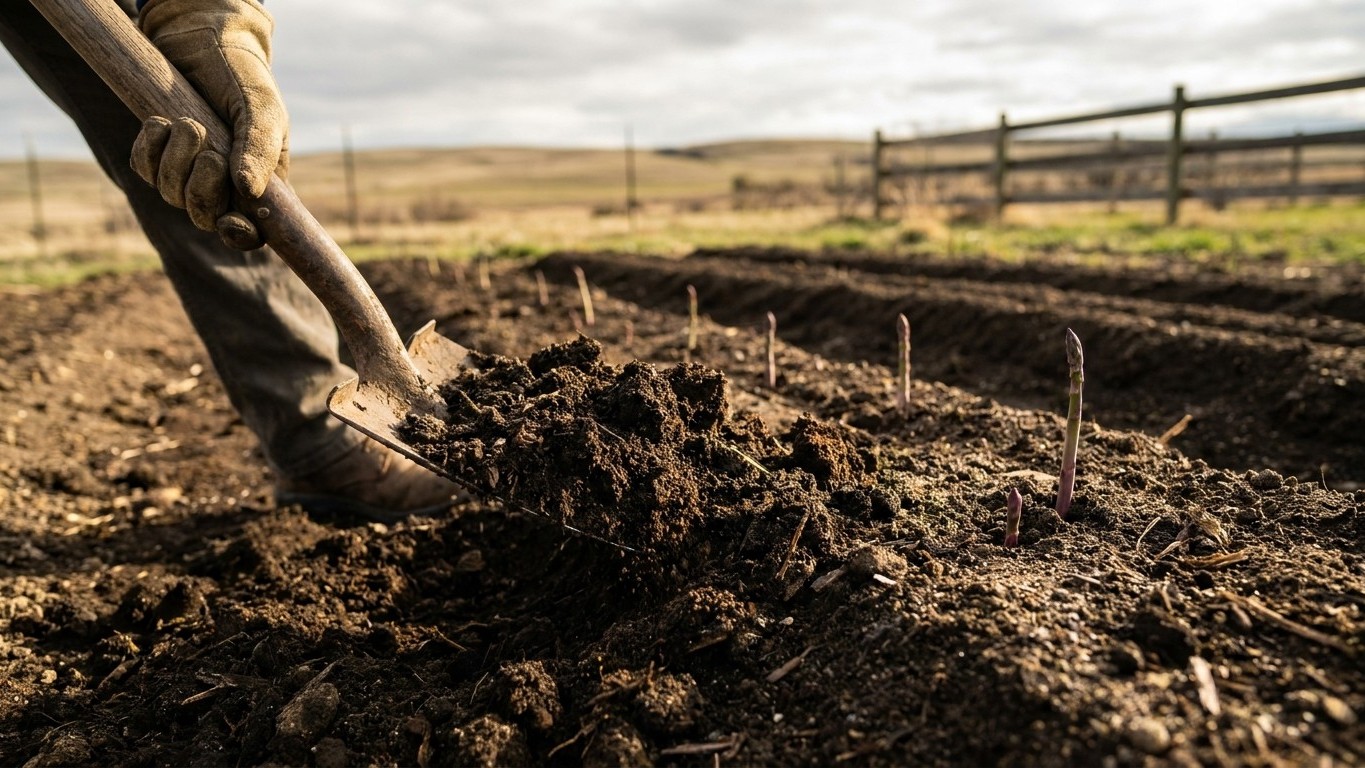

Ohio’s most common soil, the Miamian series, drains well enough for asparagus, which is the one soil trait this crop actually demands. A bed you plant this spring can still be feeding your kitchen in the 2040s, so the real question isn’t whether asparagus grows here. It’s whether the ground you’ve picked can carry a bed for 10 to 15 years without turning soggy.
The short answer
Asparagus doesn’t ask for a particular pH, a specific fertility level, or a certain texture. Utah State University Extension is blunt about it: most soils will do, as long as they drain. That single condition matters more here than it does for a tomato patch or a row of beans, because you’re not choosing this spot for one season. You’re choosing it for a decade and a half. A soggy patch that annoys you every spring with a lettuce crop is a minor headache. The same soggy patch under an asparagus bed raises a bigger question: Will Ohio Soil Hold an Asparagus Bed for Fifteen Years? It’s a mistake you live with until the bed finally gives out if the answer turns out to be no.
Ohio’s representative soil, the Miamian series, is a forest-derived Alfisol that USDA lists as the state’s benchmark soil. Its surface runs loam to silt, roughly 26 percent sand, 20 percent clay, and 53 percent silt, with organic matter around 2.0 percent and a surface pH near 6.5. The series is classified well drained. On paper, that’s a soil that lets water move through instead of sitting on top of the crowns, which is exactly what a 15-year planting needs.
Why the state soil isn’t your soil
None of that tells you what’s actually in your yard. Miamian is the soil USDA uses to represent Ohio broadly, not a survey of every backyard in the state. River bottoms hold water differently than upland fields. Ground near new construction is often compacted fill, nothing like the mapped series. If you dig a hole, fill it with water, and it’s still standing after an hour, that’s your answer regardless of what the state soil says. The fix isn’t to abandon the spot, it’s to raise it: a mounded bed or a framed raised bed lifts the crowns above the slow-draining layer, which solves the problem for the life of the planting rather than for one wet week.
The patience required matches the commitment, and it starts with getting the timing right in the first place—see When to Plant Asparagus Crowns in Ohio before you break ground. There’s no harvest at all in year one or year two. The first cutting comes in year three, and even then it’s brief, about four weeks. The following year stretches to roughly six weeks, and mature beds after that run about eight weeks of cutting. The stopping point isn’t a date on a calendar. You stop when most of the spears coming up are thinner than a pencil, which tells you the plant’s underground reserves need to rebuild for next year. Cut past that point and you’re spending down a bank account the bed needs for the following decade.
Will the summer here water it for you?
The bed’s water needs are specific: 1 to 2 inches every other week for its first two years while roots are establishing, then a lighter schedule of every three weeks once it’s mature. Ohio’s summer rainfall, by NOAA’s 1991-2020 normals for the region, runs about 12.7 inches across June, July, and August combined. Whether that covers the bed depends on when the rain falls and how your particular ground handles it.
- June averages 4.33 inches. Spread over four biweekly windows, that’s close to the 1-2 inch target for an establishing bed, assuming the rain arrives evenly rather than in one storm that runs off the surface.
- July averages 4.67 inches, the wettest month of the three. On paper this is the easiest month for a young bed to get by without supplemental watering, again with the caveat that a single downpour behaves very differently than steady rain on a well-drained soil versus a compacted one.
- August is the driest at 3.74 inches, and it’s also typically the hottest stretch of the growing season. This is the month a new bed is most likely to fall short of its biweekly 1-2 inches, and where a rain gauge on your own property, not a regional average, tells you whether to add water.
- Established beds, on the every-three-week schedule, have more slack built in and are less likely to need supplemental irrigation through a normal Ohio summer, though a stretch of 90-degree days will still pull moisture out of the soil faster than the calendar suggests.
None of these normals are a forecast for your yard. A slope, a nearby structure, or simply a summer that runs drier or wetter than the 1991-2020 average will change the math. A cheap rain gauge staked near the bed is the only tool that actually settles the question in real time.
When to put the crowns in
Crowns go into the ground in early spring, which in Ohio State University Extension’s gardening calendar lines up with the state’s last spring frost window, running around May 5 to May 15 depending on where you are (this puts most of the state in zone 6a). That’s a mean date, an average drawn from years of records, not a guarantee, so treat it as a target to plant around rather than a hard line to plant on. Waiting a few extra days after a mild early spring costs you nothing; planting two weeks ahead of a mean frost date is a gamble with young crowns that haven’t built any reserves yet.
The planting method itself is specific. Crowns go into furrows about 8 inches deep, then the furrow gets backfilled gradually rather than all at once, roughly 2 inches of soil added every other month across the season as the shoots grow up through it. That gradual fill protects the emerging spears while still letting the crown settle at the right depth by the time the furrow closes.
Crowns versus seed
Seed is the alternative route, typically started earlier indoors and moved out once the soil has warmed and frost risk has passed, giving the young plants a head start before they go into the garden. It’s a slower path to a producing bed than starting with a one-year-old crown, since you’re adding a full growing season of indoor and transplant time before the crown itself even goes into its permanent furrow.
On variety, Utah State University Extension names four: Jersey Giant and Jersey Knight, both all-male varieties, and UC 157 F1 and Purple Passion, both male and female. That’s where the published detail stops. No flavor comparison, no yield figures, and no stated reason to prefer one over another appear in that source, so pick based on availability rather than a ranking that doesn’t exist in the research record.
Checking this against your own county
State-level soil data and regional frost averages are a starting point, not a verdict on your particular quarter-acre. The most reliable next step is a soil test through your county office of Ohio State University Extension, reachable at extension.osu.edu. A test run through your local office will tell you your actual drainage behavior, your actual pH, and whether your county’s frost pattern runs earlier or later than the statewide range.
That local office is also the place to confirm anything this article leaves open, including questions the published research on asparagus simply doesn’t answer for a home garden, like chilling requirements or an exact pH target. Rather than guess at numbers that aren’t published, a call to the extension office serving your county turns a statewide average into a plan for the specific bed you’re about to commit fifteen years to.
Common questions
Does asparagus have a winter chilling requirement in Ohio?
That figure isn’t published in the source used for this article. Rather than guess at a number, treat it as an open question best directed to your county extension office.
What soil pH should I aim for?
The planting guidance used here is silent on pH. Ohio’s representative Miamian soil runs a surface pH near 6.5, but that’s a description of one mapped series, not a target for a cultivated bed, and a soil test is the only way to know your own number.
How do I know when to stop harvesting each year?
Not by counting weeks. Stop cutting when most of the spears coming up are noticeably thinner than a pencil. That’s the plant’s signal that it needs to stop feeding you and start rebuilding itself for next year.
Which variety should I choose, Jersey Knight or UC 157 F1?
The published research names four varieties by sex only, Jersey Giant and Jersey Knight as all-male, UC 157 F1 and Purple Passion as male and female, without ranking them on flavor or yield. There’s no documented reason to prefer one over another.