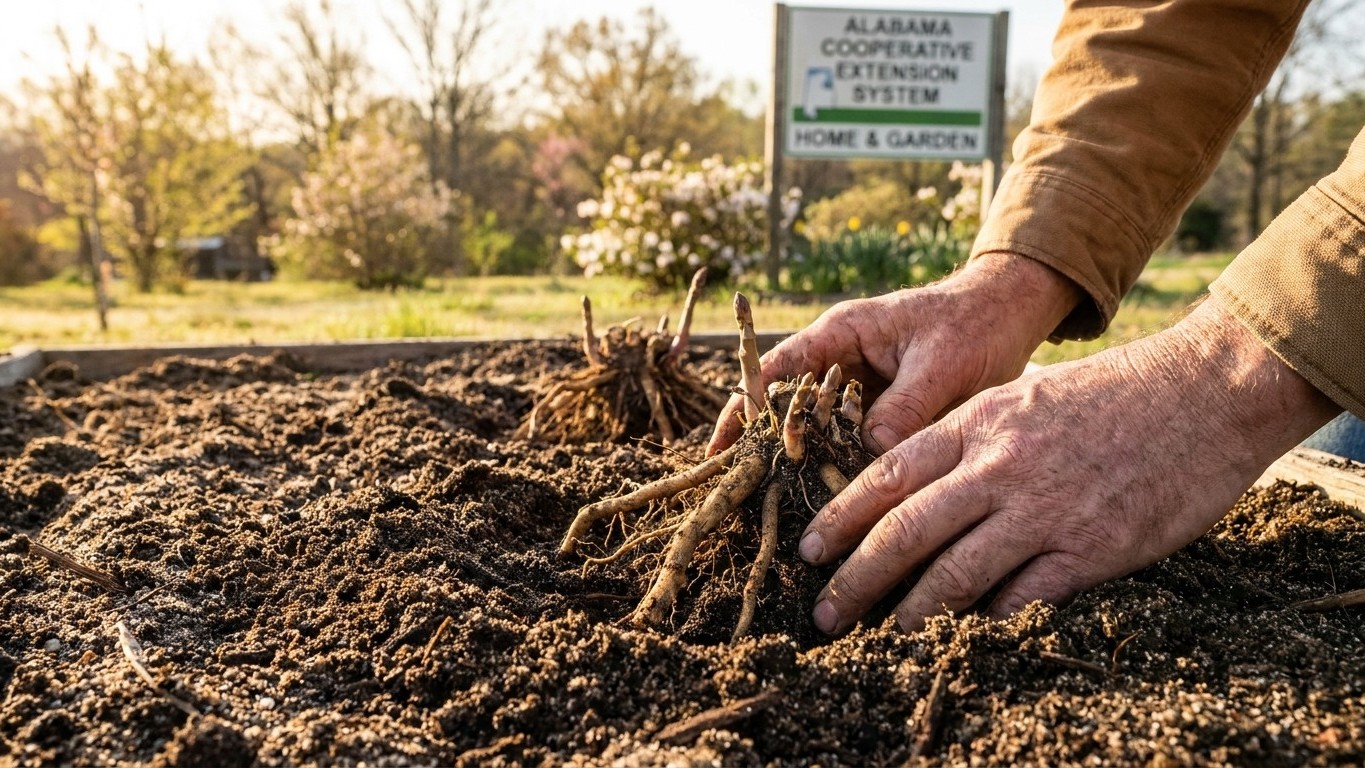

Early spring is the answer, and in Ohio that means working around the state’s last frost window, which lands somewhere between May 5 and May 15 in zone 6a. Crowns go into the ground while they’re still dormant, in the weeks leading up to that window, so roots get a head start before summer heat arrives. But before any digging happens, the ground itself decides whether that patch works for the next decade, not just for this planting season.
The short answer
An asparagus bed is not a single-season decision. Once crowns take hold, that stretch of ground works for 10 to 15 years, so the question that matters most isn’t really the calendar, it’s the dirt underneath it. The only real requirement Utah State University Extension lists for asparagus is that the soil drains. Everything else, from timing to variety, comes second to that.
Ohio’s representative soil, the Miamian series that USDA NRCS lists as the state soil, is described as well drained. It’s a forest-derived Alfisol, loam to silt in texture, running about 26 percent sand, 20 percent clay and 53 percent silt in its surface layer, with organic matter around 2.0 percent and surface pH near 6.5, slightly acid. On paper, that mix, moderate clay held together with a heavy dose of silt and sand, sheds excess water without drying out too fast between rains. For a crop staying put for over a decade, that’s close to the profile worth having.
The catch is that the Miamian series describes what’s typical across the state, not what’s under any one particular yard. A garden in a river bottom, a lot with heavy clay fill from construction, or ground that pools after every rain can sit right in the middle of Miamian territory and still behave nothing like it. If water stands in a test hole for more than a few hours after a heavy rain, that spot isn’t ready for asparagus as it currently sits.
When drainage is doubtful, the fix is to build up rather than dig deeper. Raised beds or mounded rows lift crowns above a stubborn water table entirely, and working coarse organic matter into a heavy patch helps break up compaction over time. What doesn’t work is planting crowns in a low spot and hoping for the best. Asparagus crowns rot in standing water, and because this bed isn’t dug up and replanted each year, a drainage mistake doesn’t show up as one bad season, it shows up as years of it.
Once the ground checks out, the commitment shifts to patience. Crowns planted this spring won’t be touched for harvest until year 3. After that, the season starts short: about 4 weeks of cutting, then 6, then 8 in the years after, with the stopping point tied to the spears themselves rather than a date on the wall, once most of what’s coming up is thinner than a pencil, cutting stops for the season. That schedule doesn’t change because the soil is good. It’s simply what the plant needs to build the root reserves that carry it through a decade or more of production.
Will the summer here water it for you?
For the first two growing seasons, an asparagus bed needs 1 to 2 inches of water every other week. After that establishment stretch, the schedule relaxes to roughly 1 to 2 inches every three weeks. Ohio’s summer rainfall numbers, on paper, come close to covering that, but the fit isn’t automatic.
- What summer actually delivers: NOAA’s 1991-2020 climate normals for the reference station put June rainfall at 4.33 inches, July at 4.67 inches, and August, the driest of the three, at 3.74 inches, for a summer total around 12.7 inches from June through August.
- Matching it to the every-other-week schedule: roughly 13 weeks run from early June through the end of August. At 1 to 2 inches every other week, a young bed’s demand over that stretch lands somewhere between about 6.5 and 13 inches. Ohio’s summer total falls inside that range, which sounds like good news on average.
- Why the average doesn’t settle it: rain in this region tends to arrive as thunderstorms rather than steady soakers, and a single 2-inch downpour running off a silt-heavy surface doesn’t soak in the way the same 2 inches spread over three slow days would. The Miamian soil’s silt-and-clay makeup holds moisture reasonably well once it’s in the ground, but getting it there in the first place depends on how the rain falls, not just how much falls.
- August is the gap month: at 3.74 inches, it’s the thinnest of the three, right when summer heat is pushing evaporation hardest. A bed still in its first two years is exactly the one that can’t coast through a dry stretch that month.
- Once established, the math gets easier: a bed past its second year only needs 1 to 2 inches every three weeks, a demand any single week of average Ohio summer rain can often cover on its own. That’s the point where the every-other-week worry mostly fades, unless a stretch runs unusually dry.
- The practical takeaway: treat the seasonal average as a rough guide, not a guarantee, and keep a rain gauge on the bed itself. In a normal June or July, supplemental watering may be light or unnecessary. In August, or during any week with no measurable rain, plan to add water rather than assume the sky will handle it.
When to put the crowns in
Crowns go into the ground in early spring, while they’re still dormant. In Ohio, that work centers on the state’s last spring frost window, which Ohio State University Extension places around May 5 to May 15 for zone 6a. That’s a mean date built from years of records, not a promise for any single spring, so treat it as the middle of a window rather than a line on the calendar. Growers commonly get crowns in the ground in the weeks leading into that stretch, so the young shoots that eventually emerge aren’t caught out by a late freeze while still tender.
The planting itself follows a simple furrow method: crowns go into trenches about 8 inches deep, roots fanned out, then covered. That cover isn’t added all at once. The furrow is backfilled gradually across the season, about 2 inches of soil every other month, rather than filled in completely on planting day. That staged approach lets emerging shoots keep pushing up through loose soil instead of forcing their way through a deep, compacted fill from the start.
Variety choice at this stage comes down to one distinction Utah State University Extension actually publishes: sex. Jersey Giant and Jersey Knight are all-male varieties, while UC 157 F1 and Purple Passion are male and female. Beyond that split, no flavor comparison, yield figure, or reason to favor one over another appears in that source, so any preference beyond male versus mixed planting isn’t something to lean on as settled fact.
Seed is the alternative route, and it exists, but it isn’t a shortcut. Starting from seed adds an entire extra growing season before plants reach crown size worth transplanting, on top of the three-year wait before any harvest begins once crowns are finally in the ground. For a bed meant to produce for 10 to 15 years, the seed route mostly appeals to gardeners chasing a specific variety unavailable as crowns, or those who simply prefer to grow the whole thing from scratch. For most Ohio gardeners working around that May frost window, crowns remain the more direct path.
Common questions
Can I plant asparagus crowns in Ohio before the last frost date?
Yes. Crowns are dormant when planted, so growers typically get them in the ground in the weeks leading up to Ohio’s last frost window, which runs around May 5 to May 15 in zone 6a, rather than waiting until after it passes.
How deep should the furrow be for asparagus crowns?
About 8 inches. The furrow is then backfilled gradually, roughly 2 inches of soil every other month across the season, rather than filled in all at once on planting day.
Does Ohio’s soil need amending before planting asparagus?
That depends on the individual garden, not the state as a whole. Ohio’s representative Miamian soil is described as well drained, but a specific yard, especially one on heavy fill or in a low spot, can differ. A drainage check, water standing in a test hole, is worth doing before crowns go in, since a raised bed is a straightforward fix for poor drainage while a sunken, waterlogged one is not.
When will I get my first asparagus harvest?
Not until year 3 after crowns are planted. Even then, the first harvest season runs only about 4 weeks, extending to about 6 the following year and about 8 after that, with cutting stopped each season once most spears coming up are thinner than a pencil.