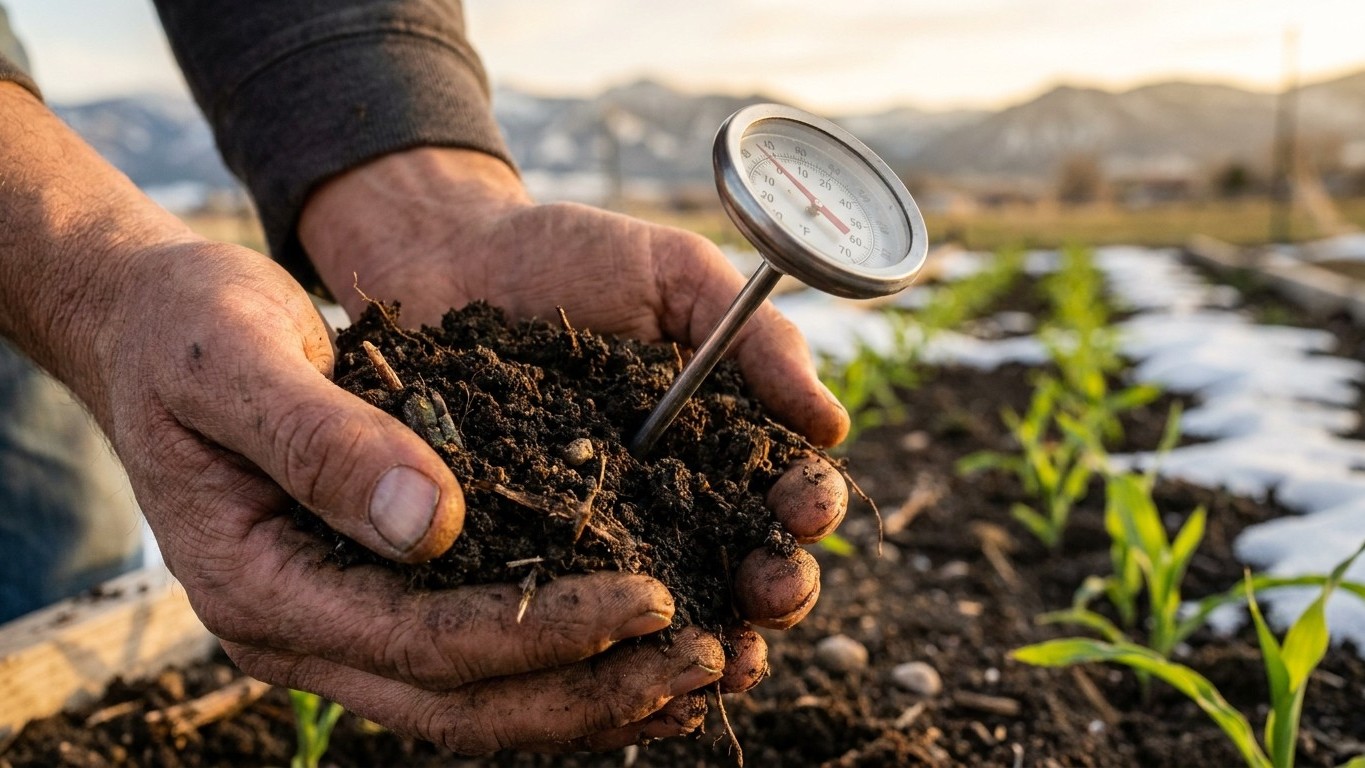

West of the Cascades, sweet corn ripens most seasons if the grower waits for the soil instead of the calendar. The last spring frost typically falls between March 6 and March 21, but the soil doesn’t reach the 60°F mark sweet corn actually needs until well after that date. Once it does, a 60- to 90-day variety has room to spare before the first fall frost, which arrives sometime between November 11 and November 27. East of the mountains, the math changes.
The short answer
The mistake most gardeners make is treating the last frost date as the planting date. It isn’t. Air temperature and soil temperature move on different schedules, and soil is slower. Sweet corn seed needs soil above 60°F to germinate reliably, and that threshold arrives weeks after the freeze risk has passed, not the same week. So the useful question isn’t “when is the last frost,” it’s “Will Sweet Corn Ripen in Oregon?” and the answer depends on when the ground actually warms up, which is later than most people plan for.
That gap matters because it eats into the growing window from the front end. Start with the frost-free interval west of the Cascades: from a last frost as early as March 6 to a first fall frost as late as November 27, that’s close to eight months. Even trimming several weeks off the start for soil to warm, there’s still a long stretch left, easily enough to fit the 60 to 90 days sweet corn needs from planting to harvest, which is exactly why knowing When to Sow Sweet Corn in Oregon matters more than fixating on the frost date alone. This is the reference station data for the Portland area, and it describes a mild, marine-influenced climate west of the mountains.
Summer heat load backs this up. The Portland-area reference station averages 11.9 days a year at or above 90°F. That’s a moderate number, not a desert number. It means enough warmth to push corn through its growth stages without the kind of relentless heat stress that stalls pollination in hotter interior climates, and without so little heat that plants sit stalled in cool soil for weeks. Sweet corn likes warmth, and west of the Cascades it usually gets enough, just not so much that watering becomes a daily battle.
None of this applies unchanged to the rest of the state. Central and eastern Oregon sit in high desert country, with a frost season shaped by elevation and continental air rather than by the Pacific. The frost-free window there runs shorter, sometimes considerably shorter, than the March-to-November stretch recorded west of the Cascades. A gardener in Bend or Burns working from the numbers above would be planning around a season that doesn’t exist where they live. The short answer, then, splits in two: yes, comfortably, west of the Cascades; check locally, and expect less room, east of them.
Does a late variety fit here?
A 60-day variety
A fast variety is the low-risk choice almost everywhere in Oregon. Once the soil clears 60°F, which happens well after the March 6 to March 21 frost window west of the Cascades, a 60-day corn only needs about two months to mature. Measured against a first fall frost landing between November 11 and November 27, that leaves a wide cushion even if the soil is slow to warm in a cool spring. This is the safer bet in any part of the state where the season runs short, because it asks the least of the calendar. If there’s real uncertainty about local timing, a shorter maturity length is the way to remove that uncertainty rather than argue with it.
A 90-day variety
West of the Cascades, a 90-day variety still fits. Even allowing for soil that takes several extra weeks after the last frost to reach planting temperature, there’s enough interval left before the November frost window to let a longer-season type finish. The margin is tighter than with a 60-day variety, and a late, cool spring narrows it further, but the season as a whole supports it in this part of the state.
That answer flips once the mountains are behind you. In central and eastern Oregon’s high desert, the frost-free window runs shorter than the one recorded west of the Cascades, and a 90-day corn is asking for more season than the calendar there reliably offers. Say it plainly: a late variety does not fit well in that part of the state, and pushing one anyway means racing a fall frost that can arrive before the ears finish. Growers in those counties are better served matching maturity length to their own local frost dates rather than to a coastal or valley timeline.
What goes wrong here
- Soil sown too cold. Planting on the frost date instead of the soil-temperature date is the most common failure. Seed sits in cold, wet ground, germination is slow and uneven, and some of it rots before it sprouts. The fix is simple: wait until the soil itself, not the air, has cleared 60°F before putting seed in the ground.
- A variety too late for the season. This shows up mainly outside the Cascades’ western side, where the frost-free stretch is shorter than the valley numbers suggest. A 90-day corn planted there can run out of season before the ears mature, caught by an early fall frost. The remedy is matching maturity length to the actual local window, which usually means choosing something at the shorter end.
- Sweetness lost to the wrong neighbor. This one has nothing to do with weather. Sweet corn types (the older su varieties, the sugary-enhanced se types, and the supersweet sh2 types) lose their sweetness and texture when two of them tassel and shed pollen at the same time nearby. It’s a pollination problem, not a climate problem, and it happens whether the season is long or short. The remedy is timing and separation of plantings so different types don’t tassel together, and planting each type in a block of three or more rows rather than a thin single line, which helps pollen land where it should instead of drifting in from elsewhere.
Checking this against your own county
The frost dates above come from a reference station in the Portland area, and they describe conditions west of the Cascades reasonably well. They don’t describe Bend, Burns, La Grande, or most of the rest of Oregon’s interior, where elevation and distance from the coast shift both the last spring frost and the first fall frost meaningfully. Before committing to a planting date or a variety’s maturity length, it’s worth checking local numbers rather than valley ones.
Oregon State University Extension (extension.oregonstate.edu) is the place to do that. County offices there track local frost history and can confirm how much season a given piece of land actually has, which is the detail that decides whether a 60-day or a 90-day variety makes sense on that specific ground.
Common questions
When should I plant sweet corn in Oregon?
Not on the last frost date. Plant once the soil itself has warmed above 60°F, which comes later than the frost-free date west of the Cascades. Testing the soil directly is more reliable than counting weeks from the frost calendar.
Can I grow a 90-day sweet corn in eastern Oregon?
It’s a tighter fit than in the valley. Central and eastern Oregon’s high desert has a shorter frost-free window than the western side of the state, and a 90-day variety can run out of season there. A shorter maturity length is the safer choice in that part of the state.
How far apart do different corn types need to be planted?
No specific distance is published for this. What matters is timing: su, se, and sh2 types lose sweetness when they tassel and shed pollen at the same time. Stagger plantings so tasseling doesn’t overlap, and grow each type in its own block of three or more rows.
How do I know sweet corn is ripe and ready to pick?
Look for three signs together, not one alone: the silks have turned dry and brown, the husk is still moist and green underneath, and a punctured kernel runs milky rather than clear or dry. All three at once mean it’s ready.