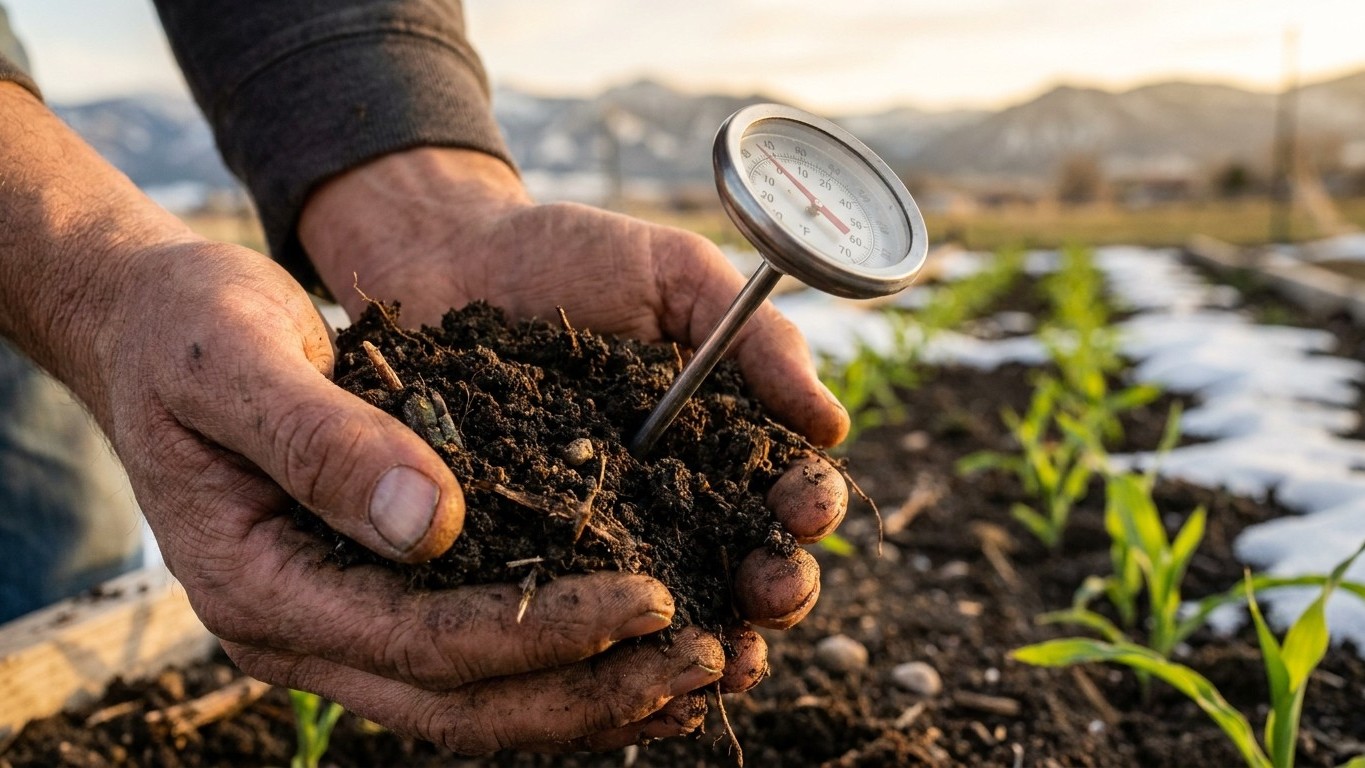

Sweet corn can ripen in Saskatchewan, but only the short end of the seed catalog has any real shot at it. The soil here needs to hold at 60 F before the seed will germinate reliably, and that threshold arrives well after the last frost has already passed. Once you plant, the crop still needs 60 to 90 days to mature, and that clock has to close out before the first fall frost shows up. The margin is thin, and a lot of it depends on which variety you pick.
The short answer
Start with the frost dates themselves, because they set the outer edges of everything else. At the Saskatoon SRC station, Environment and Climate Change Canada’s climate normals put the average last spring frost at May 18 and the average first fall frost at September 18. That’s a 123-day frost-free window on paper. But that number is a mean, not a guarantee, and a mean cuts both ways: in one year out of two, the last spring frost actually falls later than May 18, and the same logic applies to the fall date. Treat both figures as the midpoint of a range, not a date you can circle on the calendar and trust. For a closer look at how these dates translate into an actual planting window, see When to Sow Sweet Corn in Saskatchewan.
Now layer in the soil. Sweet corn seed doesn’t care what the air temperature says; it cares what the soil says, and soil warms slower than air, especially in spring when nights are still cold and the ground hasn’t caught up. That means the point at which the soil actually holds 60 F sits well after May 18, not on it. Planting into cooler soil doesn’t kill the crop outright, but it stalls germination, invites seed rot, and can push the whole season’s clock later than the calendar suggests it should be.
So the real planting window isn’t 123 days. It’s whatever is left after the soil catches up, and that gap eats directly into the 60-to-90-day maturity clock. If the soil doesn’t reach 60 F until some weeks after the frost-free date, the usable stretch before the September 18 average frost shrinks accordingly, and it shrinks faster the later the soil warms in a given year.
One thing works in the grower’s favor here: Saskatoon averages zero days a year at 90 F or above. That’s not a measure of how mild the average day feels, it’s a measure of extreme heat load, and sweet corn doesn’t need blistering heat to ripen. It needs consistent warmth over the length of the season, not spikes. The absence of hot days means there’s no heat stress to worry about, but it also means there’s no excess warmth banking extra growing degree days to bail out a late planting. The season has to be worked with, not overridden.
Does a late variety fit here?
A 60-day variety
A variety bred to mature in around 60 days from planting is the one that has real room to work in this territory. Even accounting for a soil-warmup delay that pushes planting into June, a 60-day crop still has a comfortable cushion before the September 18 average frost. If the soil warms on the later side of normal in a given year, the buffer narrows, but it doesn’t disappear. This is the length of season where Saskatchewan gardeners have the most margin for a year that runs cooler or later than average, and it’s the length where a delayed spring is least likely to wreck the harvest entirely.
A 90-day variety
A 90-day variety is a different story, and it needs to be said plainly: it does not fit safely here. Stack the soil-warmup delay on top of a 90-day maturity requirement and the math runs out of room fast. Even in a year where the fall frost holds off past its September 18 average, a 90-day crop planted after the soil has finally warmed is racing a clock with almost no slack left. In a year where the fall frost arrives earlier than average, which happens in roughly half of all years by definition of a mean, a 90-day variety simply doesn’t finish. The ears may fill partially, but full ripeness, the kind where the kernels have gone from watery to milky, is unlikely. This is the length of season to avoid, not adapt to.
What goes wrong here
- Soil sown too cold. Planting before the soil holds 60 F is the most common climate-driven failure in this region. The seed sits in cold, often wet ground, germination is slow or uneven, and some of it rots before it ever sprouts. The remedy is patience: wait for the soil itself to hold the threshold rather than planting off the calendar date, and check the ground with a soil thermometer rather than guessing from the air temperature.
- A variety too late for the season. A 90-day (or longer) variety planted here is betting on a fall frost that arrives later than the September 18 average, and on a spring that didn’t delay planting in the first place. That’s two bets stacked on top of each other, and the failure mode is a crop caught mid-ripening when the first hard cold hits. The remedy is choosing a shorter-season variety from the start, not hoping the season runs long.
- Sweetness lost to nearby tasselling, and this one has nothing to do with climate. Sweet corn types (su, se, and sh2) cross-pollinate if they tassel at the same time, and when that happens the sweetness of the sh2 and se types gets diluted toward the starchier su type. This is a timing and layout problem, not a weather problem. The remedy is to make sure different sweet corn types are not tasselling on the same days, and to plant sweet corn in blocks of three or more rows rather than a single thin row, since block planting improves how reliably the ears pollinate at all.
Checking this against your own county
Everything above is built on one reference station, Saskatoon SRC, and a province this size isn’t one climate. Northern districts and higher-elevation areas commonly run weeks behind what that single station shows for both the last spring frost and the first fall frost, which tightens the growing window even further than the numbers above suggest. Before committing to a variety or a planting date, it’s worth checking local conditions against Saskatchewan’s own agricultural resources through the Saskatchewan Ministry of Agriculture, which covers agribusiness and farmer and rancher resources specific to the province. A grower in a river valley near Saskatoon and a grower in a northern parkland district are not working with the same season, even though both are technically in the same province.
Common questions
How do I know when the ears are actually ripe?
Look for three signs together, not one alone: the silks have turned dry and brown, the husks are still moist and green, and puncturing a kernel releases milky juice rather than clear liquid. All three need to line up. Dry silks alone can mean the ear is overripe or underripe depending on the other two signs.
Is the 60-to-90-day figure the same as the harvest window?
No, and mixing them up is a common mistake. The 60-to-90-day figure counts from planting and tells you whether the variety fits the season at all. A separate window of roughly 17 to 24 days counts from silk emergence and tells you which week to actually pick. They answer different questions and shouldn’t be merged into one number.
Can I get around the slow soil warmup with raised beds or mulch?
Raised beds and dark mulch are common ways gardeners help soil warm faster in spring, since raised soil drains and heats quicker than flat ground. No specific soil-temperature gain from these methods is published in the source data for this article, so treat them as general practice rather than a guaranteed number of days saved.
Does zero days above 90 F mean the summer isn’t warm enough for corn?
Not by itself. That figure measures extreme heat stress days, not the overall warmth of the season. Sweet corn ripens on steady accumulated warmth over its maturity window, not on hot spikes, so the absence of 90 F days isn’t a strike against the crop. It does mean there’s no heat surplus to compensate for a late start, which is exactly why the length of the variety matters so much here.