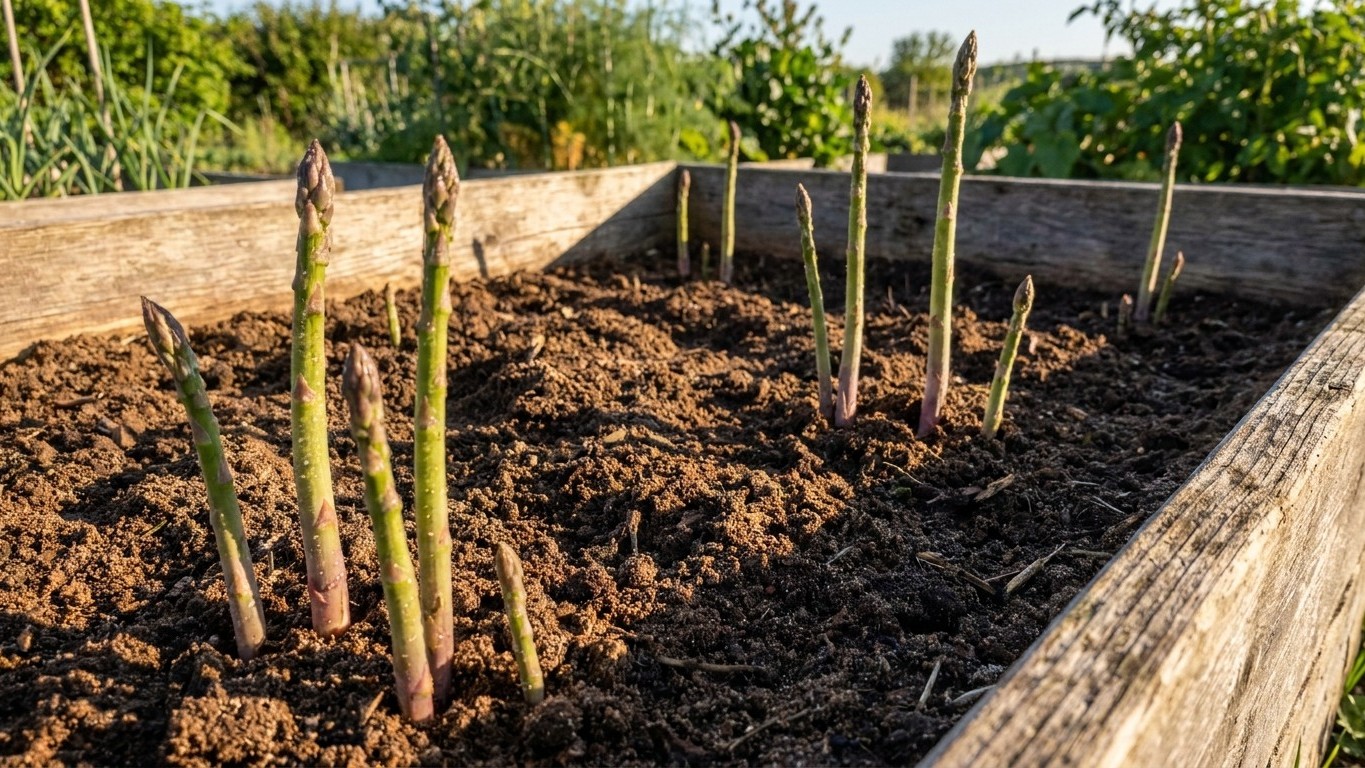

Alabama’s soil can carry an asparagus bed through its full 10- to 15-year run, but only if the ground drains. The state’s own representative soil, the Bama series, does drain well by nature. That’s a description of a mapped soil series, though, not a verdict on any one backyard. Standing water after a storm is the sign to fix before planting, not after.
The short answer
Alabama’s official state soil, named by state law in 1997 under the USDA NRCS State Soils programme, is the Bama series, classified as an Ultisol. That’s soil-science shorthand for old, heavily weathered, leached ground: centuries of rain have washed nutrients downward and left the surface naturally acid, with a representative pH around 5.3. USDA’s Soil Data Access records the surface horizon of the series (averaged across 103 mapped components) as 67 percent sand, 14 percent clay, and 19 percent silt, with organic matter around 0.8 percent. Put plainly, it’s a sandy, lean, acid soil. And critically for a bed that will sit in one spot for a decade and a half, it’s classed as well drained.
That single word, drained, is the only soil requirement Utah State University Extension attaches to asparagus. Its guidance is blunt: most soils will grow the crop, provided they drain. No pH target is published in that source, and no fertility threshold either. So the acidity and low organic matter of the Bama series aren’t disqualifying on their own. Drainage is the one variable that decides whether a bed thrives or slowly drowns its crowns.
What the state soil can and can’t tell a gardener
The Bama series is a statement about the state’s representative ground, not a soil test of any particular yard. A state spans hundreds of mapped series, and river-bottom clay, hill-country loam, or a lot a builder scraped and filled will all behave differently than the textbook profile above. Treat the Bama figures as a sketch of what the region’s soil tends toward: sandy, acid, and permeable, rather than a number to write down and build a bed around.
The practical move is a soil test through a local extension office, plus a simple field check: dig a hole about a foot deep, fill it with water, and see how long it takes to disappear. If it’s gone within a few hours, that spot can likely take fifteen years of asparagus. If water is still sitting there the next morning, the fix isn’t to skip asparagus. It’s to build a raised bed or mounded row, so the crowns sit above the water table rather than in it. Given how long this bed will occupy the same square footage, that’s a decision worth confirming with a shovel before it’s confirmed with fifteen years of crowns.
Will the summer here water it for you?
Asparagus during its first two years wants 1 to 2 inches of water every other week while the root system establishes. Once mature, that eases to roughly the same amount every three weeks. Alabama’s summer rainfall, drawn from NOAA’s 1991-2020 climate normals at reference station USW00003856, runs about 12.1 inches across June, July, and August combined, with June at 4.06 inches, July at 4.49 inches, and August, the driest of the three, at 3.55 inches.
- Do the early totals line up? Spread evenly, June and July’s totals come close to the 1-2 inch biweekly target a young bed needs, at least on paper.
- But rain rarely arrives evenly. Alabama’s summer rainfall tends to fall as thunderstorms, meaning a single 2-inch downpour can satisfy a month’s normal on the rain gauge while most of that water runs off a sloped bed rather than soaking into the root zone.
- Sand speeds the problem along. The Bama series is 67 percent sand at the surface, and sandy ground drains fast in both directions, it sheds standing water quickly, but it also lets rain pass through and out of reach of roots within a day or two.
- August is the gap month. At 3.55 inches, it’s the lowest of the three summer months, and it lands during the stretch when a mature bed’s root system is working hardest to store energy for the next spring’s spears.
- The working rule. Treat the monthly totals as a baseline that will fall short in most weeks, and keep a rain gauge on the actual bed. If a two-week stretch produces less than an inch of real, soaked-in rainfall, that’s the signal to run a hose or drip line rather than trust the sky.
When to put the crowns in
Crowns go into the ground in early spring, set into furrows about 8 inches deep. Around Alabama’s reference weather station, the last spring frost falls somewhere in the window of March 19 to April 3, based on NOAA’s 1991-2020 freeze-probability normals. That’s a mean, built from thirty years of data at one airport station, not a promise for any single spring or any particular county. Suburban and rural gardens, especially anything at higher elevation or away from the moderating effect of pavement and buildings, often see their own last frost run one to two weeks later than the station figure. Checking a local county extension date before setting crowns out is worth the five minutes it takes.
The furrow itself isn’t filled in one pass. Crowns are set at the bottom, covered lightly at first, and then backfilled gradually across the season, about 2 inches of soil added roughly every other month as the ferny top growth rises, rather than burying the whole 8 inches on planting day. That staged fill lets the emerging shoots push through without being smothered, and it’s part of why the first year looks like patience more than progress.
Patience, in fact, is most of what year one and two ask for. There’s no harvest at all during those first two seasons, full stop, regardless of how vigorous the fern growth looks. Cutting spears too early drains the reserves the crown needs to survive winter and come back stronger. The reward starts in year three, when a 4-week harvest window opens. That stretches to about 6 weeks in year four, and to roughly 8 weeks from year five onward once the crown system is fully established. The stopping point each season isn’t a date circled on a calendar. It’s a visual cue: when most of the spears coming up are thinner than a pencil, that’s the crown telling the gardener it needs to stop producing shoots and grow fern instead. Cutting past that point every year is the surest way to shorten a bed’s 10- to 15-year lifespan rather than extend it.
For gardeners who’d rather start from seed than buy crowns, Utah State University Extension lists that as the alternative route, though it adds a year or more before the first harvestable spears compared to starting with year-old crowns. On variety, the same source names four: Jersey Giant and Jersey Knight, both all-male hybrids, and UC 157 F1 and Purple Passion, which produce both male and female plants. No flavor comparison, yield figure, or preference between them is published in that source, only which produce male-only stands versus mixed. All-male varieties are generally chosen because female plants spend energy producing seed, but Extension’s own guidance stops short of ranking them, so that distinction is the extent of what’s documented here.
Common questions
Does Alabama’s soil need lime before planting asparagus?
The Bama series carries a naturally acid surface pH around 5.3, but Utah State University Extension’s guidance is silent on any pH requirement for asparagus. Without a published target, the honest answer is that a soil test is the only way to know whether a given garden needs amending, and no number here should substitute for that test.
Can a raised bed fix poor drainage in heavy Alabama clay?
Yes, that’s the standard workaround where the local ground doesn’t drain well: building the bed up above grade keeps crowns out of standing water even on soil that would otherwise hold moisture for days after rain.
How many years until an asparagus bed pays off the wait?
No harvest happens in years one and two. Year three allows about 4 weeks of cutting, year four about 6 weeks, and year five onward about 8 weeks each spring, for as long as 10 to 15 years total.
Is Alabama’s frost date the same statewide?
No. The March 19 to April 3 window comes from one reference weather station’s 30-year average. Elevation, local terrain, and distance from urban heat all shift the real date at any given address, often later by a week or two, which is why a county-level check matters before crowns go into the furrow.