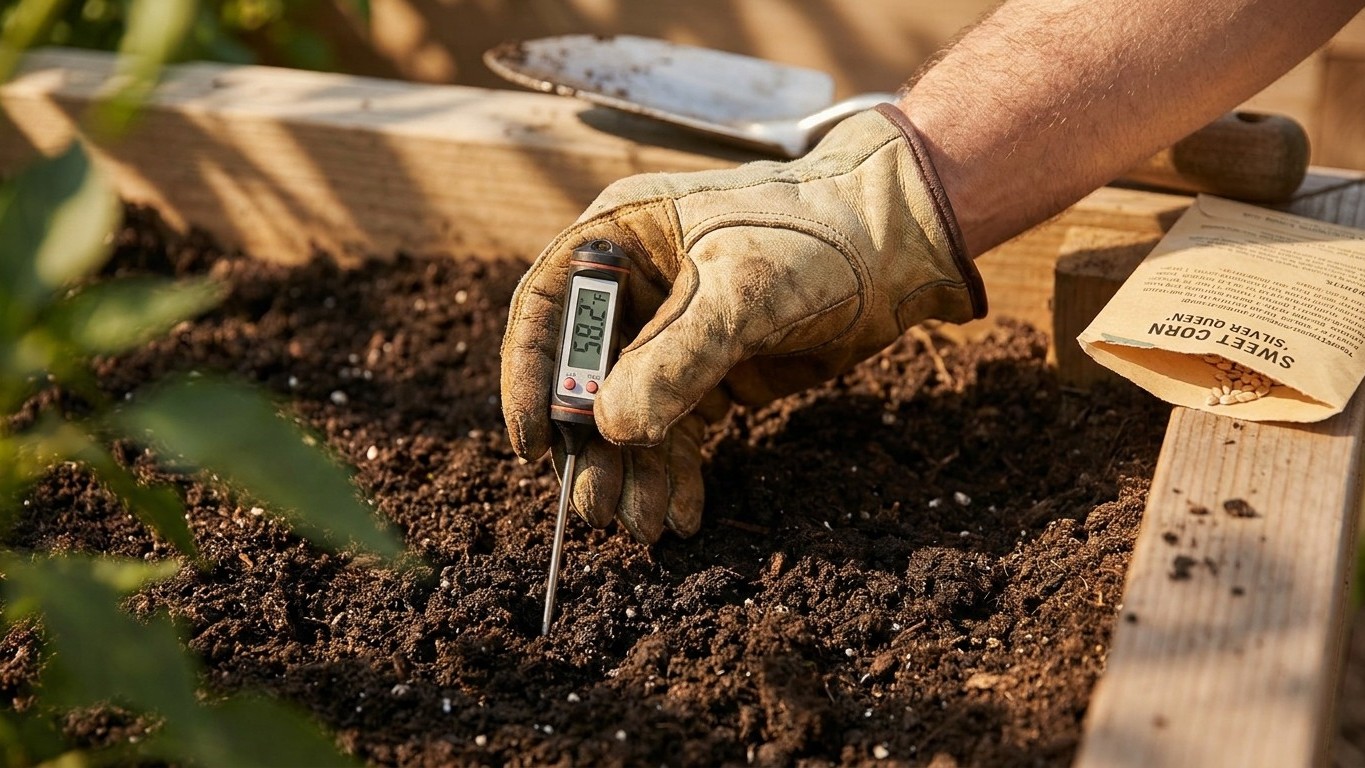

Sweet corn seed needs soil holding steady above 60°F, and in this part of Alabama that point typically arrives a few weeks after the last spring frost, not on the same day. Once the ground clears that mark, most sweet corn varieties, whether they mature in 60 days or 90, have more than enough runway before the first fall frost shows up in early-to-mid November.
The short answer
Soil doesn’t warm on the same schedule as the air. The last spring frost at the reference station (Huntsville International Airport, USW00003856) falls between March 19 and April 3, based on NOAA’s 1991-2020 climate normals. But frost-free air doesn’t mean planting-ready ground. Soil holds cold longer than the atmosphere above it, and sweet corn seed sitting in anything below 60°F tends to rot before it sprouts rather than push up a stalk. In practice, that 60°F threshold in this area usually isn’t reached until mid-to-late April, a good three to four weeks after that last frost date passes.
That gap matters more than most gardeners assume. Planting the day after the last frost, when soil is still in the low 50s, is one of the most common ways home gardens lose a sweet corn planting before it even breaks the surface. Patience here isn’t optional, it’s the difference between a stand that comes up even and one that comes up patchy, if it comes up at all.
Once the soil clears that mark, the math on the growing season gets generous. Sweet corn needs 60 to 90 days from planting to harvest, depending on the variety. The first fall frost at the reference station lands between November 2 and November 16. Counting forward from a mid-to-late April planting date, even a 90-day variety finishes well before August ends, leaving two full months of cushion before frost is even a possibility.
Home gardens complicate this slightly. Suburban and rural yards, especially those away from the heat sink of pavement and buildings that surrounds an airport weather station, tend to see their last frost land later and their first frost arrive earlier, often by a week or two, sometimes more at higher elevation. That shifts the safe window inward from both ends, but even with two weeks shaved off each side, the season here still runs from roughly early May to mid-October for practical planting purposes. That’s still 150-plus days, more than enough room for a full-season sweet corn crop and, for many gardeners, room for a second planting to stretch the harvest.
The takeaway for timing is straightforward: wait for warm soil, not just frost-free air, then plant. Checking soil temperature directly, rather than counting days on a calendar, is the more reliable move, since a cool, wet spring can push that 60°F mark later than usual even after the air has warmed.
Does a late variety fit here?
Given how wide this window runs, the more useful question isn’t whether corn will survive the season here, it’s whether a slower-maturing variety leaves enough margin for comfort, especially if a planting gets delayed by a wet week or a cool snap.
A 60-day variety
A variety that matures in 60 days planted in mid-to-late April is ready for harvest by late June. At that point, the first fall frost is still four months away. This is about as low-risk as sweet corn timing gets in this territory. It also opens the door to a second planting in early-to-mid summer, since there’s still comfortably enough season left to mature another round before frost, weather permitting.
A 90-day variety
A 90-day variety planted at the same mid-to-late April window matures around late July. That still leaves roughly three months of frost-free days in reserve before the earliest fall frost date of November 2. Unlike shorter-season regions of the country, where a slow variety can run out of season entirely, this window comfortably fits a 90-day type with room to spare. The one place to be careful is pushing a 90-day planting too late in summer. A planting made in early August, for instance, would be reaching for a harvest date in early November, right up against the earliest frost risk. That’s cutting it closer than it needs to be, given how much room exists earlier in the season. The late variety fits here. It just doesn’t need to be planted late to make use of that fit.
What goes wrong here
Most sweet corn failures in this climate trace back to one of three things, and only one of them has anything to do with weather.
- Soil sown too cold. Planting right after the last frost, before the ground has actually warmed past 60°F, is the single most common mistake. Seed sits in cool, often damp soil and rots before germinating, or comes up so unevenly that the stand never fills in properly. The remedy is simple patience: wait until soil temperature, not the calendar, confirms it’s warm enough, generally mid-to-late April in this area.
- A variety too late for the season. This is rare here given how long the frost-free stretch runs, but it still happens when a 90-day variety gets planted in late summer rather than spring, leaving too little buffer before the first fall frost between November 2 and 16. The fix is to count backward from that frost window before choosing a planting date, not just forward from the day seed goes in the ground.
- Sweetness lost to tasseling overlap. This one has nothing to do with soil temperature or frost dates. Sweet corn comes in different genetic types, standard (su), sugary enhanced (se), and supersweet (sh2), and according to Utah State University Extension, quality suffers when these types tassel at the same time nearby. Pollen drifting between types at that stage is what ruins flavor and texture, not the weather. The source gives no specific isolation distance to plant by, so the fix isn’t measured in feet, it’s measured in timing: stagger planting dates so different types don’t tassel together, or plant only one type per season if separating tassel timing isn’t practical. Sweet corn should also go in as blocks of three or more rows rather than a single long row, which is about pollination shape in the garden, not planting date.
Common questions
Can I plant sweet corn right after the last frost date in Alabama?
Not reliably. The last frost date only tells you when the air is likely safe. Soil in this area typically needs a few more weeks after that to hold steady above 60°F, and planting into cooler ground is one of the main reasons seed fails to germinate evenly.
How many sweet corn plantings can fit in one season here?
With soil warming by mid-to-late April and the first fall frost not arriving until November 2 to 16, there’s typically enough season for two, sometimes three, successive plantings of a 60-day variety, spaced a few weeks apart, for a stretched-out harvest rather than one large one.
Does the number of days above 90°F affect sweet corn here?
This area averages 58.5 days a year at or above 90°F, based on NOAA climate normals for the Huntsville reference station. That heat load raises water demand during the growing season, so consistent watering matters more here than in cooler climates, particularly as plants approach tasseling and ear fill.
Do different sweet corn types need to be kept apart by a set distance?
The published guidance from Utah State University Extension doesn’t specify a distance in feet or rows. What it does say is that su, se, and sh2 types lose sweetness if they tassel at the same time nearby. The practical fix is separating planting dates so tasseling doesn’t overlap, or sticking to one type per planting season.