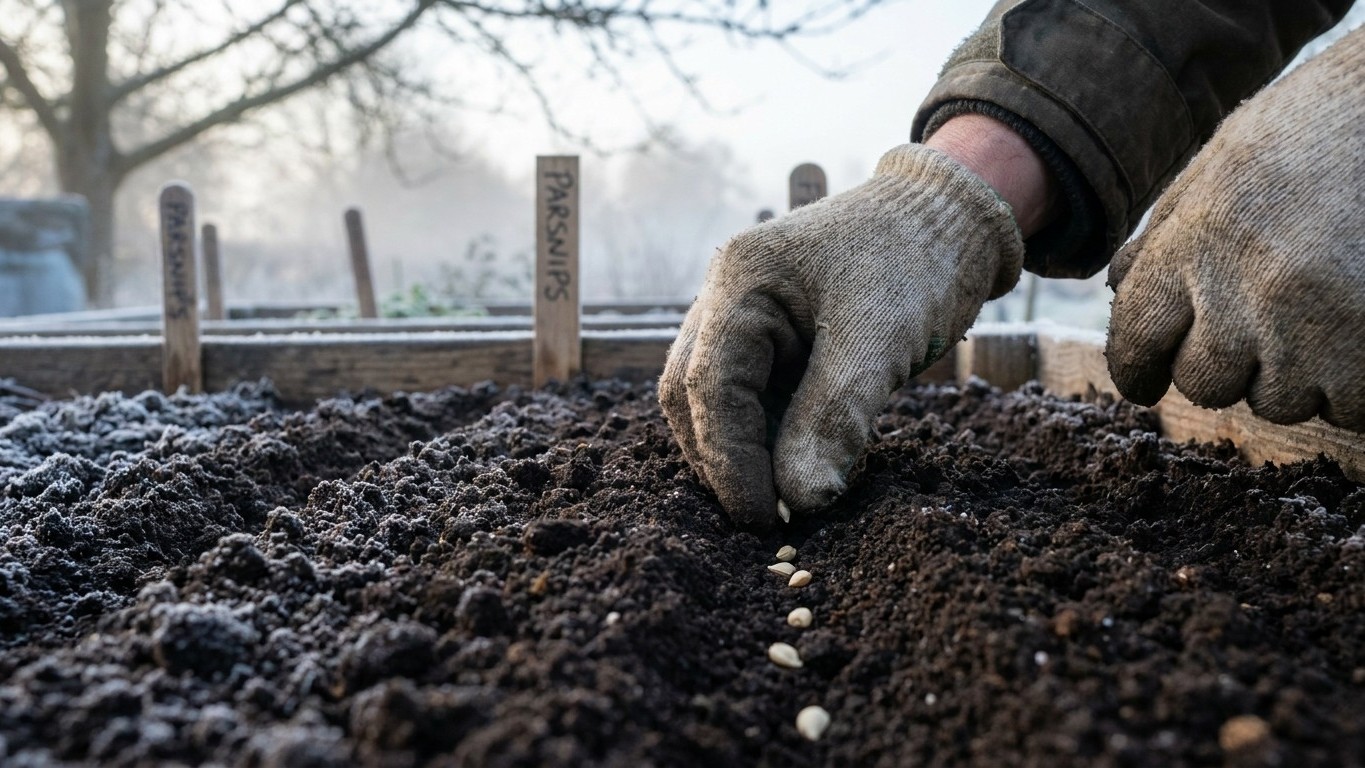

Sow parsnips in Manitoba between the first week of May and mid-May, aiming for 2-3 weeks before the average last spring frost of May 23. That places seeding around May 2 to May 9, giving the crop its full 100 to 120 days before the average first fall frost on September 22. Manitoba’s cold winters guarantee the frost exposure parsnips need to sweeten.
The short answer
Here’s the question that actually settles this, and it isn’t about which hardiness zone Manitoba falls into. It’s whether the territory delivers several weeks of hard frost each year, because that’s the mechanism that converts a parsnip’s stored starch into sugar. Manitoba answers that question loudly. The mean daily minimum temperature of the coldest month, drawn from Environment and Climate Change Canada’s Climate Normals for the reference station at Winnipeg, sits at -6.6°F. That’s not a record low or a one-off cold snap. It’s the average low across the entire coldest month, and it tells you that sub-freezing nights aren’t rare in this province, they’re the baseline.
That number matters for a specific reason. According to Utah State University Extension, parsnips taste best after several weeks of cool, frosty weather, because that exposure is what triggers the starch-to-sugar conversion in the root. Grow a parsnip in a climate that stays mild through fall and winter, and you’ll harvest something perfectly edible but bland, a root that grew fine but never sweetened. Manitoba doesn’t have that problem. With a coldest-month average minimum well below zero Fahrenheit, roots left in the ground into autumn and beyond get the sustained cold they need.
This is worth separating clearly from hardiness zone talk, because the two get confused constantly. A hardiness zone tells you the coldest temperature a perennial plant might survive over winter. It says nothing about whether a biennial root vegetable, harvested as an annual crop, gets enough frost exposure during its growing and curing period to sweeten. Manitoba could theoretically sit in a warmer zone and still fail to sweeten parsnips if its frosty stretch were short or mild. It doesn’t. The province’s frost season is long and its cold is genuine, which is exactly what this crop wants.
So the short answer: yes, sow here, and expect a parsnip that doesn’t just grow but sweetens properly, provided the roots stay in the ground through enough of that frosty stretch before harvest. The climate does its part. The timing of your sowing is what determines whether the plant has enough season left to reach a harvestable size before that cold arrives.
Does the season fit?
Parsnips are sown directly in place, not started indoors and transplanted, and the 100 to 120 days Utah State University Extension cites run from the moment seed goes into soil, not from germination. Here’s how that arithmetic plays out against Manitoba’s frost calendar.
- Set the sowing window. Two to three weeks before the average last spring frost of May 23 puts seeding at roughly May 2 to May 9. Parsnip seed tolerates cool soil, which is why it goes in early rather than waiting for frost-free ground.
- Account for slow germination first. Parsnip seed is notoriously slow to sprout, taking 14 to 21 days to emerge. That’s not part of the 100 to 120 day count toward maturity, but it does mean three weeks can pass with no visible sign of a crop. Don’t dig up the row or re-sow during that stretch; it’s simply how this seed behaves.
- Count forward to maturity. From a sowing around May 2, the 100-day mark lands near mid-August, and the 120-day mark lands near the end of August, close to September 1.
- Compare against the fall frost date. Manitoba’s average first fall frost is September 22. That gives roughly three weeks of buffer beyond even the 120-day maturity mark, before the season’s typical cold arrives.
- Verdict: the season fits comfortably. Even accounting for the slow start below ground, there’s margin between maturity and the average frost, and that margin is exactly what lets the roots then sit through the cooling weeks that follow and pick up sweetness before harvest.
The catch is the word “average” doing a lot of work in both frost dates. Environment and Climate Change Canada’s normals are mean dates, not guarantees, so in any given year the last spring frost can land later than May 23 and the first fall frost can arrive earlier than September 22. A gardener who sows right at the calculated window rather than a week or two ahead of it is trading away the buffer that makes this comfortable margin comfortable in the first place.
What goes wrong here
- Forked or twisted roots from heavy or stony ground. Parsnips push a long taproot straight down, and anything that deflects it, compacted clay, rocks, old root channels, splits it into forks. Utah State University Extension recommends deep, sandy soil for this reason, and where soil runs heavier, double digging the bed before sowing gives the root a clear path down instead of a maze of obstructions.
- Forked roots from overwatering, a separate cause entirely. Even in loose, workable soil, roots can fork if the ground stays saturated rather than evenly moist. This isn’t a soil texture problem, it’s a watering habit problem, and the fix is consistency rather than volume: water enough to keep the bed from drying out completely, without keeping it soggy for stretches at a time.
- A season that runs out before the roots size up. Sowing late, waiting until after the last frost date instead of the recommended 2-3 weeks ahead of it, eats directly into the buffer described above. In a year where spring frost lingers past its average date, a late-sown crop can find itself racing the calendar with the first fall frost close behind.
- A winter too mild to finish the job. This isn’t Manitoba’s problem given its cold, but it’s worth naming as the flip side of the whole equation: a parsnip pulled and eaten the moment it reaches size, without any exposure to the season’s cold snaps, misses the starch-to-sugar conversion entirely. In a province with a coldest-month average minimum near -6.6°F, leaving roots in the ground through some of that cold rather than rushing the harvest is what actually delivers on the crop’s reputation for sweetness.
Common questions
Can I sow parsnips earlier than the recommended window to get ahead of Manitoba’s short spring?
Parsnip seed tolerates cool soil, which is why the recommended window already sits 2-3 weeks ahead of the average last frost. Pushing much earlier than that risks seed sitting in cold, wet soil for even longer than the normal 14 to 21 day germination stretch, with no real gain in the season fit already described above.
How do I know if germination has failed versus it just being slow?
Utah State University Extension notes germination runs 14 to 21 days, so bare-looking soil at two weeks in is normal, not a failure. Wait out the full window before assuming a re-sow is needed.
Do parsnips need to be dug up before Manitoba’s first fall frost?
No, and leaving them in the ground into the cooler weeks after the average September 22 frost date is exactly what allows the starch-to-sugar conversion Utah State University Extension describes. The frost is part of the process, not a deadline to beat.
Is a fall harvest date fixed, or does it shift with the weather that year?
The September 22 figure is a mean date from Environment and Climate Change Canada, not a guaranteed cutoff. In roughly half of all years the first fall frost arrives later than that, and in the other half it can arrive earlier, so treat it as the midpoint of a window rather than a fixed marker on the calendar.