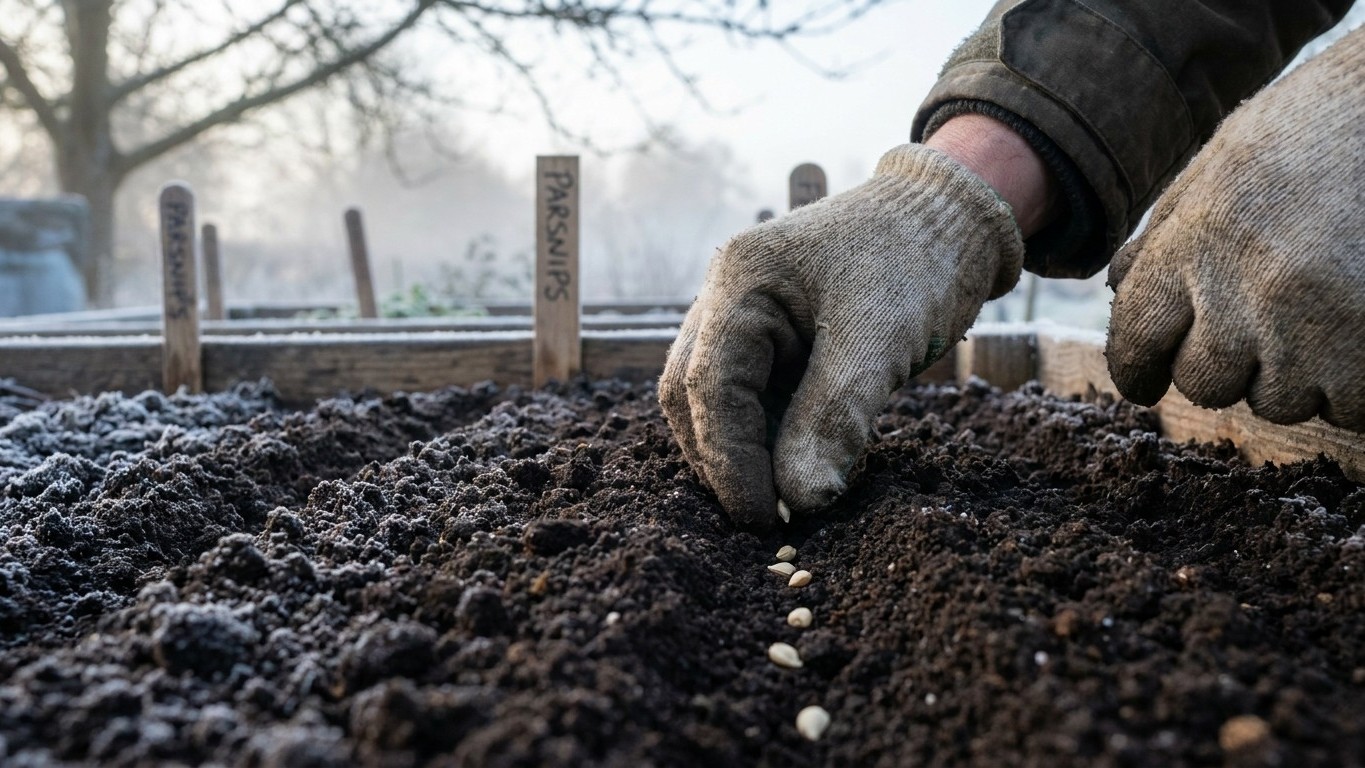

Sow parsnip seed directly in the garden bed, never as transplants, from mid-March into early April in most of Maryland, timing the sowing 2 to 3 weeks ahead of the last spring frost. Expect germination to take 14 to 21 days before any green shows. That patience matters more than the calendar date itself, and the payoff comes months later when frost turns the roots sweet instead of just starchy.
The short answer
Everything about whether a Maryland-grown parsnip turns out sweet or merely edible comes down to one figure: how cold the nights get during the coldest stretch of winter. At the Baltimore reference station, the mean daily minimum for the coldest month sits at 25.4°F. That’s not a record low and not a seasonal average. It’s the typical overnight low, night after night, during the harshest part of winter. And 25.4°F is well below freezing, repeated often enough to count as real, sustained cold exposure.
That number matters because parsnips don’t sweeten from being grown in a certain climate zone. They sweeten from actual exposure to frost. The starches stored in the root convert to sugars only after the plant has sat through several weeks of freezing or near-freezing nights. A garden where the coldest month averages a minimum in the mid-20s is a garden that delivers exactly that kind of repeated cold. So the answer for most of Maryland is straightforward: a parsnip grown here should not just survive, it should develop the flavor gardeners actually plant it for.
That said, this figure comes from one reference point, and Maryland’s geography stretches it in both directions. Western Maryland, up in Garrett and Allegany counties, sits at higher elevation and runs colder and later than the Baltimore-area numbers suggest, meaning frost exposure there is even more assured. The Eastern Shore runs milder, with the moderating effect of the Chesapeake Bay and Atlantic proximity softening the coldest nights. A gardener on the Eastern Shore working from the same sowing calendar may see fewer hard-freeze nights than someone in the Piedmont or the western counties, and that difference is worth factoring in before assuming every parsnip patch in the state gets identical treatment.
None of this means the Eastern Shore can’t grow a decent parsnip. It means the frost exposure there is thinner, and a gardener there benefits more than most from leaving the roots in the ground as long as possible once frost arrives, squeezing out every cold night available rather than harvesting at the first opportunity.
Does the season fit?
Parsnips need 100 to 120 days from the day the seed goes into the ground to reach harvestable size, and that clock only starts once seedlings are up and growing, not on the sowing date itself. Laying out Maryland’s frost calendar against that requirement shows how much room there actually is.
- Start with the sowing window. Two to three weeks before the last spring frost, which falls between April 3 and April 16 across most of the state, puts direct sowing somewhere between mid-March and the first days of April.
- Add the wait for germination. Parsnip seed is famously slow, taking 14 to 21 days to emerge. A mid-March sowing might not show visible seedlings until early April; a late-March sowing might not emerge until mid-April.
- Count forward the 100 to 120 growing days. From seedlings up in early-to-mid April, 100 to 120 days lands the crop at maturity somewhere in the range of late June to mid-July.
- Compare that to the first fall frost, which runs October 26 to November 5. The gap between a mid-summer maturity date and the first frost in late October or early November is roughly three to four months of open calendar.
- Read what that gap means. The crop isn’t racing the frost. It matures well ahead of it, and the weeks between maturity and first frost, then the weeks after first frost, become the window where the roots actually develop the sweetness the crop is grown for.
In practical terms, Maryland’s season doesn’t just fit a parsnip crop, it fits it comfortably, with enough slack that a late sowing in early April, or a slow germination stretching toward three weeks, still leaves plenty of time before the ground freezes hard. The real planning question in Maryland isn’t whether the season is long enough. It’s whether the gardener resists the urge to pull the roots too early, before they’ve had their frosty weeks.
What goes wrong here
- Forked or split roots in heavy or stony ground. Maryland’s clay-heavy Piedmont soils and rocky patches common across the Piedmont and western counties force a taproot to fork around obstructions instead of growing straight down. The remedy is double digging the bed before sowing, breaking up compacted layers to at least a foot or more, and clearing out stones so the root has a clear, loose path downward.
- Forked roots from overwatering, a separate cause entirely. Even in loose, well-prepared soil, keeping the bed consistently soggy encourages the root to branch rather than grow as a single long taproot. Water enough to keep germination moisture steady but let the soil dry slightly between waterings once seedlings are established.
- Giving up on germination too soon. Because parsnip seed takes 14 to 21 days to show any green, it’s common to assume the sowing failed and till the bed under, or sow a second round on top. That doubles the crop and wastes the first sowing. Mark the row clearly, keep the soil consistently moist, and wait out the full three weeks before deciding anything failed.
- Sowing so late the season runs out of comfortable room. Missing the mid-March to early-April window and sowing well into late spring compresses the gap between maturity and first frost. Given how much slack the Maryland calendar normally offers, this mostly matters for gardeners who sow unusually late; sticking to the standard window avoids the problem entirely.
- A crop that grows fine but never tastes sweet. This shows up most on the milder Eastern Shore, where frost exposure is real but thinner than inland Maryland. The fix isn’t the sowing date, it’s the harvest date: leave the roots in the ground through as many frosty nights as the fall and early winter allow, rather than harvesting on the first cool day.
Common questions
Can I start parsnip seeds indoors in Maryland and transplant them later?
Parsnips are sown directly in place. The 100 to 120 day maturity period runs from seeding in the garden bed itself, and the long taproot doesn’t handle transplanting well. Starting indoors and moving seedlings outside isn’t part of how this crop is grown.
How long can parsnips stay in the ground once frost arrives?
The published guidance is that flavor develops after several weeks of cool, frosty weather, since that exposure is what converts stored starch into sugar. Beyond noting that the window runs from the first fall frost (October 26 to November 5) onward, no specific end-of-harvest date is published here, so gardeners should watch the ground condition rather than a fixed calendar day.
Does Western Maryland need an earlier or later sowing date than the rest of the state?
Later. The mountainous counties of Garrett and Allegany run weeks behind the rest of the state on both the last spring frost and the first fall frost, so sowing there should shift later into spring than the mid-March to early-April window that fits the Baltimore-area reference dates.
What soil should I prepare for parsnips in Maryland?
Deep, sandy soil is what the crop prefers. Where Maryland ground runs heavy, as much of the Piedmont clay does, the bed needs double digging to loosen it well beyond a shallow tilled layer. That state soil description is a starting point for bed preparation, not a diagnosis of what any single yard actually has, so checking the bed’s texture before sowing is worth the extra few minutes.