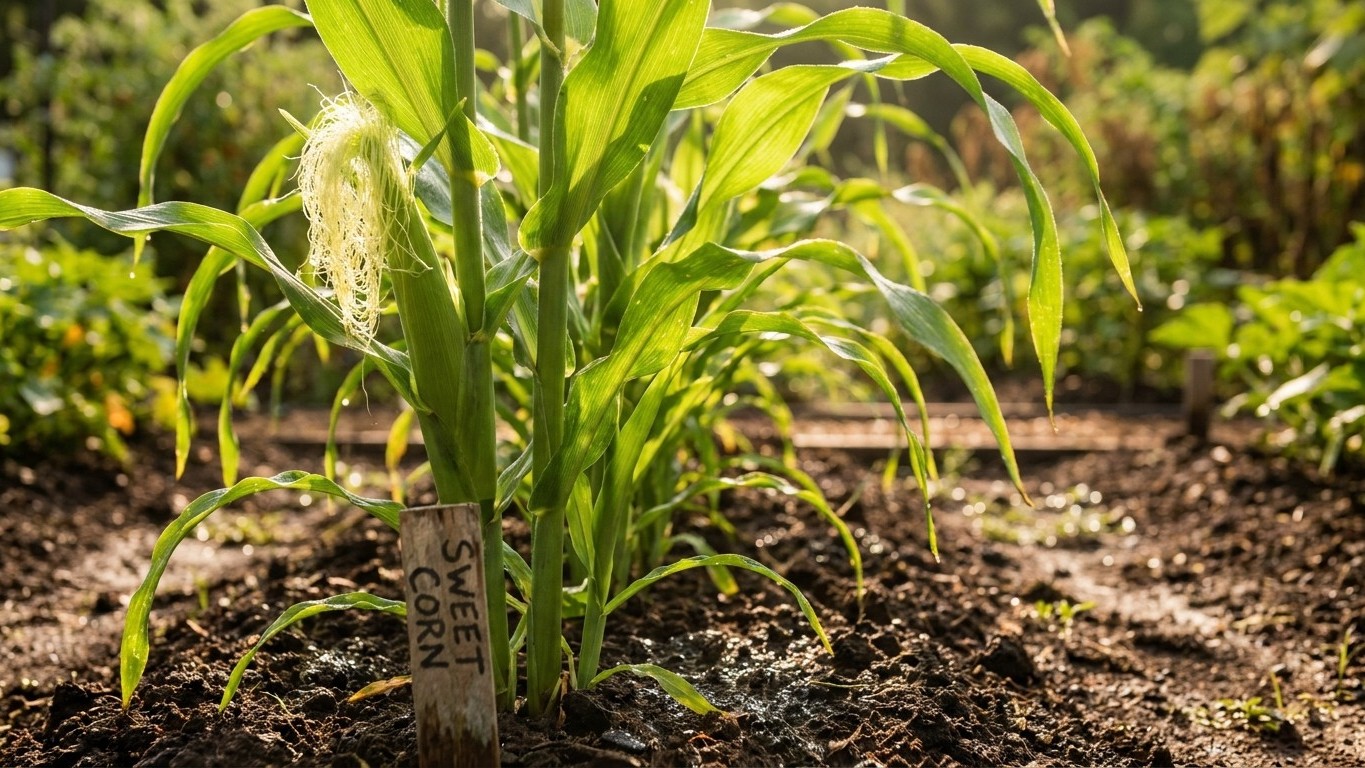

Yes, sweet corn ripens reliably across most of Alabama. The frost-free window here, roughly from the last spring freeze in late March or early April to the first fall freeze in early-to-mid November, gives standard 60- to 90-day corn far more room than it needs. The real question isn’t whether the season is long enough. It’s whether you plant by soil temperature instead of the calendar, and whether you keep different corn types from tasseling at the same time.
The short answer
Soil doesn’t warm up on the same day the frost stops. It lags behind air temperature, sometimes by several weeks, depending on rainfall, sun exposure and whether the bed is mulched or bare. Sweet corn needs soil above 60°F before the seed will germinate well, and according to Utah State University Extension, that threshold, not the frost date, is what actually starts the clock on the 60 to 90 days corn needs to mature.
At the Huntsville reference station, NOAA’s 1991-2020 Climate Normals put the last spring freeze between March 19 and April 3, and the first fall freeze between November 2 and November 16. Even using the most conservative pairing, an April 3 last frost and a November 2 first fall freeze, that’s roughly 213 frost-free days. Pair the earliest possible spring date with the latest fall date and the window stretches to about 242 days. Either way, it’s a long season by national standards.
Subtract a few extra weeks for the soil to climb past 60°F after the frost clears, and there’s still comfortably more than 180 days of growing time left before the first fall freeze arrives. A 90-day corn planted once the soil reads warm on a thermometer, not by guessing from the frost date, lands with weeks to spare. A 60-day type has even more cushion, enough for a second planting later in spring if you want a staggered harvest.
There’s a separate factor worth weighing alongside season length: heat load. The same Huntsville reference station averages 58.5 days a year at 90°F or hotter. That doesn’t shorten the season, but it does mean corn tasseling during the hottest stretch of summer can suffer poor pollen viability, leading to spotty ears even when the plant had plenty of time to mature. Season length and heat stress are two different problems, and Alabama gardeners deal mostly with the second one.
One caution applies to all of this. These dates come from an airport weather station. Gardens in the suburbs and out in the county typically see the last spring frost arrive later, and the first fall frost arrive earlier, often by one to two weeks, and more if the property sits at higher elevation. Treat the Huntsville figures as a reference point, then check your own county’s typical frost pattern before locking in a planting date.
Does a late variety fit here?
With a frost-free window running from roughly 213 to 242 days, both a quick 60-day corn and a longer 90-day type have room to work with here. That’s not true everywhere in the country, which is why this question matters more in some climates than others. In Alabama, the constraint isn’t the calendar running out. It’s heat during pollination and getting the soil temperature right at planting.
A 60-day variety
A 60-day sweet corn fits this window with margin to spare, even accounting for a delayed planting date while you wait for soil to clear 60°F. That margin is useful for a second reason beyond just safety: it lets you stagger plantings two or three weeks apart, so you’re not harvesting everything at once, and so you can potentially time an early planting to tassel before the hottest weeks arrive, when heat stress on pollen is worse. A 60-day type planted once soil is reliably warm will mature well before the November frost window opens at the reference station, and the buffer only grows if your county’s actual first fall frost runs later than Huntsville’s average.
A 90-day one
Unlike shorter-season climates where a 90-day corn can bump right up against the first frost, Alabama’s long season gives it room to spare. Even factoring in a planting delay while the soil warms past 60°F, 90 days later still lands well ahead of the November 2 to November 16 freeze window. Say it plainly: the late variety does fit here. The tradeoff is timing tasseling. Planted too late in spring, a 90-day type may end up silking during the peak of summer, right when the region averages the bulk of its 58.5 annual days above 90°F, and that heat can thin out kernel set even though the plant has plenty of season left to finish.
What goes wrong here
Most sweet corn problems in Alabama gardens trace back to one of three causes, and only one of them has anything to do with climate.
- Soil sown too cold. Planting by the last-frost date instead of soil temperature is the most common mistake. Seed sitting in soil below 60°F germinates unevenly, rots, or gets picked off by soil pests before it ever sprouts. The fix is simple: use a soil thermometer at planting depth, and wait for a consistent reading above 60°F rather than trusting the calendar.
- A variety too late for the season. The season here is long enough for a 90-day corn, but pushing the planting date too far into early summer erases that buffer. Planted late, a 90-day type can tassel during the hottest stretch of the year, and in a rural spot where the first fall frost may arrive earlier than the Huntsville reference dates suggest, the safety margin shrinks further. Plant 90-day types as soon as soil is reliably warm in spring, not later in the season, to keep that cushion intact.
- Sweetness lost to timing, not climate. This one has nothing to do with frost dates or heat. Su, se and sh2 sweet corn types lose their sweetness when they tassel at the same time nearby, because cross-pollination between types changes the kernel starch content. The source gives no isolation distance to plant by, so the fix isn’t measured in feet. It’s measured in timing: stagger planting dates so different types don’t tassel together, and grow each type in its own block of three or more rows rather than a single thin row, so pollen from the right plants dominates.
Common questions
Can I plant sweet corn twice in one season in Alabama? Yes. With a frost-free window of roughly 213 to 242 days at the reference station, there’s enough room for a first planting of a 60-day type followed by a second planting a few weeks later, as long as soil stays above 60°F for the second round too.
What happens if I plant sweet corn too early? Seed sown before the soil clears 60°F germinates poorly or rots outright. The last frost date passing doesn’t mean the soil is ready; check it directly with a thermometer instead of planting on the frost date itself.
Does summer heat actually hurt sweet corn in Alabama? It can. The reference station averages 58.5 days a year at 90°F or above, and pollen viability drops in extreme heat. Corn that tassels during that stretch can end up with poorly filled ears even though the plant had plenty of season to mature.
How do I know if two corn varieties will cross-pollinate? The concern isn’t distance, it’s timing. If su, se or sh2 types are tasseling at the same time nearby, pollen can cross and dull the sweetness of the harvest. Staggering planting dates so tasseling windows don’t overlap addresses this directly.