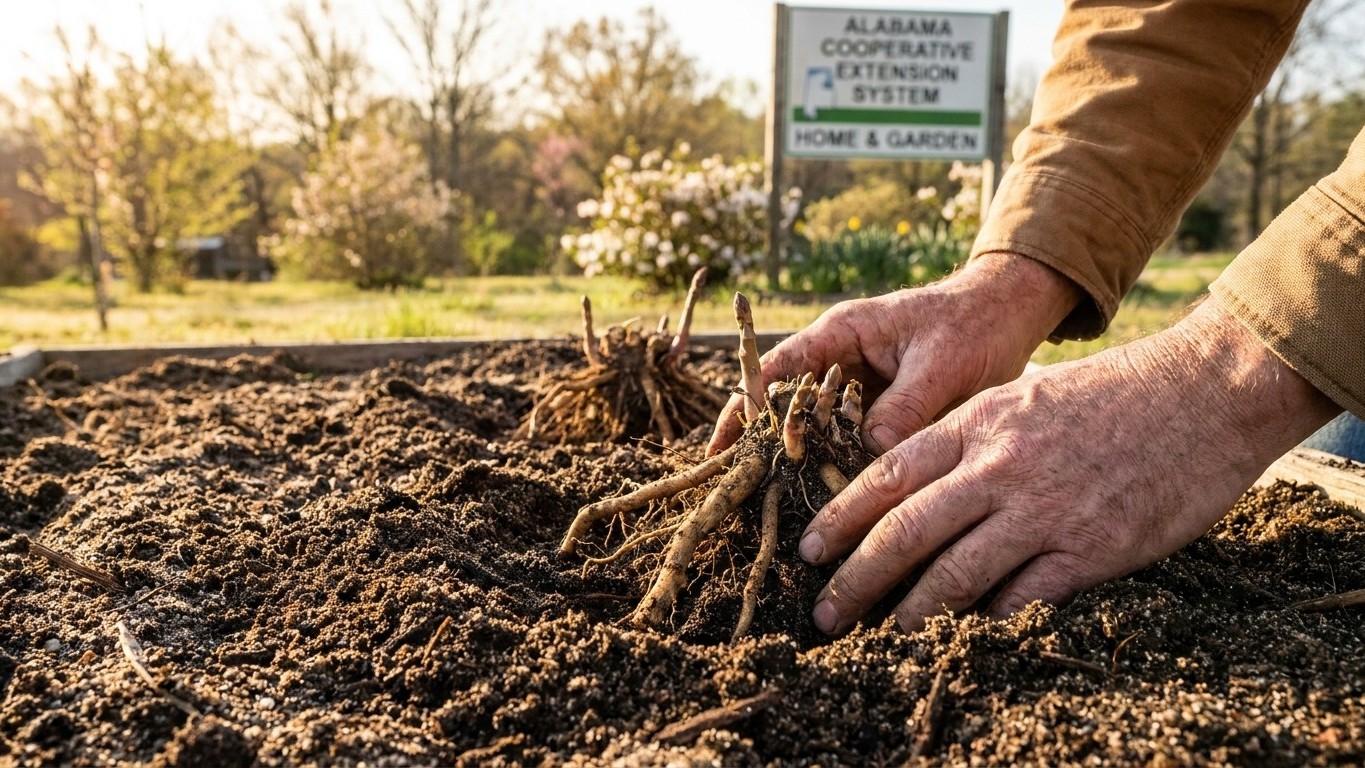

Plant Asparagus Crowns in Alaska in early spring, once the ground has thawed and can be worked, which lines up with the region’s frost window in the first half of May. That single planting decision then locks in a bed that will occupy the same patch of soil for 10 to 15 years, so the timing question is really two questions: when the ground is ready, and whether the ground itself is the right kind of ground at all.
The short answer
Ten to fifteen years is a long commitment for a vegetable bed, and Utah State University Extension’s guidance on asparagus is blunt about what matters most for that stretch of time: the soil has to drain. Not “should drain well” as a nice-to-have, but drain, full stop, because a crown sitting in standing water for a decade and a half doesn’t get a do-over the way a row of lettuce does.
That makes Alaska’s representative soil worth a hard look before anyone digs a furrow. USDA’s soil survey data lists the Tanana series as the state’s representative soil, and it’s a Gelisol, meaning permafrost sits within reach of the profile. The surface horizon runs strongly acid, with a pH around 4.7, and texturally it’s a loam-to-silt mix: roughly 63 percent silt, 30 percent sand, and 7 percent clay. Organic matter in that surface layer averages about 90 percent, which points to a natural peat, muck, or forest-litter layer rather than a worked garden bed. And the series is classified, in USDA’s own terms, as poorly drained.
None of that is a verdict on any one backyard. The Tanana series is what USDA uses to represent Alaska broadly, not a survey of every plot in it. A garden dug into a river terrace, a hillside clearing, or fill soil brought in during construction can behave nothing like the mapped series, and permafrost depth in particular varies enormously across the state depending on drainage, vegetation cover, and how much the ground has been disturbed. The only way to know what’s actually under a given asparagus bed is a soil test pulled from that specific spot, not a state-level average.
Still, “poorly drained” and “permafrost-influenced” are two words that should make any gardener planning a 10-to-15-year bed pause. If a test or simple observation (water pooling for hours after rain, for instance) confirms the ground drains slowly, the fix isn’t to force asparagus into it anyway. Raised beds solve most of the problem outright, since they let a gardener build a rooting zone above the native soil using a mix that actually moves water through. Where permafrost sits close to the surface, raised beds also keep the crown’s root zone above the coldest, wettest layer rather than fighting it. Amending native soil with coarse organic matter can help at the margins, but for a bed meant to outlast a decade of winters, building up rather than digging down is usually the more reliable route.
Will the summer here water it for you?
Utah State’s guidance gives a specific watering rhythm for a new asparagus bed: 1 to 2 inches of water every other week for the first two growing seasons, easing to every three weeks once the planting is established. That’s a demand schedule, and the next question is how much of it Alaska’s own summer rainfall covers before a hose gets involved.
- NOAA’s 1991-2020 climate normals for the reference station put summer rainfall (June, July, and August combined) at about 5.8 inches. Spread over three months, that’s already short of what a two-year-old bed would need if it fell in the recommended every-other-week rhythm.
- The shortfall isn’t even across the summer. June is the driest month by far, averaging just 1.02 inches, compared with 1.82 inches in July and 2.93 inches in August. That means the earliest weeks after planting (the exact stretch when a young crown is trying to establish roots) fall in the driest part of the season.
- For the first two years, when the bed wants 1 to 2 inches every other week, June rainfall alone covers only a fraction of one cycle. A gardener relying purely on natural rainfall through June would need to supplement with irrigation almost every cycle that month, tapering off slightly as July and August bring more rain.
- Once the bed matures and the watering target eases to every three weeks, August’s higher rainfall (2.93 inches) does more of the work on its own, though it still won’t reliably deliver a full 1-to-2-inch dose precisely on a three-week schedule every time.
- None of these are guarantees for a specific yard. The normals describe what the reference station has recorded on average over three decades, not a forecast and not a measurement of rainfall on a particular lot, which can run drier or wetter depending on local terrain and exposure. A rain gauge staked next to the actual bed is the only way to know, in a given year, whether supplemental watering is needed that week or not.
When to put the crowns in
Utah State University Extension’s timing guidance for asparagus is simple: crowns go into 8-inch furrows in early spring. In Alaska, “early spring” has to be read against the region’s actual frost calendar rather than a generic calendar date, because ground that’s still locked up doesn’t take a furrow no matter what the season says.
NOAA’s 1991-2020 climate normals put the last spring frost for the reference station around May 3 to May 12. That’s a probability band, not a single guaranteed date, so treat it as the window when the odds of another freeze drop off rather than a hard line the calendar promises to respect. Planting crowns as that window closes, once the soil has thawed enough to dig a clean 8-inch furrow, matches the “early spring” instruction about as closely as the region allows. Pushing much earlier risks setting crowns into soil that’s still cold and slow to release them into growth; waiting much past that window shortens an already tight growing season further.
It’s worth remembering this frost window describes the reference station’s conditions, and Alaska’s interior and northern regions run considerably shorter and colder seasons than the milder coastal areas the station represents. A gardener working land well outside that reference area should treat May 3 to May 12 as a rough anchor point, not a transferable date, and adjust based on when their own ground actually thaws and dries enough to work.
Seed is the other route into asparagus, and it exists as an alternative to crowns for gardeners who want to start earlier or grow their own stock rather than buy transplants. But the source’s specific planting instructions here concern crowns going into furrows in early spring, and it doesn’t lay out a parallel seed-starting calendar for Alaska’s frost dates. Anyone choosing that path is working from general seed-starting practice rather than the crown-specific timing detailed above, and should expect an even longer wait before the bed produces anything, since seed-grown plants typically need extra time to reach crown size before the standard multi-year establishment clock even starts.
Common questions
When can I first harvest asparagus after planting crowns in Alaska?
Not until year 3. Utah State University Extension’s guidance is explicit that asparagus isn’t harvested at all in the first two years after planting. In year 3, harvest runs about 4 weeks; the following year, about 6 weeks; after that, up to 8 weeks. The stopping point each season isn’t a date on the calendar but a condition in the bed: harvest stops once most of the spears coming up are running thinner than a pencil, which signals the plant’s energy reserves for that cycle are spent.
Do I fill in the planting furrow all at once?
No. The furrow is backfilled gradually over the course of the season rather than in one pass, with about 2 inches of soil added back roughly every other month as the crown grows. Filling it in all at once defeats the purpose of the deep furrow, which is to let the crown’s shoots grow upward through loose soil rather than pushing through compacted ground.
Which asparagus varieties are recommended specifically for Alaska?
None are singled out for the state in the sourced guidance. Utah State University Extension names four varieties, distinguished only by their flowering type: Jersey Giant and Jersey Knight are all-male varieties, while UC 157 F1 and Purple Passion are male/female. No flavor comparison, yield figures, or regional preference between them is published, so choosing among them comes down to availability rather than any documented performance edge for Alaska conditions.
Does asparagus need a certain amount of winter chill to grow well in Alaska?
That figure isn’t published in the sourced guidance, and it shouldn’t be assumed from Alaska’s cold winters or hardiness zone alone. The source covers soil drainage, watering, planting depth, and harvest timing, but it’s silent on any chilling requirement, so treat that as an open question rather than a settled number.