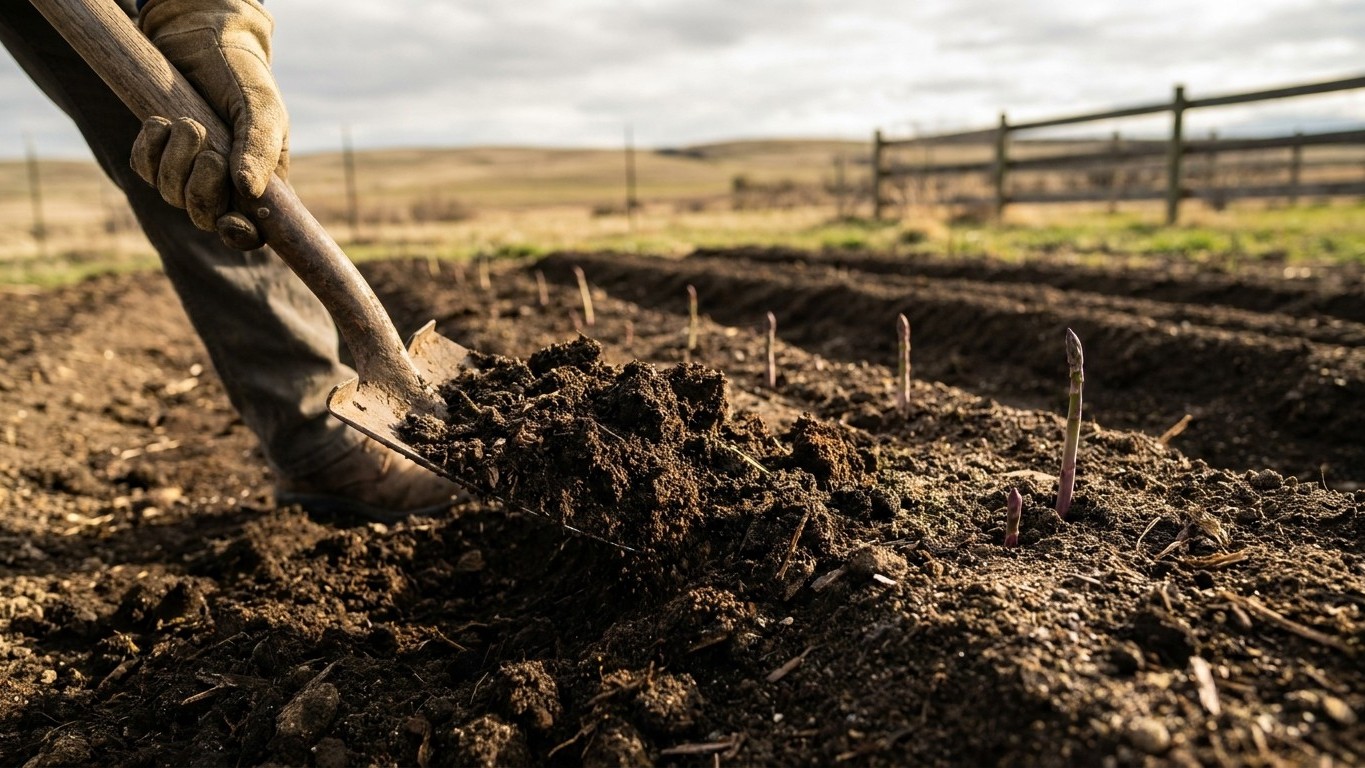

Yes, asparagus can be grown in Alaska, but the state’s representative soil is poorly drained, and that single fact matters more than climate ever will. A bed you plant this spring is a bed you’ll still be harvesting in a decade and a half, so before anything about frost dates or watering schedules, the ground itself has to pass one test: does it drain.
The short answer
Start with what the crop demands. Asparagus crowns go into the ground once, and the resulting bed produces for 10 to 15 years afterward, according to Utah State University Extension. There’s no yearly do-over, no rotating to a fresh bed the way you might with tomatoes or lettuce. You pick a spot, and that spot is committed for the length of a mortgage refinance cycle, which raises the question Will Alaska Soil Hold an Asparagus Bed for Fifteen Years? The source is direct about what that spot needs: most soils will work, provided they are well drained. That’s the whole requirement. Not a specific pH, not a particular texture, just drainage.
Alaska’s representative soil, the Tanana series, doesn’t clear that bar on its own. It’s classified as a Gelisol, meaning permafrost sits within reach of the soil profile, and USDA NRCS records it as poorly drained. The surface horizon runs strongly acid, with a pH around 4.7, and it’s a loam-to-silt mix, roughly 63 percent silt, 30 percent sand, and 7 percent clay. Organic matter measures near 90 percent at the surface, which points to a natural peat, muck, or forest-litter layer rather than a worked garden bed. None of that is friendly to a plant that needs water to move through and away from its roots.
Here’s the catch worth sitting with: the Tanana series is what USDA lists as representative of Alaska soils broadly. It is not a verdict on any one backyard. A garden built on a river terrace, a hillside, or land a builder graded and filled years ago can behave completely differently from the mapped norm. Permafrost proximity also varies enormously across the state, and a yard in a milder coastal pocket may sit nowhere near frozen ground at all.
What a gardener does if the native soil doesn’t drain: build up rather than dig down. A raised bed, even a modest 10 to 12 inches of imported, well-draining loam sitting above the native ground, sidesteps the permafrost-and-poor-drainage problem entirely. Mounding the planting area a few inches above grade helps too, since asparagus crowns rot in standing water faster than almost anything else in the vegetable garden. Before committing a fifteen-year decision to any single square of ground, a basic soil test, run through a local lab, tells you what the mapped series can only suggest, and it’s worth pairing that test with a look at When to Plant Asparagus Crowns in Alaska so the drainage work and the planting window line up.
Will the summer here water it for you?
The bed has a watering rhythm of its own, and it doesn’t match what Alaska’s summer sky typically provides. Utah State University Extension lays out the schedule: 1 to 2 inches of water every other week for the first two years while the crowns establish, then a lighter 1 to 2 inches every three weeks once the bed matures. Here’s how that stacks up against what actually falls from June through August, based on NOAA’s 1991-2020 normals for the reference station:
- June delivers about 1.02 inches, the driest month of the growing season, and well short of the 1-2 inches the bed wants every two weeks during establishment.
- July brings roughly 1.82 inches, closer to what a mature bed needs on its three-week cycle, but still light for a bed still in its first two years.
- August is the wettest of the three at about 2.93 inches, which can cover a mature bed’s needs for the month but may still fall short during establishment years when the schedule calls for water every two weeks rather than every three.
Add the three months together and summer totals about 5.8 inches, against 16.4 inches for the year, meaning the bulk of Alaska’s moisture falls outside the growing season entirely. For a first- or second-year bed, that means supplemental watering isn’t optional; June alone falls well under half of what a two-week cycle would require. A mature bed on its three-week schedule sits in better shape, especially in wetter August, but June still leaves a gap most years.
None of this accounts for soil texture, which changes everything. The Tanana series’ poor drainage means water that does fall, or that a gardener adds, may sit longer in the root zone rather than passing through, which cuts both ways: it stretches irrigation further, but raises rot risk if a raised bed hasn’t fixed the drainage problem. A rain gauge on the actual plot, not just the seasonal average, is what tells a gardener whether the hose needs to come out.
When to put the crowns in
Crowns go into 8-inch furrows in early spring, and in Alaska, “early spring” has to be measured against a frost record that’s later than almost anywhere else in the Lower 48. NOAA’s 1991-2020 normals put the average last spring freeze, the point where 32F frost probability drops into the 30 to 70 percent range, somewhere around May 3 to May 12 at the reference station. That’s a mean, not a promise, so treat it as the center of a range rather than a hard switch that flips on a calendar date.
That timing pushes planting later than gardeners in milder states are used to. Furrows opened and crowns set in around that early-May window give the plant a fighting chance against a late cold snap, though a gardener working colder ground farther from the coast, or at higher elevation, should expect the safe window to land later still. The source is silent on how many degrees of frost the young growth can tolerate once it emerges, so erring toward the later end of “around” early May costs little and protects a bed you’re committing to for over a decade.
Backfilling the furrow isn’t a one-time job either. The trench gets filled in gradually, roughly two inches every other month across the season, rather than buried all at once at planting time. That staged approach lets the crown’s growing tip stay just ahead of the soil line as it pushes upward, instead of getting smothered under a full 8 inches on day one.
Seed is the alternative starting method to crowns, for gardeners who’d rather grow their own rather than buy established roots. The source doesn’t detail a seed-specific calendar or germination window, so beyond noting it exists as an option, there’s nothing published here to specify timing for that route. What is published: four named varieties differ only by their flower sex. Jersey Giant and Jersey Knight are all-male; UC 157 F1 and Purple Passion are male/female. Utah State University Extension publishes no flavor, yield, or preference guidance among them, so choosing between them isn’t a question this source answers.
Checking this against your own county
Everything above comes from a statewide soil series and a single reference weather station, and Alaska is too large and too varied for either to stand in for one specific yard. A garden in a river valley, on a south-facing slope, or in a milder coastal community can differ sharply from both the Tanana series and the frost dates cited here.
The University of Alaska Fairbanks Cooperative Extension Service is the named authority for confirming any of this locally. Reach them. A soil test through their program, or a conversation about frost timing specific to your borough, turns a statewide average into an actual answer for the ground you’re about to commit for fifteen years.
Common questions
Can asparagus survive Alaska’s permafrost soils?
The representative Tanana series has permafrost within reach of the soil profile and is classified poorly drained, which works against a crop that needs well-drained ground. Raised beds built above native soil are the practical workaround, since they let a gardener control drainage without relying on the native profile.
Should I test my soil’s pH before planting?
The Utah State University Extension source used here says nothing about a target pH for asparagus, so no specific number is published to aim for. What is documented is that the state’s representative soil runs strongly acid, around 4.7, which is worth knowing even without a stated target, and a local soil test is the way to find out what your own bed measures.
How many years before I get my first asparagus harvest?
None until year three. The bed needs two full seasons to establish before any spears are cut, and the source is specific that harvest doesn’t begin before that third year.
How do I know When to Stop Cutting spears each season?
Stop when most of the spears coming up are thinner than a pencil. That’s a physical signal from the plant, not a date on the calendar, and it applies every year of the bed’s 10 to 15 year life, not just the first harvest season.