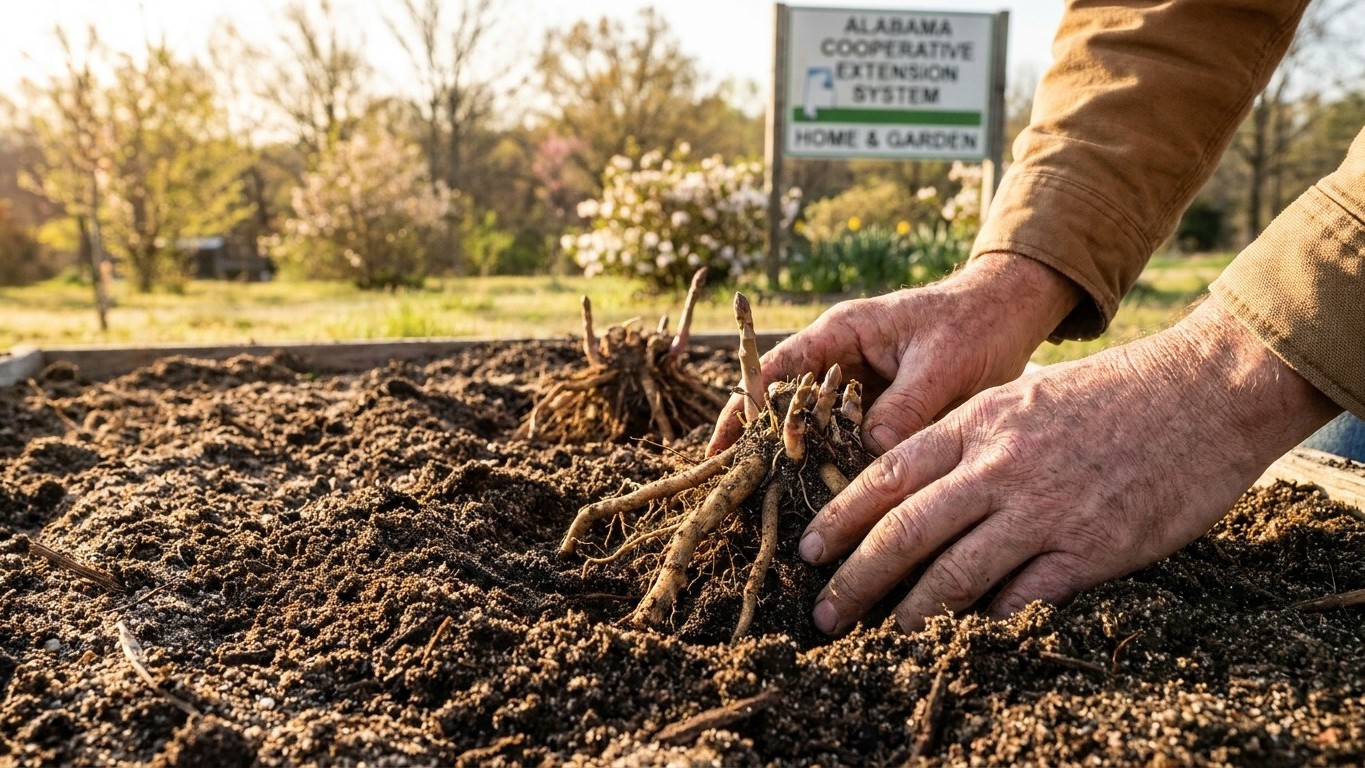

Plant Asparagus Crowns in Arkansas in early spring, once the soil has warmed and the last hard frost has likely passed. That single planting decision then locks in a bed that will occupy the same ground for a decade or more, which makes the timing question only half the story. The other half is whether the spot chosen can support that commitment at all.
The short answer
Asparagus is a crop you plant once and harvest for years. A well-tended bed produces for 10 to 15 years, and the only soil requirement that matters to establish one is drainage. Not fertility, not a particular texture, not a specific pH. Just: water has to move through it and not sit.
Arkansas’s official state soil, the Stuttgart series, gives a useful starting picture of what much of the region’s ground actually does. It’s an Alfisol, a forest-derived soil of moderate fertility that holds nutrients reasonably well, running loam to silt (about 30 percent sand, 16 percent clay, 54 percent silt), with a surface pH around 5.6 and organic matter near 1.8 percent. The detail that matters most here: it’s classified as somewhat poorly drained. That’s not disqualifying for most garden crops, but it’s a caution flag for a plant that will occupy the same spot for well over a decade without a second chance to move it.
If a plot tends toward heavy, slow-draining ground, the fix isn’t complicated but it isn’t optional either. Building a raised bed or mounding the row six to eight inches above grade gives water somewhere to go besides sitting around the crowns. Working in organic matter before planting loosens a silty, compacted surface. And any gardener unsure which side of the fence their own dirt falls on should run a simple percolation test, or send a sample out for a real soil test, before committing a bed to fifteen years of asparagus. The state soil describes a representative average across the region, not the particular six-by-twenty-foot patch behind one house.
The long game this crop asks for
Patience is baked into the plant. There’s no harvest at all in year one or two while the crowns build root reserves. The first cutting comes in year three, and it lasts four weeks. The following year stretches to six weeks. Once the bed matures, eight weeks becomes the ceiling for a healthy stand. The signal to stop cutting for the season isn’t a date circled on a calendar: it’s when most of the spears coming up run thinner than a pencil. At that point, the rule is to let them go, let them fern out, and let the plant rebuild for next year.
Variety choice is simpler than it looks, mostly because the published information is limited to one detail: sex. Beyond that, no flavor comparison, yield figure, or regional preference is documented.
| Variety | Type |
|---|---|
| Jersey Giant | All-male |
| Jersey Knight | All-male |
| UC 157 F1 | Male/female |
| Purple Passion | Male/female |
Will the summer here water it for you?
an Asparagus Bed has a clear watering rhythm for its first two years: 1 to 2 inches of water every other week while the crowns are establishing. After that, the demand eases to roughly the same amount every three weeks. The question for anyone planting in Arkansas is how much of that job the sky handles on its own.
- What the region typically delivers. Summer rainfall across June, July, and August averages about 10.0 inches total, out of roughly 50.4 inches for the year. Spread evenly, that’s close to the 1-to-2-inch-per-two-weeks target the bed wants during its establishment years.
- But rainfall isn’t spread evenly. June averages 3.55 inches and July 3.33 inches, both reasonably close to what a two-week cycle needs when it lands as steady rain rather than one storm.
- August is the gap month. It’s the driest of the three at 3.16 inches for the entire month, which works out to well under the every-other-week target once that total is spread across four biweekly stretches. A bed in its first two summers is likely running short right when heat stress is highest.
- Thunderstorm rain runs off more than it soaks in. A normal-looking monthly total built from one or two heavy downpours doesn’t behave like the same total delivered as gentle, regular rain. Much of it sheds off the surface, especially on a silty soil that’s already slow to drain.
- The practical move. Keep a rain gauge on the actual bed, not a general assumption from the regional average, and plan to supplement with a hose or drip line whenever two weeks pass without close to an inch and a half falling naturally, particularly through August.
- Once the bed is mature (year three onward), the every-three-weeks rhythm is easier for a normal Arkansas summer to cover, but the same August dry stretch is still the one to watch.
When to put the crowns in
Crowns go into the ground in early spring, planted into furrows about 8 inches deep. For most of Arkansas, that window opens around the last spring frost, which for the region falls somewhere between March 12 and March 28, going by 1991-2020 climate normals from the closest reference weather station. That’s an average across three decades of data, not a guarantee for any single spring, so treat it as a planning target rather than a fixed date to circle.
There’s a second, tighter frost threshold worth knowing about if a gardener is also nursing along more tender seedlings in the same bed area. NWS Little Rock puts the light-frost date, the 36F mark rather than the harder 32F freeze, at around April 3. Asparagus crowns themselves are hardy enough that the earlier window generally works fine, but that April date is the one to lean on for anything genuinely tender started nearby.
Once the crowns are in the furrow, resist the urge to bury them completely on day one. The furrow gets backfilled gradually across the year, adding about two inches of soil every other month rather than filling it in all at once. That staged approach lets the emerging spears push through loose soil rather than fighting their way up through a deep, compacted layer from the start.
Crowns aren’t the only route in. Asparagus can also be started from seed, though that path begins well ahead of the crown-planting window, with seedlings raised and grown on before they’re mature enough to move into the garden. It’s a slower way to reach the same three-year wait for a first harvest, and most home gardeners in Arkansas find crowns the more direct route to a producing bed. Whichever start is chosen, the site decision that goes with it, drainage above all, is the one that can’t be undone once the bed is established.
Common questions
Can asparagus crowns go in the fall instead of spring? The planting guidance behind this article covers spring planting into furrows once the ground has warmed past the last frost window. Fall planting isn’t addressed in that guidance, so this article can’t confirm it as a reliable alternative for Arkansas.
What if a soil test comes back with a low pH? The source used for this article doesn’t specify a target pH for asparagus, and the state soil’s own pH (around 5.6) is a regional average, not a garden-specific reading. A soil test result for the actual bed site is the number to act on, not a regional figure.
Does a raised bed solve a poorly drained yard for good? Raising the bed or mounding the row lifts the crowns above standing water, which addresses the main risk on heavier, slower-draining ground. It doesn’t change the underlying soil, so drainage should still be checked periodically as the bed matures over its 10-to-15-year life.
Is winter cold a factor in when to plant? Winter chilling requirements for asparagus aren’t addressed in the source behind this article, and no chilling figure should be inferred from Arkansas’s hardiness zone. Timing here is driven by spring frost dates and soil warmth, not a winter chilling threshold.