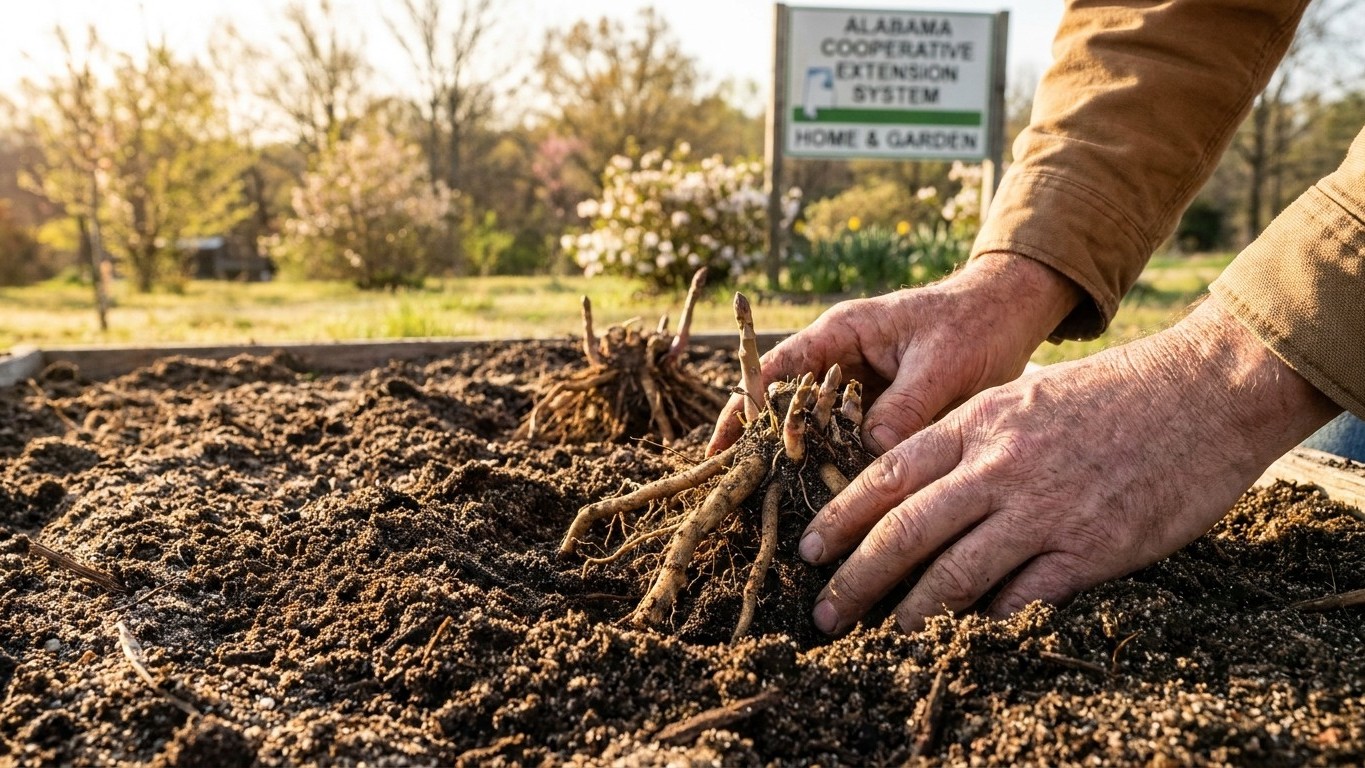

Plant Asparagus Crowns in British Columbia in early spring, once the ground has thawed and dried enough to dig, with the region’s mean last frost date of March 18 as the rough marker to plan around. Crowns settle into 8-inch furrows in well-drained soil, and from that point the bed needs two full years before the first spear is ever cut. What decides whether a given plot can carry that project isn’t the calendar so much as what the ground does with water.
The short answer
an Asparagus Bed is not a season’s project. Once crowns go in, that patch of ground is committed for 10 to 15 years of production, and the only soil condition that actually matters, according to Utah State University Extension, is that it drains. Not the pH, not the fertility level, not the texture in fine detail. Drainage. That single requirement is worth taking seriously here, because it is the one thing a gardener cannot fix later without digging the whole bed back up.
The dominant soil mapped across British Columbia’s agricultural regions is a Brunisol, a young soil whose horizons are still only beginning to separate, typical of ground built on recent or coarse parent material. It covers about 33 percent of the mapped surface, more than any other soil order in the province (Podzolic soils come next). The measured surface layer runs loam to silt, with roughly 52 percent sand, 38 percent silt, and just 10 percent clay, carrying about 5.0 percent organic matter and a median pH near 5.8, slightly on the acid side. And critically, that surface horizon is classed as well drained.
That’s a workable starting point for a 15-year asparagus bed. A soil that’s more sand and silt than clay, with a well-drained classification attached to it, tends to shed excess water rather than sit soggy through a wet spring. Asparagus crowns rot in standing water long before they suffer from an acid soil or a lean one, so a province-wide profile that drains well is genuinely good news for anyone eyeing a permanent bed.
But a provincial median is not a verdict on any one backyard. This figure comes from mapped agricultural soils across British Columbia, thousands of sampled components averaged together. It says nothing about the specific patch behind a specific house, and it explicitly does not cover the province’s far north. River bottoms hold water differently than upland slopes. Ground that’s been filled, graded, or compacted by a builder can behave nothing like the surrounding native soil, no matter what the regional average says. If a plot floods, stays soggy for days after rain, or shows standing water in a test hole dug a foot down, the fix is not to hope the median profile applies. Raised beds or mounded rows solve the drainage problem directly, lifting the crowns above the water table that a heavy or compacted spot can’t shed on its own. A simple home soil test, or a call to a local extension office, settles the question for an actual garden far better than any provincial statistic can.
Will the summer here water it for you?
Utah State University Extension’s guidance for an asparagus bed is specific: 1 to 2 inches of water every other week for the first two years while roots establish, then a lighter schedule of watering roughly every three weeks once the planting matures. That’s the target. What a British Columbia garden gets from the sky is a separate question, and the numbers don’t quite line up.
- What summer actually delivers. Normals from the Vancouver Int’l A station put total summer rainfall (June, July, August combined) at about 5.0 inches, out of 46.8 inches for the year. Spread across three months, that’s nowhere close to the 1-2 inches every two weeks an establishing bed calls for.
- The dry month to watch. July is the thinnest month of the three, at just 1.4 inches. June runs a bit higher at 2.12 inches, and August sits close to July at 1.45 inches. A bed planted in early spring is heading into its first full growing season right as rainfall bottoms out.
- The math on the gap. Over a two-week stretch in July, natural rainfall works out to well under an inch, against a target of 1 to 2 inches. That means supplemental watering isn’t optional in a typical year, it’s the difference between an establishing crown surviving and one that dries out before its root system can spread.
- Why the average still isn’t the whole story. These are 1981-2010 station normals, a long-run average for one location, not a forecast and not a measurement of any particular yard. A rain shadow, a slope, or simply a different corner of the province can push actual totals higher or lower than the Vancouver station shows. The only way to know what a specific garden gets is a rain gauge on that plot, tracked through the growing season and checked against the two-week, 1-2 inch target.
The practical takeaway: treat this territory’s summer rain as a partial contribution, not a substitute for a watering plan. Plan to make up the difference by hand or with irrigation, especially through July, and keep that up through the full two years before harvest even begins.
When to put the crowns in
Crowns go into the ground in early spring, and in this territory that means planning around a mean last spring frost of March 18 at the Vancouver Int’l A station. That date is an average, not a promise: in roughly half of all years, frost arrives after it. Treat March 18 as the middle of a window rather than a safe line to plant right up against, and lean toward waiting until the soil itself is workable and dried out rather than racing the calendar. Districts north of the Fraser Valley or at higher elevation run behind this station’s timing, sometimes by weeks, so a gardener well outside the Lower Mainland should expect their own local frost pattern to lag what Vancouver sees.
The furrow itself runs about 8 inches deep, with the crown set at the bottom and the trench filled in gradually rather than all at once, roughly 2 inches of soil added back every other month across the season as the new shoots grow up through it. That gradual backfill protects the emerging spears while still letting the crown settle at proper depth by year’s end.
Seed is the alternative route, for gardeners willing to trade time for a lower upfront cost, since seed-started plants take longer to reach the point where crowns would normally be transplanted. For most home gardens, crowns remain the more direct path to that first harvest, which regardless of starting method does not arrive until the third year.
Whichever way a bed gets started, Utah State University Extension names four asparagus varieties without ranking them on flavor, yield, or any other quality. Two are all-male: Jersey Giant and Jersey Knight. Two carry both male and female plants: UC 157 F1 and Purple Passion. The source gives no reason to prefer one over another, and no nursery is named here, so choosing among them comes down to what’s locally available rather than a documented performance difference.
Common questions
Can I harvest asparagus the same year I plant the crowns?
No. Utah State University Extension is direct on this point: there is no harvest at all in year one or year two. The bed needs that time to build a root system strong enough to support cutting. The first harvest comes in year three, and even then it starts light.
How long does a harvest season last once the bed matures?
It builds gradually rather than opening at full length. Year three’s harvest runs about 4 weeks, moving to roughly 6 weeks the following year, then about 8 weeks once the bed is fully established. Each season, harvest stops not on a fixed date but when most of the spears coming up are thinner than a pencil, a sign the crown’s energy is running low for the season.
Does British Columbia’s soil pH matter for asparagus?
The province’s mapped agricultural soils run a median surface pH near 5.8, slightly acid. Utah State University Extension’s guidance on asparagus doesn’t specify a pH requirement, so no target number is published here. Drainage is the documented factor that matters for this crop.
What if my winters are colder than the coastal normal, does that change when I plant?
The frost date and rainfall figures here come from the Vancouver Int’l A station, and a garden further inland or at elevation will run a different pattern. The source used for asparagus planting is silent on any winter chilling requirement, so no chilling figure is given, and none should be assumed from the hardiness zone. Planting timing should still track around the local last frost rather than the coastal one.