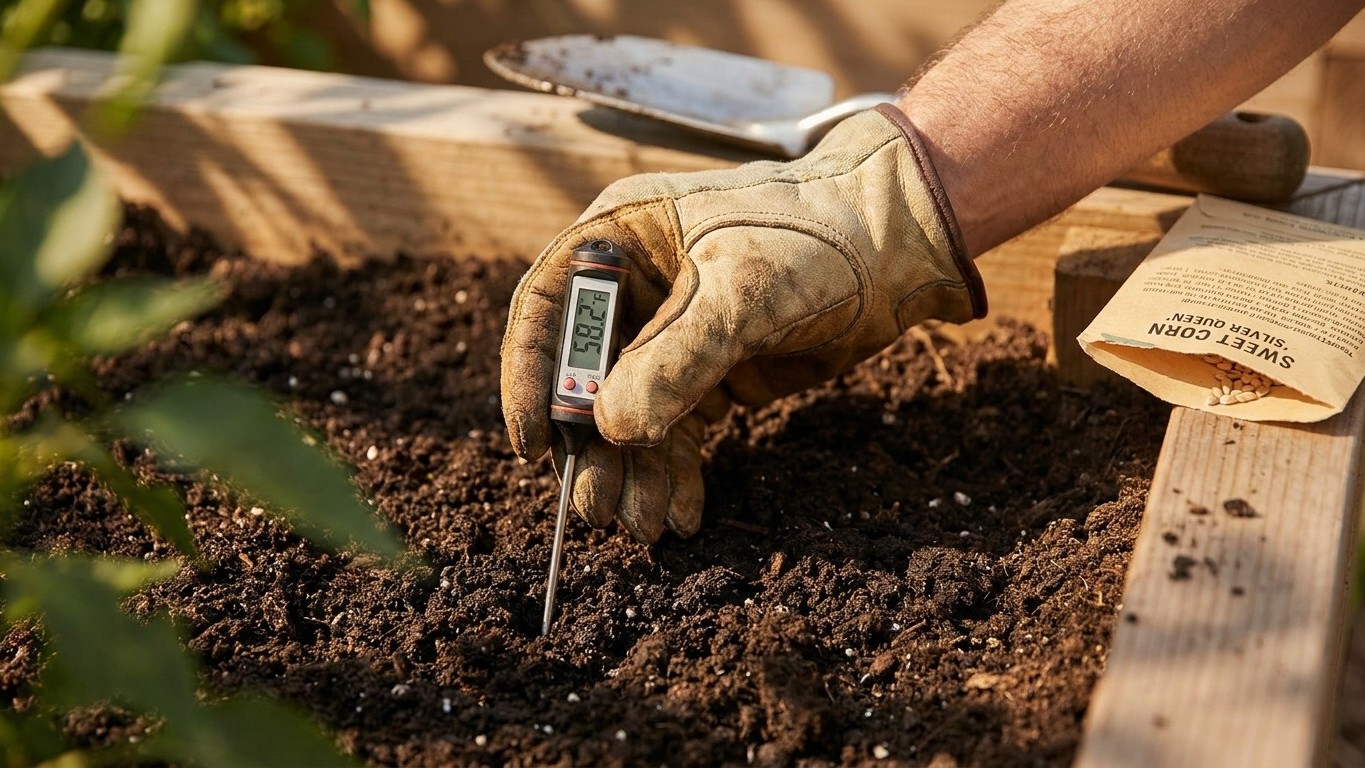

In Arkansas, sweet corn goes into the ground once soil temperature climbs above 60°F, and that milestone usually shows up well after the last spring frost (March 12 to March 28, NOAA NCEI). That gap between frost and workable soil is the whole story here. It pushes most plantings into mid-to-late spring, but it still leaves comfortable room before the first fall frost (November 7 to November 20) for corn to finish its 60-to-90-day clock.
The short answer
Here’s the part gardeners get wrong most often: the last frost date and the “safe to plant corn” date are not the same day. Air temperature climbs fast in Arkansas spring. Soil temperature does not. A patch of ground can sit well below 60°F for weeks after the air stops freezing, especially in a wet spring or in heavier clay soils that hold cold longer than sandy loam. Sweet corn seed dropped into cold, damp soil doesn’t just germinate slowly. It often rots before it sprouts at all, which is why the Utah State University Extension guidance on sweet corn ties planting to a soil threshold, not a frost calendar.
So the practical move is to stop watching the sky and start watching the ground. A simple soil thermometer, pushed down about four inches at the same time each morning for a stretch of days, tells you more than any date on a seed packet. Once that reading holds above 60°F, not just spikes there on a warm afternoon, the window opens.
Now the second half of the question: does the 60-to-90-day clock actually fit before autumn shuts things down? Arkansas’s first fall frost lands November 7 to November 20. Even in a slower spring where soil doesn’t reach 60°F until well into the back half of spring, there’s still a long stretch of warm-season growing time ahead before that November frost window arrives. Run the math from either end of the fall frost range and the 60-to-90 day maturity window fits with room to spare, not a tight squeeze.
That margin matters because Arkansas summers aren’t gentle. The reference station averages 69.2 days a year at 90°F or hotter. That’s not a planting-date number, but it’s the backdrop the corn grows into: heavy water demand, stress during pollination if the crop is timed to silk during the hottest stretch, and a reminder that “fits before frost” and “grows comfortably” aren’t the same claim. The season is long enough. The heat load still needs managing.
Does a late variety fit here?
Once soil crosses 60°F, the next decision is maturity length, and Arkansas’s frost-to-frost window gives more flexibility than gardeners in shorter-season states get.
A 60-day variety
A fast-maturing type sown once soil holds above 60°F has an easy run at it. Even accounting for the soil-warming lag behind the March 12 to March 28 frost dates, a 60-day corn planted in the back half of spring is finished well before summer’s peak heat, and nowhere close to bumping up against the November 7 to November 20 fall frost window. This is the low-risk choice, and it also opens the door to a second planting later in the season if the first block was small, since there’s so much unused calendar left after harvest.
A 90-day variety
The longer-season type is the one worth checking carefully, and here the math actually works in Arkansas’s favor. Counting backward from the earliest fall frost date, November 7, a 90-day maturity needs to go into the ground no later than roughly early August to finish safely. Since soil is already well past 60°F long before August in a typical Arkansas spring and summer, there’s a wide stretch of usable planting time, not a narrow crack. A 90-day variety fits this territory. It doesn’t need to be rushed into the ground the moment soil warms; it has flexibility that gardeners farther north simply don’t get. The tradeoff isn’t season length, it’s heat. A 90-day crop spends more of its life inside that 69.2-day stretch of 90°F-plus weather, which raises water needs and can stress pollination if silking lands during the hottest weeks of summer.
What goes wrong here
- Soil sown too cold. Seed goes in right after the last frost date instead of after a soil thermometer confirms 60°F. The fix is patience: track soil temperature for several consecutive mornings and wait for a stable reading, not a single warm day, before planting.
- A variety pushed past its window. Even with Arkansas’s generous frost-to-frost stretch, planting drifts too late in the season, whether from a delayed cold spring or simply a late start, and the 60-to-90 day clock runs out of room before November’s first frost. The remedy is counting backward from the earlier end of the fall frost range (November 7) before choosing a planting date, especially for a 90-day type.
- Sweetness lost to a neighboring block. This one has nothing to do with weather. Su, se, and sh2 sweet corn types lose their sweetness if they tassel at the same time as each other, because cross-pollination changes kernel quality. The fix is timing and layout: stagger plantings so the types don’t tassel together, and grow each type in its own block of three or more rows rather than a single thin row, so pollen from one block doesn’t dominate another.
Common questions
Is it safe to plant sweet corn right after the last spring frost in Arkansas?
Not necessarily. The last frost date (March 12 to March 28) marks when air temperature stops threatening tender growth, but soil takes longer to warm. Sweet corn needs soil consistently above 60°F, which usually arrives weeks after that frost date, not on it.
How do I know when soil is warm enough to plant?
Check with a soil thermometer at planting depth over several consecutive days rather than relying on a calendar date. A single warm afternoon isn’t enough; the soil needs to hold above 60°F consistently.
Will a 90-day sweet corn variety mature before Arkansas’s first fall frost?
Yes, in this territory it fits comfortably. Counting back from the earliest fall frost date (November 7), a 90-day crop needs to go in by roughly early August, and soil is warm enough for planting long before that deadline in a typical spring and summer.
Can I grow two types of sweet corn without losing sweetness?
Yes, as long as the different types (su, se, sh2) don’t tassel at the same time. Stagger your planting dates by variety and grow each type in a block of three or more rows rather than a single row, so timing, not distance, keeps the sweetness intact.