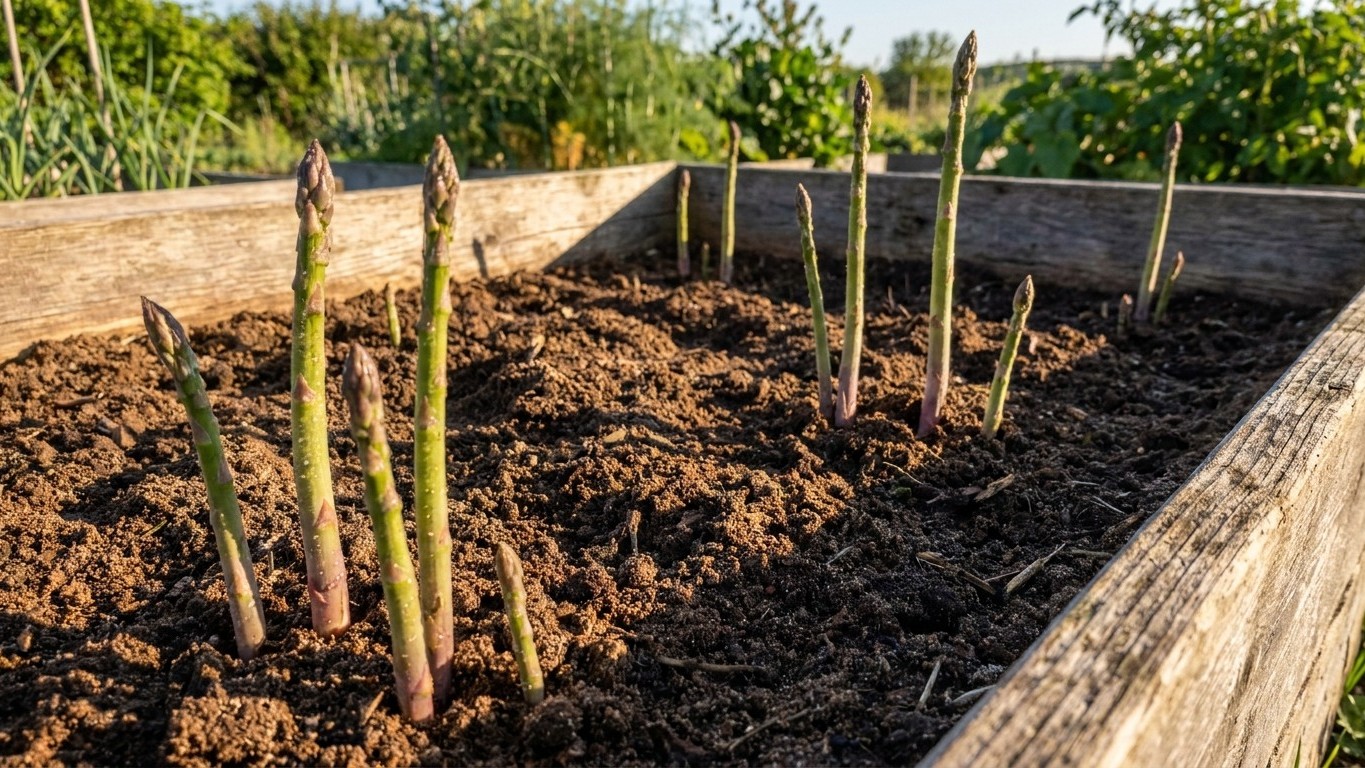

Colorado’s representative soil, the Seitz series, is classed as well drained — which is the only soil condition asparagus actually asks for. That’s a green light on paper. But a bed you plant this spring will still be producing spears a decade and a half from now, so the state’s representative soil is a starting point, not a verdict on the ground behind your house.
The short answer
Start with what asparagus demands, because the list is short. Utah State University Extension puts it plainly: crowns go into 8-inch furrows, no harvest happens until the third year, and once the bed matures it keeps producing for 10 to 15 years. The soil requirement attached to all of that is a single word: drained. Not fertile, not a particular pH, not a texture. Drained.
Colorado’s representative soil clears that bar. The Seitz series is an Alfisol, a forest-derived soil of moderate fertility that holds nutrients reasonably well, with a surface texture that runs 42 percent sand, 21 percent clay and 37 percent silt, a loam-to-silt blend, and a surface pH around 5.6. USDA lists it as well drained. On paper, a bed planted in ground like this has no structural reason to fail before its time is up.
The catch sits in that phrase “on paper.” The Seitz series is what USDA’s Soil Survey Geographic Database records as representative of Colorado, drawn from an average of 32 mapped components. It is not a reading of your yard. A state this size holds hundreds of distinct soil series, and the ground fifteen minutes from a Seitz-mapped area can behave nothing like it, especially anywhere a river has laid down clay, a foothill has exposed rock, or a builder has scraped and refilled a lot before pouring a foundation. The organic-matter figure attached to this series, around 70 percent at the surface, is a further flag rather than a garden target: a number that high describes a natural surface layer, peat or forest litter, not a worked and cultivated bed. No vegetable garden runs anywhere near that.
What actually changes the answer for your bed is drainage you can watch with your own eyes. Dig a hole about a foot deep, fill it with water, and see how long it takes to disappear. Standing water after several hours signals a heavy, slow-draining spot, exactly the condition that rots a fifteen-year asparagus crown from below rather than killing an annual vegetable you’d simply replant next season. If that’s what your test shows, the fix isn’t abandoning asparagus. It’s building a raised bed or mounded row a foot or so above grade, working in coarse organic matter, and giving the crowns a drainage path the native soil won’t provide on its own. A raised bed sidesteps the state soil question entirely, because you’re no longer trusting the ground beneath it to do the work.
Will the summer here water it for you?
Asparagus has its own water calendar, separate from the planting calendar. Utah State’s guidance calls for 1 to 2 inches of water every other week for the bed’s first two years, then a lighter schedule of roughly every three weeks once the crowns are established. Set that against what a Colorado summer actually delivers and the gap becomes concrete.
- Know the summer total. The NOAA climate normals for the reference station covering this data run about 5.7 inches of rain across June, July and August combined, against roughly 14.5 inches for the full year. Summer is not the wet season here.
- Break it down month by month. June averages 1.94 inches, July 2.14 inches, and August is the dry one at 1.58 inches. That means the driest stretch of a young asparagus bed’s first two summers lands right when the crowns need water most consistently.
- Compare that to the every-other-week rule. Over a 12-week summer, the every-other-week schedule calls for roughly six watering cycles at 1 to 2 inches each, somewhere between 6 and 12 inches of water across the season. Even at the low end of that range, natural rainfall covers under half of it.
- Do the same math for year three onward. An every-three-week schedule works out to about four cycles across the same 12 weeks, again in the 4-to-8-inch range. Summer rain still falls short, just by a smaller margin.
- Plan to irrigate through the dry months regardless. August’s 1.58-inch average is the one to build a system around, since it’s the month most likely to leave a young bed short. A soaker hose or drip line on a timer removes the guesswork.
- Verify with a rain gauge on your own property. Climate normals describe a reference station over a 1991-2020 period, not your specific lot. A slope, a nearby wall, or simple local variation can shift what actually lands on your bed, so a $10 gauge tells you more than any regional average.
When to put the crowns in
Utah State’s guidance is simple on timing: crowns go into the ground in early spring. Anchoring that to a specific calendar window means looking at when the risk of a hard freeze has mostly passed, and for the reference station behind these figures, NOAA’s 1991-2020 normals put the last spring frost somewhere between May 1 and May 11, based on the probability band for a 32-degree freeze.
Treat that window as a guide, not a guarantee. A mean frost date is built from thirty years of averages, and any single spring can run early or late against it, particularly at higher elevations where a mountain town’s growing season can be far shorter than the plains around Denver, with frost risk persisting well past what a statewide normal suggests. The safer approach is to watch your own soil and forecast as the date approaches, rather than circling it on a calendar months in advance.
Once you’re past that frost risk, dig the furrows to the 8-inch depth Utah State specifies, set the crowns in, and cover them with only a couple of inches of soil at first, not the full depth. The rest of the backfill happens gradually over the season, adding roughly two more inches every other month as the shoots grow, rather than burying the crown all at once. That staged filling gives young growth room to reach daylight without smothering it early.
Seed is the other route, for gardeners who’d rather grow their own crowns than buy them, though it adds a year or more to the timeline before the bed reaches the same maturity a purchased crown starts with. Whichever start you choose, remember the patience this crop demands from the outset: no harvest at all in the first two years, and even in year three the cutting window stays short before the plant needs to rebuild its energy for the following spring.
Common questions
Does my garden’s actual soil pH matter for asparagus?
The state’s representative soil runs a surface pH around 5.6, slightly acid, but that number describes the Seitz series specifically, not your plot, and the Utah State University Extension guidance behind this crop’s growing requirements doesn’t publish a pH threshold for asparagus at all. A home soil test is the only way to know your own number, and there’s no published figure here to compare it against.
What if a soil test shows my ground doesn’t drain?
Don’t force a fifteen-year crop into standing water. Building a raised bed or a mounded row, worked with coarse organic matter, gives the crowns the drainage the native soil isn’t providing, and sidesteps the question of what the state’s representative soil does or doesn’t guarantee.
Which asparagus variety should I plant?
Utah State University Extension names four: Jersey Giant and Jersey Knight, both all-male varieties, and UC 157 F1 and Purple Passion, which produce both male and female plants. The source doesn’t publish flavor, yield, or a reason to prefer one over another, so the choice comes down to what’s available rather than a documented performance difference.
How do I know when to stop harvesting each spring?
The rule isn’t a date on a calendar, it’s a look at the spears themselves. Once most of what’s coming up runs thinner than a pencil, that’s the signal to stop cutting for the season and let the plant put its energy into building next year’s crop instead.