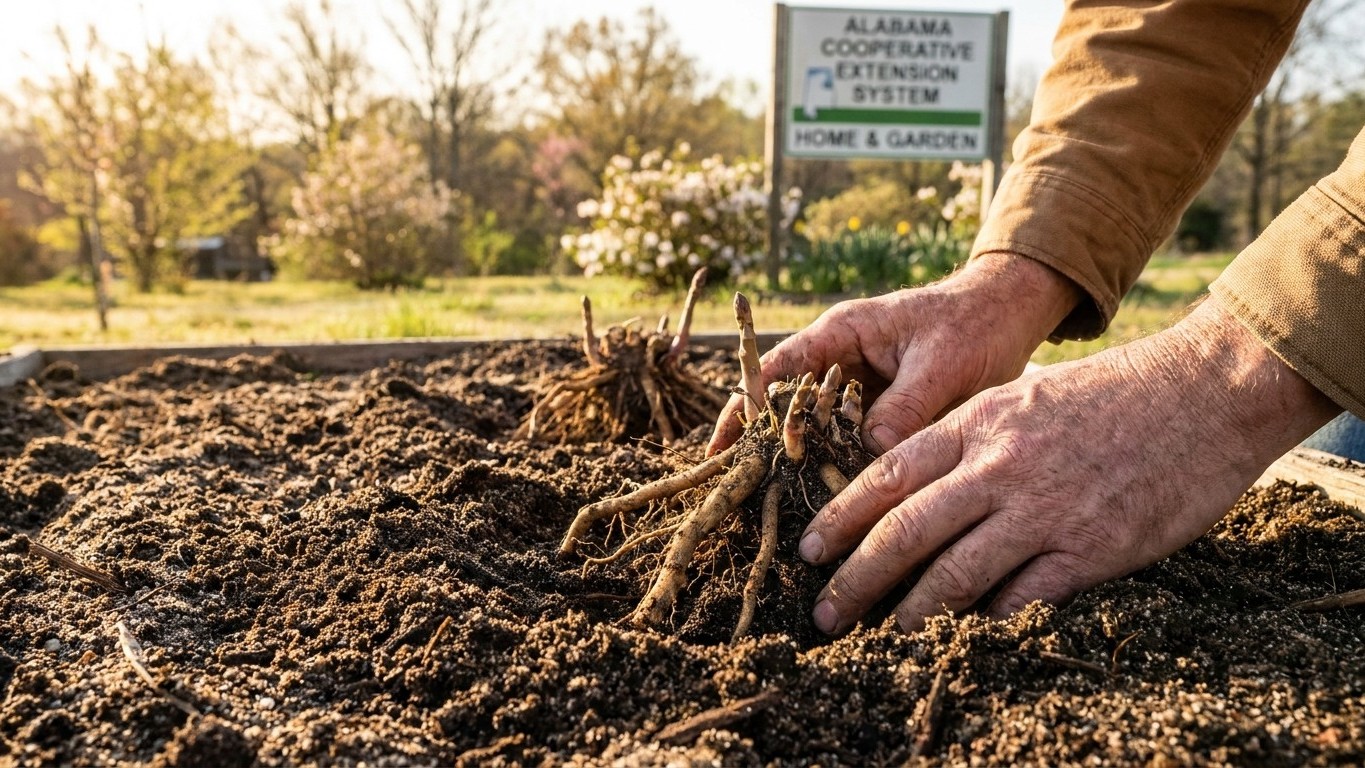

In Colorado, asparagus crowns go into the ground in early spring, timed to the region’s mean last spring frost window of around May 1 to May 11. That single planting decision locks in a bed that, once established, keeps producing for 10 to 15 years, so most of the real work happens underground long before the first spear ever breaks the surface. Drainage, not fertility, is the one soil requirement Utah State University Extension attaches to asparagus, and that detail changes how the answer plays out across a state where soils shift dramatically from one county to the next.
The short answer
Ten to fifteen years is a long time to commit a strip of garden to one crop. Asparagus doesn’t ask for rich ground, and Utah State University Extension is direct about it: most soils will grow asparagus fine, provided they drain. That’s the whole requirement. No pH target, no fertility threshold, nothing about winter chilling either. So before a single crown goes in the ground, the only real question is whether water moves through that soil, or sits in it.
Colorado’s representative soil, the one USDA lists as the state’s benchmark series, is called Seitz, an Alfisol formed under forest cover. It runs loam to silt in the surface horizon (42 percent sand, 21 percent clay, 37 percent silt), with a surface pH around 5.6, slightly acid, and it’s classified as well drained. On paper, that’s a soil that would suit a fifteen-year asparagus bed reasonably well: the sand fraction keeps water moving, the clay and silt hold enough structure to carry some nutrients, and the drainage rating is exactly the box asparagus needs checked.
But a state soil describes a mapped average, not the dirt behind any one house. Colorado’s ground varies enormously: sandy loams on the eastern plains, heavy clay in older subdivisions where a builder scraped the topsoil and graded with subsoil, decomposed granite in the foothills, alkaline flats in irrigated valleys. The Seitz series is what USDA records as representative for the state under its State Soils program, built from surface-horizon measurements across 32 mapped components. It’s a starting point for thinking about how Colorado ground tends to behave, not a lab report on a particular backyard.
That’s why the practical move, before digging furrows meant to last over a decade, is a shovel test. Dig a hole roughly a foot deep, fill it with water, and see how long it takes to disappear. If it drains within a few hours, the ground is a candidate for asparagus as it sits. If water is still standing the next morning, the bed needs help: raised rows, added coarse organic matter worked in deep, or a mounded bed that lifts the crowns above the compacted layer causing the holdup. None of that is exotic. It just has to happen before planting, because a fifteen-year bed is not something a gardener gets to relocate two summers in because the crowns are sitting in a bathtub.
Will the summer here water it for you?
an Asparagus Bed has a watering rhythm that changes with its age. For the first two years, while the crowns are establishing root systems, it wants 1 to 2 inches of water every other week. After that, once the planting is mature, the interval stretches to every three weeks. Colorado’s summer rainfall doesn’t come close to filling that on its own, and the shortfall is worth walking through step by step.
- Total summer rainfall. Across June, July and August, the reference station used for Colorado’s climate normals records about 5.7 inches of rain, out of 14.5 inches for the whole year. That’s the entire summer’s natural water supply for the bed, spread across three months.
- Month by month. June averages 1.94 inches, July 2.14 inches, and August, the driest of the three, just 1.58 inches. A newly planted bed alone is asking for roughly 2 to 4 inches every two weeks through that same stretch, which June and July rainfall don’t reach even before accounting for evaporation.
- The gap in year one and two. Matching the every-other-week target of 1 to 2 inches means supplemental watering covers most of the requirement most weeks, especially in August when natural rainfall drops to its low point for the season.
- The gap after the bed matures. Once the schedule eases to every three weeks, the math gets friendlier, but Colorado’s summer rain still arrives unevenly, often as a single thunderstorm rather than a steady soak, so a chunk of any given storm can run off rather than reach the root zone.
- What settles it locally. These are 1991-2020 normals for one reference station, not a forecast and not a reading from any individual yard. A rain gauge on the actual bed, checked against the every-other-week or every-three-week target, is what tells a gardener whether the hose needs to come out this week or not.
When to put the crowns in
Crowns go into 8-inch furrows in early spring, and in Colorado that means working around the mean last frost window of roughly May 1 to May 11. That’s an average built from three decades of freeze-probability data at one reference station, not a guarantee, so treat it as the center of a planting window rather than a fixed date. Push crowns in too early into cold, waterlogged ground and they can rot before they ever root; wait too long and the bed loses growing time it won’t get back, since nothing gets harvested from it for three full years regardless of when it starts.
Colorado’s geography makes that “around” matter more than in flatter states. Denver sits at 5,280 feet on the plains, and the May 1 to May 11 window applies to that kind of elevation and exposure. Mountain towns run shorter seasons entirely, with frost risk that can stretch into July some years, and the western slope has its own pattern again. A gardener working at altitude or in a mountain valley needs to shift the planting window later than the plains figure suggests, and there’s no single statewide date that covers a Denver suburb and a high-country town equally well.
The furrow itself isn’t filled in one motion. Crowns get set in the 8-inch trench, covered with a couple inches of soil at planting, and then the rest of the backfill happens gradually across the season, roughly two inches added every other month as the fern growth extends upward. That staged filling is part of why asparagus beds take real patience: the structure of the bed itself is still being built the same year the crowns go in.
Seed is the alternative route, and it exists precisely because crowns aren’t the only option, just the faster one. Starting from seed pushes the harvest timeline out further, since seedlings need a season of growth before they’re even crown-sized enough to transplant. For a bed that already won’t produce until year three from crowns, most home gardeners in Colorado lean toward crowns for exactly that reason: it skips a full growing season of waiting before the three-year clock even starts.
Variety choice, meanwhile, is a narrower decision than it might seem. Utah State University Extension names four: Jersey Giant and Jersey Knight, both all-male varieties, and UC 157 F1 and Purple Passion, both male/female types. That’s where the published detail stops. No flavor comparison, no yield ranking, no stated reason to prefer one over another appears in that source, and no nursery or supplier is specified either. The decision comes down to what’s available locally and what a grower prefers to plant, not a documented performance difference.
| Variety | Sex type | Source detail |
|---|---|---|
| Jersey Giant | All-male | Named only, no yield or flavor data published |
| Jersey Knight | All-male | Named only, no yield or flavor data published |
| UC 157 F1 | Male/female | Named only, no yield or flavor data published |
| Purple Passion | Male/female | Named only, no yield or flavor data published |
Common questions
How soon can an Asparagus Bed be harvested in Colorado?
Not until year 3, regardless of planting date. Harvest then starts at roughly 4 weeks, extends to about 6 weeks the following year, and reaches around 8 weeks once the bed is mature. There’s no shortcut that lets a gardener take “a few spears” earlier than that without weakening the crowns.
How does a gardener know when to stop cutting spears each season?
The signal isn’t a date, it’s the spear itself. Once most spears coming up are thinner than a pencil, that’s the stop point for the season, letting the plant put its energy into fern growth instead of continued cutting.
Does Colorado’s soil need to be tested before planting asparagus?
The state’s representative soil, the Seitz series, is well drained with a surface pH around 5.6, but that’s a mapped average, not a reading from any individual yard. A simple drainage test, and ideally a soil test, on the actual planting site is what tells a gardener whether amendment or raised beds are needed before committing a spot for over a decade.
Is there a hard rule for how much winter cold asparagus needs in Colorado?
Not one that’s published in the source used here. Utah State University Extension is silent on any winter chilling requirement, so no specific chilling-hours figure or hardiness-zone conversion applies. Planting timing in Colorado is instead built around the last spring frost window and the crop’s own furrow-and-backfill schedule.