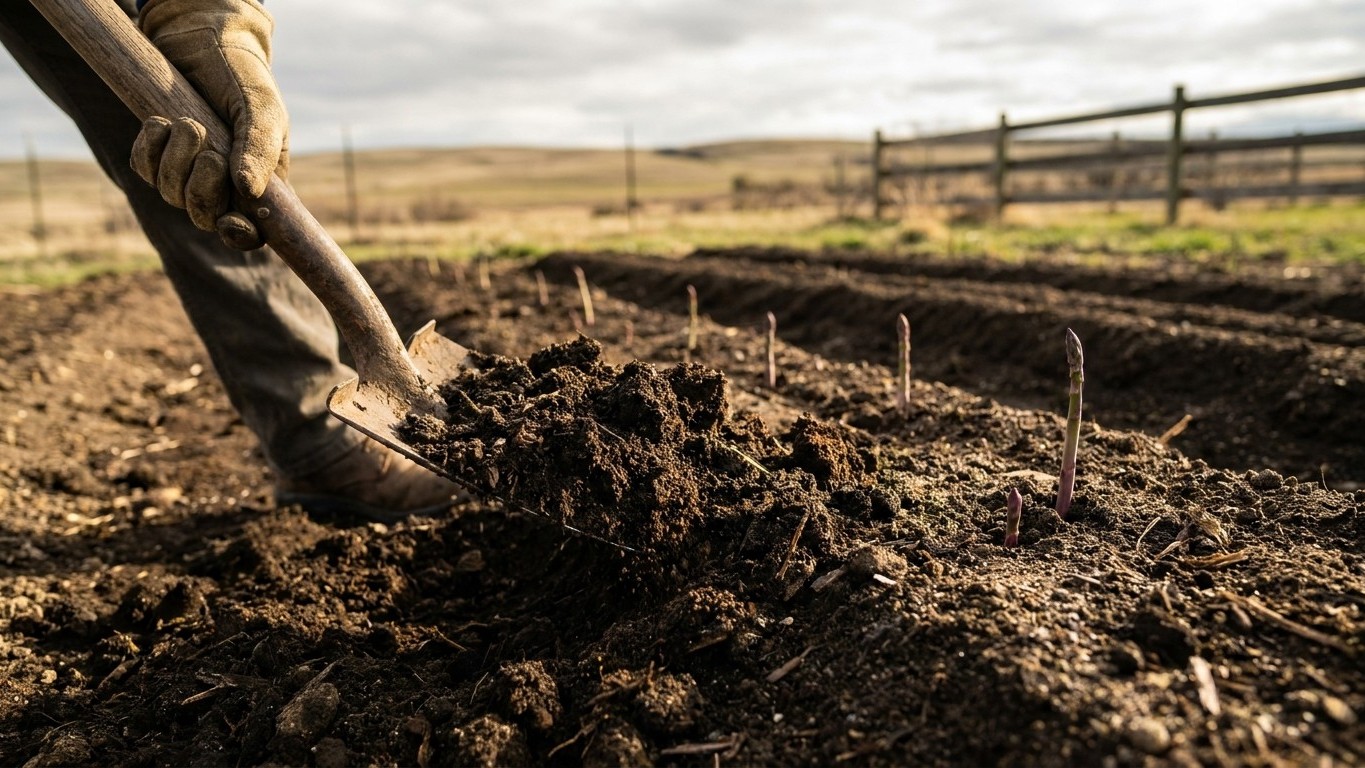

Colorado can grow asparagus, but the bed you dig this spring is the bed your household will still be cutting from in a decade and a half. That single fact changes how you should think about the spot: not “will this soil grow a plant this year,” but “will this soil still be doing its job in fifteen years.” Getting When to Plant Asparagus Crowns in Colorado right matters just as much as the soil itself, and the state’s representative ground turns out to be a reasonable match, with one condition attached.
The short answer
Asparagus crowns, once set, produce for 10 to 15 years according to Utah State University Extension, and the only soil requirement the source gives is drainage. Not fertility, not a specific pH, not a particular texture. Drainage. That’s a low bar, but it’s an absolute one, because a crown sitting in standing water for a decade and a half doesn’t get a second chance the way a tomato plant does next season.
The soil USDA lists as representative of Colorado is the Seitz series, an Alfisol, which is a forest soil with moderate fertility that holds nutrients reasonably well. Its surface runs 42 percent sand, 21 percent clay, and 37 percent silt, a loam-to-silt mix, with a surface pH around 5.6. USDA records it as well drained. On paper, that’s exactly the texture asparagus tolerates: enough sand to move water through, enough silt and clay to hold nutrients between waterings.
Here’s the caution worth sitting with: the Seitz series is what USDA uses to represent Colorado’s soil in general, not a measurement of any one backyard, which raises the real question of Will Colorado Soil Hold an Asparagus Bed for Fifteen Years? The state stretches from river-bottom clay to sandy foothill ground to whatever a builder scraped and refilled before pouring a foundation. The organic matter figure attached to this series, cited near 70 percent, applies to the surface horizon as mapped, which for a series like this usually reflects a natural forest litter layer, not a cultivated bed. A worked garden plot will not carry that number, so don’t expect to see it in a soil test from your own yard.
What that means practically: before you commit a corner of the yard for fifteen years, check what your own ground does after a hard rain. If water sits on the surface for more than an hour or two, or if a shovel comes up sticky and slick a foot down, that spot doesn’t drain the way the crop needs. The fix isn’t complicated. A raised bed, or a mounded row built up 8 to 10 inches above grade, solves the drainage question without solving anything else you’d need to guess at. It’s a one-time build for a fifteen-year bed, which is a fair trade.
Will the summer here water it for you?
An established asparagus bed asks for 1 to 2 inches of water every other week for its first two seasons, then eases to every three weeks once the root system is mature. Colorado’s summer, measured at a reference station under NOAA’s 1991-2020 normals, delivers about 5.7 inches of rain across June, July, and August combined, with August the driest month at just 1.58 inches. Lay those two numbers side by side and the gap becomes obvious.
- Add up the bed’s demand. At 1 to 2 inches every other week, a young bed wants roughly 2 to 4 inches per month, which works out to somewhere near 6 to 12 inches across the three summer months just from irrigation, before counting whatever falls naturally.
- Compare it to what falls from the sky. The region’s June, July, and August normals run 1.94, 2.14, and 1.58 inches. Even at the high end of that range, natural rainfall covers well under half of what a first- or second-year bed is asking for.
- Watch August specifically. It’s the driest of the three summer months on the books, which means the gap between rainfall and need widens right when the plant’s root system is working hardest to store energy for next year’s spears.
- Plan to run a hose or drip line on a schedule, not a hope. Because the shortfall is structural, not occasional, watering can’t be reserved for dry spells. It’s a standing task for the first two years, tapering once the bed reaches its every-three-week maturity rhythm.
- Let your own rain gauge settle the final number. A single summer thunderstorm can dump an inch in twenty minutes and mostly run off a clay surface rather than soak in, while the same inch spread over two days on a sandy bed soaks through completely. The normals tell you what to expect on average; a gauge on your own plot tells you what actually reached the roots.
When to put the crowns in
Crowns go into the ground in early spring, set into furrows about 8 inches deep. In Colorado, spring’s last freeze at 32°F falls somewhere around May 1 to May 11, based on NOAA’s 1991-2020 normals for a reference station on the plains. That’s a mean date, not a promise, so treat it as the center of a window rather than a line on the calendar. Mountain towns run far shorter seasons than that plains figure suggests and can see frost well into summer, and the western slope has its own separate pattern, so a gardener there should lean on local knowledge rather than a single statewide date.
The furrow itself doesn’t get filled in one pass. Crowns are backfilled gradually, about two inches of soil added every other month across the first year, rather than covered all at once at planting. That staged fill gives the emerging shoots room to push upward without being buried under a full 8 inches on day one.
Seed is the alternative route to crowns, and it’s a real option, though the source gives no specific timeline beyond naming it as an alternative starting point. Whichever way the bed begins, the harvest clock doesn’t move: no cutting happens in year one or two. The first harvest, taken in year three, runs about 4 weeks. The following year stretches to about 6 weeks, and from there the bed settles into an 8-week harvest window each year it’s mature. The rule for When to Stop Cutting each season isn’t a week count at all: stop once most of the spears coming up are thinner than a pencil. That’s a signal from the plant, not a date on a calendar, and it matters more than the week number because a thin spear means the crown needs to stop feeding you and start feeding itself again.
Variety choice is one place where the published record stays narrow. Utah State University Extension names four, distinguished only by sex, with no flavor, yield, or preference guidance attached to any of them.
| Variety | Sex type |
|---|---|
| Jersey Giant | All-male |
| Jersey Knight | All-male |
| UC 157 F1 | Male/female |
| Purple Passion | Male/female |
All-male varieties tend to be favored in practice because female plants spend energy producing seed, but that reasoning isn’t part of what this source publishes, so treat variety choice as a decision to make with a local nursery rather than a settled question here.
Checking this against your own county
Everything above is built from state-level normals and a state-representative soil series, and neither one is a substitute for what’s happening in your specific yard. Colorado State University Extension, at extension.colostate.edu, is the land-grant resource built for exactly that gap. Its county offices can point you toward a soil test, tell you whether local frost dates run earlier or later than the statewide mean, and flag anything about your elevation or microclimate that changes the picture. Before you dig a furrow meant to last fifteen years, a call to your county office is a cheap way to catch a problem the statewide numbers can’t see.
Common questions
Can asparagus grow in Colorado’s alkaline or acidic patches? The source behind this article is silent on soil pH requirements for asparagus, and the state-representative soil’s pH of about 5.6 describes one mapped series, not your yard. A local soil test is the only way to know your own number.
Does Colorado’s cold winter hurt an established bed? No chilling requirement is published in the source used here, and hardiness zone figures don’t translate into a chilling number on their own. That detail simply isn’t part of the record this article draws from.
How soon can I eat spears after planting? Not before year three, regardless of how vigorous the plant looks in year one or two. Cutting early weakens the crown’s root development for every year that follows.
What if my yard sits below the mean frost date range? Treat May 1 to May 11 as a center point, not a guarantee, especially in mountain or western-slope locations where local patterns diverge from the plains reference station. Your county extension office can supply a more local expectation.