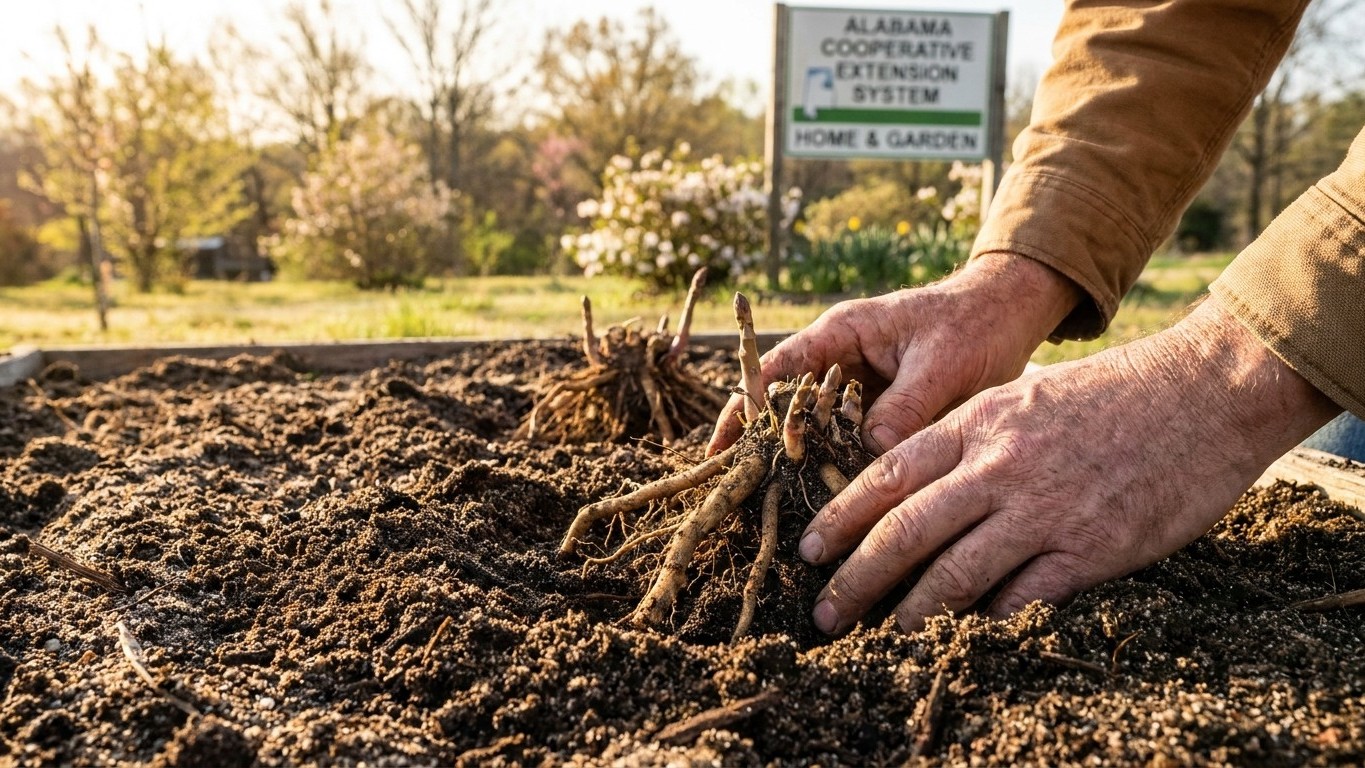

Plant Asparagus Crowns in Delaware in early spring, in the weeks around the region’s average last-frost window of April 3 to April 14. That timing gets the crowns into cool, workable soil before top growth starts, which is what this crop needs to settle in for a bed that will still be producing more than a decade from now.
The short answer
Asparagus is a commitment crop. Once a bed is established it keeps producing for 10 to 15 years, and the plant itself won’t yield a single harvestable spear until its third year in the ground. That changes how a gardener should think about “where to plant” long before “when to plant” ever comes up, because the spot chosen this spring is the spot that bed occupies for the next decade and a half. According to Utah State University Extension, most soils will support asparagus just fine, with one condition: the ground has to drain well. Standing water around dormant crowns is the one thing this plant won’t tolerate over that kind of timeline.
Delaware’s official state soil, the Greenwich series, happens to answer that question in the gardener’s favor. It’s classified as an Ultisol, an old, heavily weathered soil, and the surface horizon runs a loam-to-silt texture, roughly 48 percent sand, 43 percent silt, and just 9 percent clay, with organic matter around 1.7 percent. Critically, it’s mapped as well drained. A soil built that way, with more sand and silt than clay, tends to let water move through rather than pool around root systems, which is exactly the trait an Asparagus Bed needs for the long haul.
That said, the state soil describes a representative series across Delaware, not the dirt in any one backyard. Hundreds of soil series exist across the state, and anything from a low river bottom to a yard that’s been graded, filled, or compacted during construction can behave nothing like the Greenwich series. The only way to know what a specific plot does with water is to watch it after a hard rain, or run a simple soil test. If a spot holds water for more than a few hours after a storm, that’s the signal to either choose different ground or build up a raised bed with amended soil before crowns go in. Fifteen years is a long time to find out a low spot doesn’t drain.
Will the summer here water it for you?
Asparagus beds have a fairly specific thirst curve. In their first two years, while roots are still establishing, they want 1 to 2 inches of water every other week. Once mature, that eases back to roughly 1 to 2 inches every three weeks. Delaware’s summer rainfall doesn’t quite hand that over on its own, so here’s how the season typically breaks down against what the bed actually needs:
- June: the region averages 4.67 inches for the month, which works out close to the 1-to-2-inch-every-other-week target for young crowns, assuming that rain falls in fairly even installments rather than one or two heavy storms that mostly run off.
- July: average rainfall of 4.41 inches keeps pace in a similar way, but July is also when Delaware’s heat climbs, and higher evaporation rates mean more of that rain never reaches root depth.
- August: this is the driest summer month at 3.98 inches, and it’s the point in the season where a young bed is most likely to fall short of its every-other-week requirement without supplemental watering.
- Across the full June-through-August stretch: the region totals about 13.1 inches of the year’s 45.3-inch average, which sounds substantial but arrives unevenly, storm by storm, rather than as the steady biweekly soak an establishing bed prefers.
- For a mature bed past its second year, the lighter every-three-weeks requirement is easier for a Delaware summer to cover on its own, though August still tends to be the month worth checking with a rain gauge before assuming the ground has enough.
None of these normals substitute for what’s actually falling on a specific piece of ground. They’re drawn from a single reference station’s 1991-2020 averages, and a slope, a rain shadow, or simply a dry summer can push any given year well off that pattern. A rain gauge staked next to the bed is the only way to know, in real time, whether nature is covering the every-other-week schedule or whether a hose needs to fill the gap.
When to put the crowns in
Crowns go into the ground in early spring, planted into furrows about 8 inches deep. In Delaware, that generally lines up with the weeks around the region’s average last-spring-frost window of April 3 to April 14, since a mean frost date is an average and not a guarantee, and the actual date can run later in suburban and rural gardens away from the reference station. Waiting until the soil is workable and not sodden matters more than hitting a specific calendar date.
Once crowns are in the furrow, the covering isn’t a one-time job. The furrow is backfilled gradually across the year, adding about 2 inches of soil back over the crowns every other month rather than filling it in all at once. That gradual approach lets the emerging shoots keep pace with the soil level instead of getting buried too deep too fast.
Four varieties are documented by Utah State University Extension, and the only distinction the source draws between them is reproductive type. Jersey Giant and Jersey Knight are all-male varieties, while UC 157 F1 and Purple Passion are male-and-female types. No flavor difference, yield advantage, or disease resistance is attached to any of these names in that source, so choosing among them isn’t a matter of one being objectively better, just a matter of which reproductive habit a gardener wants in the bed. No nursery or supplier is named here either; that’s a separate decision entirely.
Starting from seed is the alternative route, though it adds a full extra year to the timeline before those seedlings are ready to go into a permanent bed as crowns would. For a gardener who wants spears sooner rather than later, buying dormant crowns and planting them directly in early spring remains the faster path. Either way, the finish line is the same: no harvest at all in year one or two, a first light harvest of about 4 weeks in year three, then 6 weeks the following year, then 8 weeks once the bed is fully established. The signal to stop cutting each season isn’t a date on the calendar, it’s the spears themselves, once most of what’s coming up runs thinner than a pencil, that’s the cue to let the plant put its energy back into the roots for the rest of the year.
Common questions
Can I Plant Asparagus Crowns in Delaware clay soil?
Delaware’s representative state soil, the Greenwich series, is mapped as loam-to-silt and well drained, not heavy clay, so the region’s dominant ground tends to favor asparagus. But any individual yard can differ, especially fill dirt or low spots, so watch how the specific plot handles water after a heavy rain before committing a bed there for over a decade.
Do I need to water asparagus the same amount every year?
No. The first two years call for 1 to 2 inches every other week while roots establish. After that, mature beds only need 1 to 2 inches roughly every three weeks, which Delaware’s summer rainfall pattern is generally better equipped to cover on its own, apart from dry stretches in August.
What’s the difference between all-male and male/female asparagus varieties?
According to Utah State University Extension, the documented varieties differ only in reproductive type: Jersey Giant and Jersey Knight are all-male, while UC 157 F1 and Purple Passion are male-and-female. No flavor, yield, or resistance advantage is published for any of them, so the choice comes down to that reproductive trait alone.
Can I start asparagus from seed instead of buying crowns?
Yes, seed is the alternative path, though it adds an extra year to the process before those plants are ready to move into a permanent bed as crowns. For a faster route to that first light harvest in year three, planting dormant crowns directly in early spring is the quicker option.