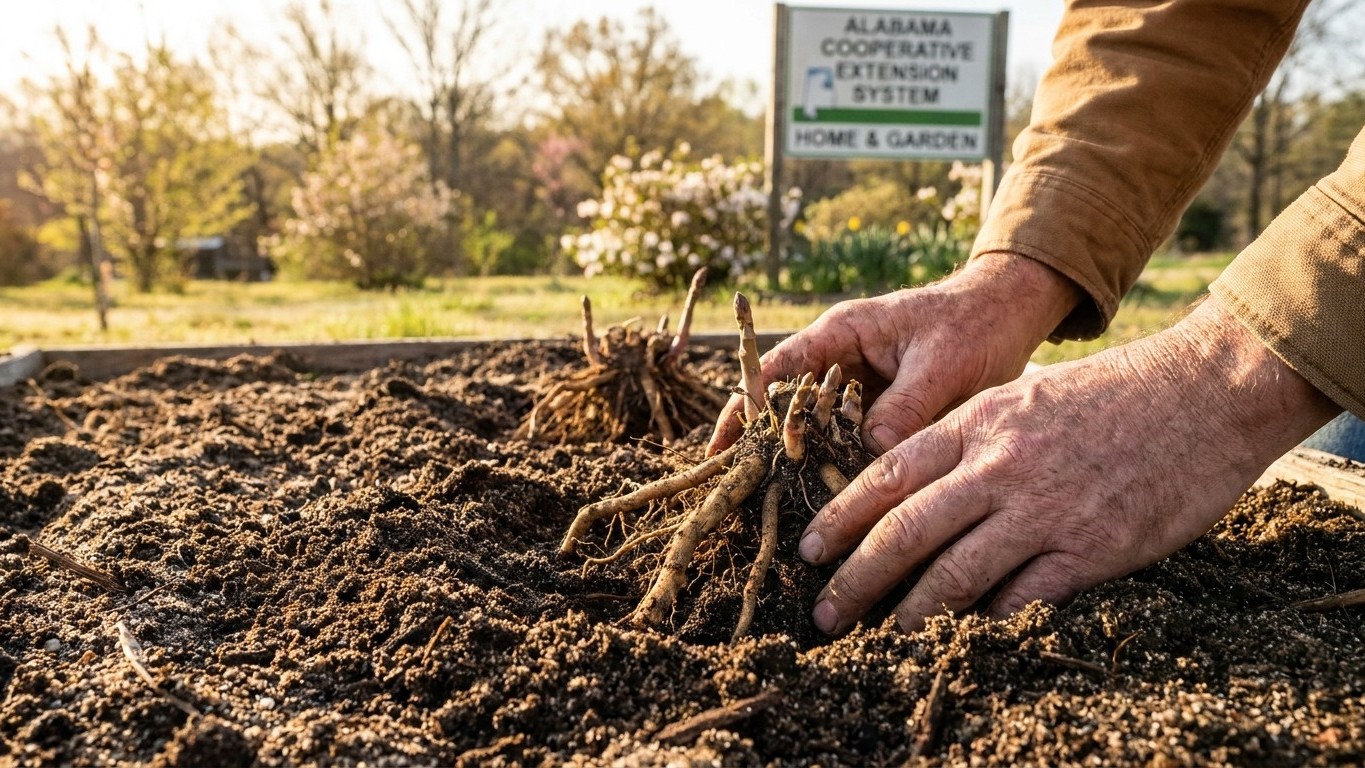

North Florida’s last frost lifts in the roughly three-week span around late February and early March, and that window is what sets the asparagus crown planting date across most of the state. Crowns go into the ground in early spring, buried 8 inches deep in a furrow, and won’t produce a single harvestable spear until the third year. In central and south Florida, where frost barely registers, the whole calendar inverts.
The short answer
an Asparagus Bed isn’t really a plant, it’s a piece of real estate. Once crowns go in, that patch of ground stays asparagus for somewhere between 10 and 15 years, and the only site requirement Utah State University Extension attaches to it is that it drains. In Florida, that one word carries a lot of weight.
What the state soil says about drainage
Florida’s official state soil, the Myakka series, is a reasonable stand-in for what a lot of the state’s ground does with water, and the picture isn’t flattering for a bed meant to sit undisturbed for over a decade. Myakka is a Spodosol, mapped by the USDA’s Natural Resources Conservation Service at roughly 97 percent sand, 2 percent clay and 1 percent silt at the surface, with organic matter around 2.0 percent and a surface pH near 5.1, strongly acid. Despite being almost pure sand, the series is classified as poorly drained. Sand alone doesn’t guarantee good drainage: many spodosols carry a compacted layer beneath the surface that water struggles to move through, so rain can perch above it long after a sandy topsoil would suggest it should have soaked away.
That’s a statewide average, not a verdict on any single backyard. A soil test is the only real way to know whether a given plot drains fast enough to keep crowns from sitting in standing water for a decade-plus. Where a test, or just watching the ground after a storm, shows water lingering, a raised bed or a mounded planting row lifts the crowns clear of that wet layer without requiring a search for different ground entirely.
A commitment measured in years, not seasons
The timeline makes the site choice matter even more. Crowns planted this spring won’t yield anything the first year, or the second. Utah State University Extension lays out a step-up harvest starting in year three: about four weeks of cutting that first harvest year, six weeks the year after, then eight weeks in the years that follow, once the bed is fully established. Each season’s harvest doesn’t end on a calendar date, it ends on a signal from the plant: once most of the emerging spears are thinner than a pencil, cutting stops so the plant can rebuild its roots for next year. Pick the spot with that whole arc in mind, because there’s no easy do-over once a bed is three years into a fifteen-year run.
Will the summer here water it for you?
Once crowns are in, Utah State University Extension calls for 1 to 2 inches of water every other week through the bed’s first two growing seasons, tapering to every three weeks once it’s established. Florida’s summer doesn’t hand that over as a tidy biweekly ration, but the numbers are worth walking through.
Rainfall versus the bed’s schedule
- Over three decades of NOAA climate normals, the reference station used for these figures averages about 21.2 inches of rain across June, July and August, out of 53.4 inches for the full year, roughly three times what a young bed’s every-other-week allotment adds up to over the same stretch.
- July, the driest of the three summer months, still averages 6.77 inches. June comes in higher at 7.6 inches, and August sits at 6.88 inches. On paper, no summer month falls short of what the bed needs.
- The way that rain arrives matters as much as the total. Florida summer rain tends to fall as afternoon thunderstorms, dropping a large share of a month’s total in an hour or two rather than spreading it evenly across the weeks. On the sandy surface the Myakka series represents, a heavy burst can run through the topsoil quickly, leaving the days between storms drier than the monthly average implies.
- A bed can go a week or ten days with no rain even inside a wet month, and that’s precisely the kind of gap the every-other-week rule is built to cover. Supplemental watering earns its keep in those stretches, not as a blanket addition across the whole summer.
- The normals describe a reference station’s average over three decades, not what falls on one particular garden in one particular year. A rain gauge on-site, checked against the every-other-week target, is what actually decides whether the hose comes out that week.
Florida summers generally outrun what a young asparagus bed needs, but rain that falls in bursts on fast-draining sand still leaves dry gaps inside a wet season. The every-other-week rule, not the monthly total, is the one to track.
When to put the crowns in
The frost-driven window in north Florida
Utah State University Extension’s guidance is simple: crowns go into 8-inch furrows in early spring. In north Florida, that lines up with the region’s last frost, which three decades of NOAA climate normals put at around February 16 to March 7 for the reference station near Jacksonville. That range comes from freeze probabilities built across 30 years of records, not a promise for any single year, which is why “around” carries the weight here rather than a fixed date.
Central and south Florida don’t really have a spring frost date to plan around. Freezes are rare enough there that the growing calendar flips entirely: the cooler months become the main season, and summer heat becomes the obstacle to manage instead. Anyone gardening south of the Jacksonville area’s frost window should treat this early-spring crown planting date as a north Florida rule, not a statewide one.
Planting mechanics and variety choice
Once the crown is laid into its furrow, the covering soil isn’t backfilled all at once. It goes back in gradually over the course of the year, roughly 2 inches at a time every other month, as the spears push up, rather than burying the crown under a full 8 inches on planting day.
Crowns aren’t the only way in. Asparagus can also be started from seed, though that route adds time before the plants reach crown size, and Utah State University Extension’s guidance doesn’t lay out a separate seed-planting calendar in the same detail as the crown timeline. For most home gardeners aiming at that early-spring crown date, seed is simply a slower path to the same three-year wait for a first harvest.
On variety, the same source names four options strictly by sex, without ranking them on flavor or yield: Jersey Giant and Jersey Knight are all-male varieties, while UC 157 F1 and Purple Passion are male-and-female types. Beyond that distinction, no preference among the four is published.
Common questions
Can asparagus actually grow in Florida’s sandy soil?
It can, provided the site drains well. The state’s representative soil, the Myakka series, is nearly all sand but is still classified as poorly drained because of what sits beneath the surface, so sandy topsoil alone isn’t proof a spot is suitable for a bed meant to last 10 to 15 years.
What if a soil test shows the ground doesn’t drain well?
A raised bed or a mounded row lifts the crowns above the wet layer. Neither the state soil data nor the Utah State University Extension guidance specifies a required amendment beyond drainage, so a site-specific soil test remains the way to judge any individual garden.
How long before an Asparagus Bed in Florida produces a harvest?
No spears are cut until year three. From there, harvest runs about four weeks that first cutting year, six weeks the next, and eight weeks in the years after, stopping each season once most spears come up thinner than a pencil.
Does the crown-planting window change across the state?
Yes. The early-spring, frost-anchored window described here applies to north Florida, tied to the Jacksonville-area frost dates. Central and south Florida rarely see frost at all, which shifts the growing season toward the cooler months instead of spring.