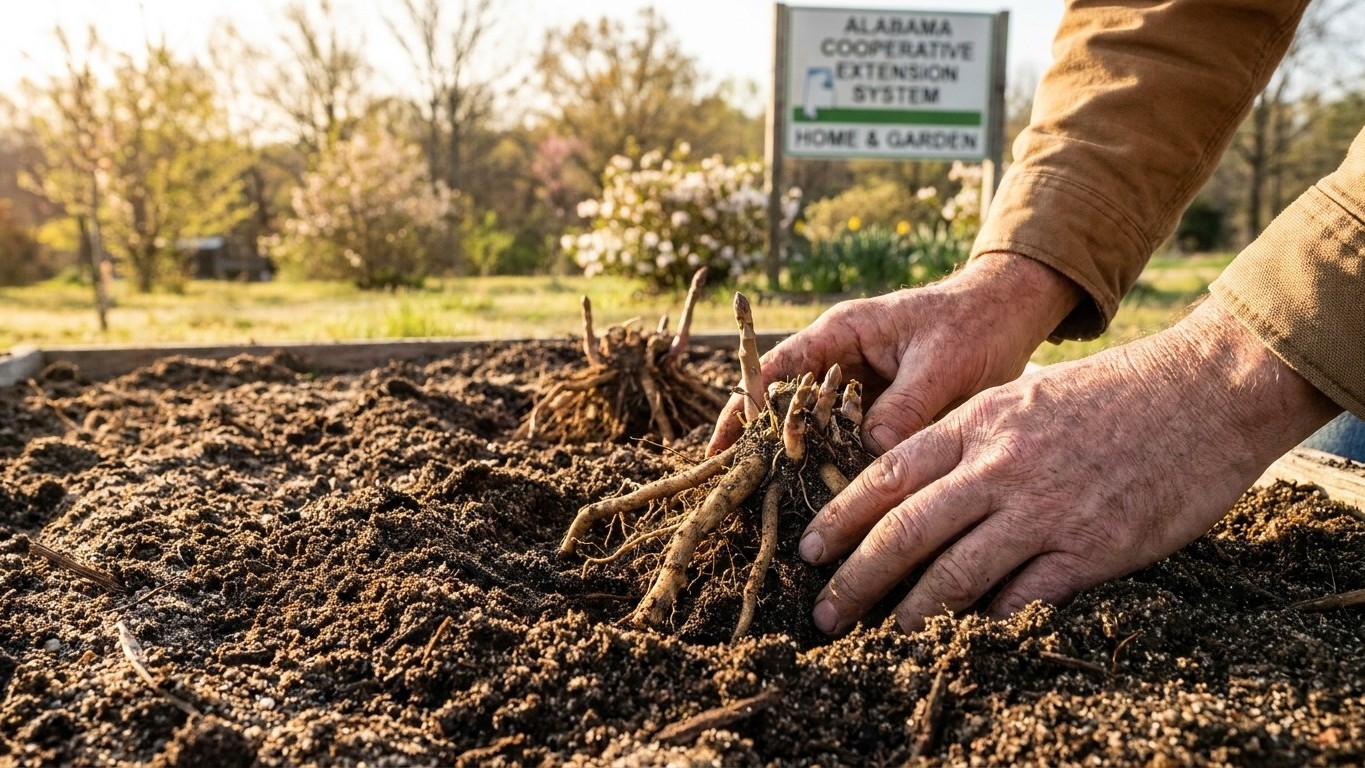

The short answer is early spring, once the soil has warmed enough to work and the coldest nights are behind you. But that single sentence hides a bigger decision: an Asparagus Bed isn’t a plant you swap out next season. It’s a fifteen-year lease on a patch of your yard, and the ground you choose matters more than the calendar date you pick.
The short answer
Asparagus crowns go into the ground as a one-time investment. Plant them right and that bed feeds a household for 10 to 15 years before it needs replacing, according to Utah State University Extension. That timeline changes how you should think about the soil question. A tomato bed with drainage trouble is an annual headache you can fix with raised rows next year. an Asparagus Bed with drainage trouble is a problem you live with for a decade and a half, because crowns planted in soggy ground rot before they ever get a chance to grow.
The source is specific but not fussy: asparagus tolerates most soils, provided they drain. That’s the only real requirement, and it rules out low spots, heavy clay pans, and anywhere water still sits a day after a hard rain.
What Georgia’s representative soil tells you
The USDA lists the Tifton series as the soil representative of Georgia, and it happens to answer the drainage question well. Sampled across 173 components statewide, the Tifton series surface horizon runs 84 percent sand, 6 percent clay, and 9 percent silt, with organic matter around 0.8 percent, and USDA classifies it as well drained. Sand-heavy ground like that lets water move through quickly rather than pooling around a crown’s roots, which is exactly the condition asparagus wants.
None of that means your own backyard matches the state soil. The Tifton series is a mapped average, not a survey of every lot in Georgia. River bottoms hold water longer, hill country runs rockier, and any yard a builder has graded or filled can behave nothing like the series it technically sits on. If your soil is heavier clay and water lingers after rain, the fix isn’t to abandon the spot. Build the row up, work in coarse organic matter to open the structure, or set the bed on a raised mound so the crowns sit above the standing water line. The furrow itself starts at 8 inches deep regardless of what’s around it, so raising the surrounding grade is often easier than fighting a wet low spot for fifteen years.
Skip the guesswork on your own plot. A basic soil test, run before you dig, tells you whether you’re working with sand, clay, or something in between, and whether drainage needs help before the crowns go in the ground.
Will the summer here water it for you?
Newly planted asparagus is thirsty for its first two growing seasons, then it settles into a lighter routine. The target is 1 to 2 inches of water every other week for those first two years, dropping to about every three weeks once the crowns are established. Georgia’s summer rainfall doesn’t hand you that on a schedule, so here’s how the numbers line up against what you’ll need to add.
- June brings about 4.54 inches of rain on average, which can cover roughly two to three of the every-other-week targets for an establishing bed, assuming it falls evenly rather than in one heavy storm that mostly runs off.
- July follows close behind at about 4.75 inches, the wettest of the three summer months, giving young crowns their best natural coverage of the season.
- August is the driest summer month at about 4.3 inches, and it’s also typically the hottest stretch, so evaporation eats into whatever rain does fall faster than in June or July.
- Add it up and summer delivers about 13.6 inches across June, July and August, against roughly 50.4 inches for the year, according to the NOAA reference station normals. That’s a fair amount of water on paper, but normals describe an average month, not the week you’re actually watering.
- The practical move is a rain gauge on your own bed. Sandy ground drains fast and dries fast, so a sand-heavy row can need supplemental water even in a wet month, while heavier soil holds moisture longer between storms. Track what actually falls on your plot and top off the difference by hand or with drip irrigation, rather than trusting the calendar to cover it.
None of these figures are a forecast. They’re a 1991-2020 normal for one reference station, and a rain shadow, a slope, or even a nearby parking lot can shift what lands on your particular bed.
When to put the crowns in
Crowns go into the ground in early spring, timed around the last frost rather than a fixed date on the calendar. For the reference station used in Georgia’s climate normals, the last spring freeze at 32F falls somewhere between March 11 and March 29, based on NOAA’s 30-70 percent freeze probability band. That’s a range, not a single day, so treat it as the window to work around rather than a deadline. Plant crowns once that stretch has mostly passed and the soil is dry enough to work without turning to mud in your hands.
Say “around” and mean it. A mean frost date is an average built from decades of data at one station, not a promise about this particular spring. Atlanta’s own reference station sits at an urban airport, which runs a little warmer than the surrounding area, so North Georgia and the mountains can freeze several weeks earlier in fall, and the coastal plain tends to run milder than the statewide average suggests. Whatever region you’re in, watch your own ground and local frost history rather than leaning on a single station’s number.
Crowns aren’t the only path in. Seed is the alternative route, though it adds a full extra year before the plant reaches transplant size, since seedlings need to grow to crown stage before they go into the permanent bed. Most home gardeners skip that wait and start with crowns for a faster path to a producing row.
If you’re buying crowns, Utah State University Extension names four varieties without ranking them on flavor or yield: Jersey Giant and Jersey Knight are all-male types, while UC 157 F1 and Purple Passion are male/female varieties. The source doesn’t publish a reason to prefer one over another, so the choice comes down to what’s available locally rather than a documented performance difference.
Once crowns are in the 8-inch furrow, don’t fill it in all at once. Backfill gradually, adding about 2 inches of soil every other month across the season as the shoots grow up through the loose fill. And however early the row looks, no cutting happens the first two years. Year three brings the first harvest, limited to about 4 weeks, followed by 6 weeks the next year and 8 weeks once the bed is fully established. Stop cutting each season when most of the spears coming up are thinner than a pencil, a sign the plant needs its remaining energy to rebuild the crown for next year.
Common questions
Can I Plant Asparagus Crowns in fall in Georgia instead of spring?
The source specifies early spring planting for crowns, tied to the ground warming up after the last frost window. It doesn’t cover a fall planting timeline for this region, so spring remains the documented approach.
Does Georgia’s soil need lime or fertilizer before planting asparagus?
The source is silent on soil pH and nutrient amendments for asparagus specifically. What is published is that the crop tolerates most soils as long as they drain, so a soil test focused on drainage and structure is the practical first step, with pH questions left to that test rather than a blanket statewide recommendation.
How long before an Asparagus Bed in Georgia produces a real harvest?
Three years minimum. No cutting happens in years one and two while the crowns establish. Year three allows about 4 weeks of harvest, extending to 6 weeks in year four and 8 weeks once the bed matures, always stopping for the season once most spears run thinner than a pencil.
Will the four named asparagus varieties grow differently in Georgia’s climate?
Utah State University Extension names Jersey Giant, Jersey Knight, UC 157 F1, and Purple Passion by their sex type only, all-male or male/female, without publishing flavor, yield, or regional performance differences. No documented reason favors one variety over another for Georgia conditions specifically.