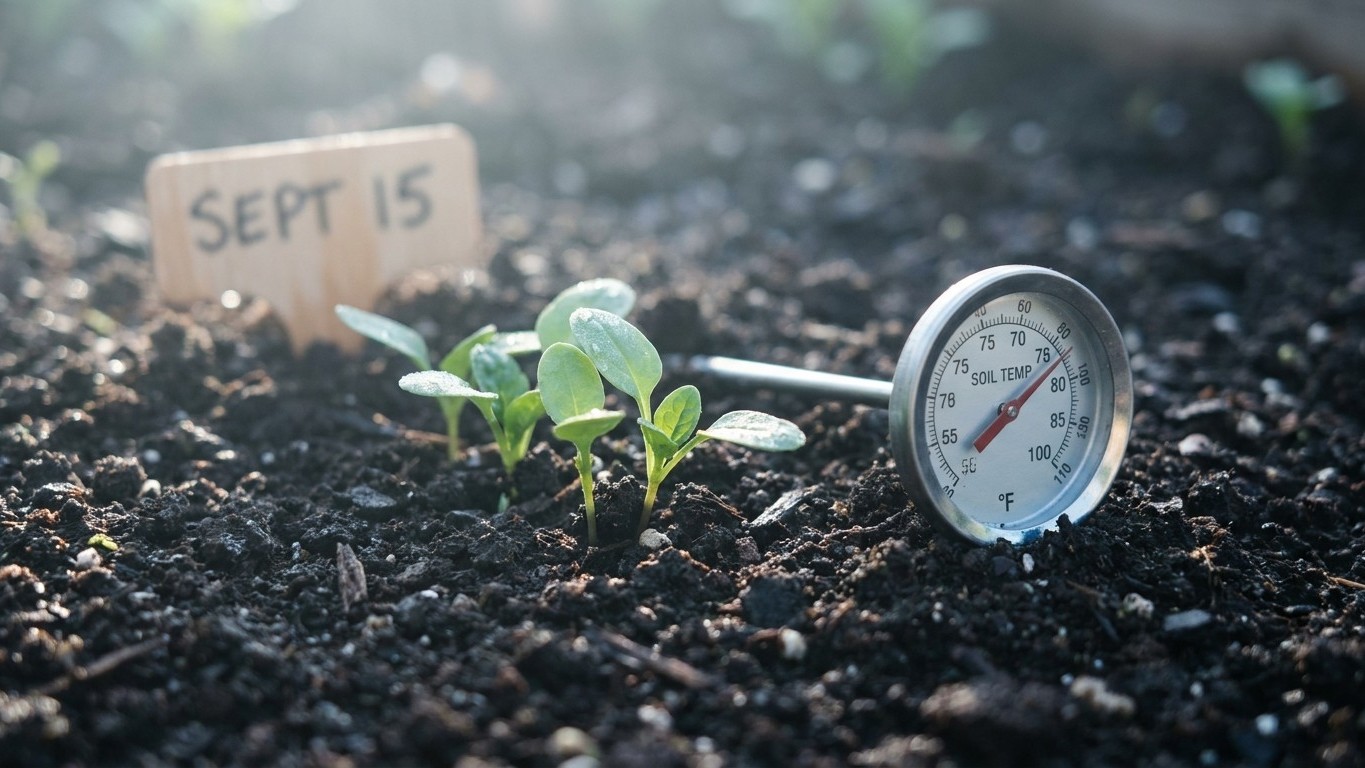

In Delaware, autumn spinach goes into the ground from roughly mid-August through early September, timed backward from a harvest before the first fall frost. That window is set less by cold than by soil that’s still too warm to let seed germinate well. Get the timing wrong in either direction and you either fight failed germination or run out of season before the plants size up.
The short answer
On the longest day of the year, the Wilmington area sees 14 hours and 49 minutes of daylight. For spinach, that number matters for one reason only: long days push the plant toward flowering, a process gardeners call bolting. A cool summer doesn’t cancel that signal. Even if temperatures stayed mild all July, the day length alone would still be nudging spinach toward seed stalks rather than leaves. That’s a different mechanism than the heat-driven bolting most vegetable gardeners think about, and it means a shady, cool corner of the yard buys you very little once the calendar rolls past the solstice.
Heat compounds the problem here. Delaware’s reference station averages 17.6 days a year at 90 F or hotter, and spinach growth quality falls apart well before that mark: the plant does its best work below 75 F. Once daytime highs push past that ceiling, growth slows, leaves turn bitter, and the plant is primed to bolt at the first long stretch of daylight. So the limiting factor in Delaware isn’t one or the other. It’s both, working together. Long days set the bolting clock in motion, and the state’s heat load speeds the plant toward that same outcome from the other direction.
That combination is exactly why spinach here behaves as two short seasons rather than one long one. Spring plantings have to get established and harvested before the days lengthen and temperatures climb. Autumn plantings have to wait out the hottest stretch of soil, then race the shortening days and the first hard frost. There’s no version of a Delaware summer where spinach simply keeps growing. Between the day-length trigger and the heat load, summer is a dead zone for this crop, not a slow season.
Nothing here contradicts what you may already know about other vegetables. Onions respond to long days by forming bulbs, a genuinely useful reaction to summer daylight. Spinach doesn’t get that benefit. For a leaf crop, the same long day that helps an onion size up its bulb is the signal telling spinach to stop producing leaves and start producing seed. That’s worth remembering any time daylight length comes up in the vegetable garden, because it means opposite things depending on what you’re growing.
How long the spring window really is
- Spinach seed goes in the ground 2 to 3 weeks before the last spring frost. At the Wilmington-area reference station, that last frost falls between April 3 and April 14, so the earliest sowing dates land in mid-March, with the latest safe sowing about three weeks after that, into early April.
- From there, the clock is running against day length and heat rather than cold. Growth stays good only while temperatures stay under 75 F, and Delaware’s climate normals show a fast climb toward summer heat, with the station averaging 17.6 days a year at 90 F or above. That kind of heat load doesn’t build gradually over months; it tends to arrive in a compressed stretch once late spring turns to early summer.
- Put those two boundaries together and the usable spring window in Delaware runs from roughly mid-March sowing to a harvest that needs to wrap up before the days grow long and the heat climbs past that 75 F ceiling, typically leaving something in the neighborhood of six to eight productive weeks before the plants start bolting or turning bitter.
- That’s a real but narrow window. It rewards gardeners who get seed in the ground at the earliest safe date rather than waiting, since every week of delay eats directly into the harvest before bolting sets in.
Frost dates from the reference station are a starting point, not a guarantee for every yard. Suburban and rural gardens around the state often see that last spring frost arrive later than the airport station records, sometimes by one to two weeks, and even later at higher elevations. Anyone gardening outside the immediate Wilmington area should check local frost history before locking in a sowing date.
The autumn crop, and when the soil lets you sow
Autumn Spinach in Delaware has to clear two separate obstacles before it becomes a realistic harvest, and they sit at opposite ends of the calendar.
Soil still too warm to germinate
Spinach seed germinates poorly once soil temperature climbs above 80 F, according to Utah State University Extension. That threshold, not any calendar date, is what actually opens the autumn sowing window in a state with Delaware’s heat load. With 17.6 days a year averaging 90 F or hotter at the reference station, soil in exposed garden beds stays hot well into late summer, often lagging behind cooling air temperatures by a couple of weeks. Practically, that means sowing too early in August risks poor or spotty germination, even if the air feels tolerable, because the soil hasn’t caught up yet.
Racing the first frost
On the other end, the first fall frost at the reference station arrives between October 26 and November 7. Utah State University Extension’s guidance for a fall crop is to plant 50 to 75 days before the date you want to harvest. Aiming for a harvest by October 26, the earlier end of that frost window, puts the sowing date somewhere between mid-August and early September: about 75 days back lands near August 12, and about 50 days back lands near September 6. That gives Delaware gardeners a practical target of sowing from mid-August through the first week of September, adjusted earlier if soil is still running hot or later if a particular yard tends to stay warmer than the reference station.
As with spring, the reference station’s frost dates aren’t a statewide promise. Rural and suburban gardens frequently see the first fall frost arrive earlier than the airport station shows, sometimes by one to two weeks, which shortens the safe sowing window further. Checking a local frost record, rather than relying on the state average alone, is the difference between a full autumn crop and one cut short.
Four spinach varieties commonly come up in seed catalogs and extension guidance: Bloomsdale, Melody, Teton, and Olympia. The sourced data for this article doesn’t include maturity dates, disease resistance ratings, or bolt-resistance comparisons for any of them, so none of that is included here. Anyone choosing between varieties should look at seed packet information for the specific maturity window, since that number isn’t published in the climate data this guidance is built on.
Common questions
Can I sow spinach in Delaware in midsummer to fill the gap between spring and fall crops?
Not with good results. Midsummer sits squarely inside the long-day, high-heat stretch that triggers bolting and drops growth quality below the 75 F threshold. Soil temperatures during this period also tend to sit above the 80 F germination ceiling, so seed sown in July is fighting both problems at once.
Why does a cool, shady spot in the garden not help spinach get through summer?
Shade can lower leaf temperature somewhat, but it does nothing about day length, and day length alone is enough to trigger bolting regardless of how cool the plant feels. The two triggers, long days and heat, work independently, so removing only one still leaves the other in place.
Is frost actually a problem for Autumn Spinach in Delaware, or just the endpoint?
Frost timing sets the outer edge of the autumn harvest window, since the plan is to count 50 to 75 days back from a harvest date near the first fall frost. But frost itself isn’t what blocks sowing. The real obstacle earlier in the season is soil still too warm to germinate well, not cold.
Should I trust the frost dates from the Wilmington reference station for my own yard?
Use them as a starting reference, not a fixed rule. Suburban and rural gardens across the state often see the last spring frost later and the first fall frost earlier than the airport station reports, sometimes by one to two weeks, and more at higher elevations. Checking local frost history will sharpen both the spring and autumn sowing windows described here.