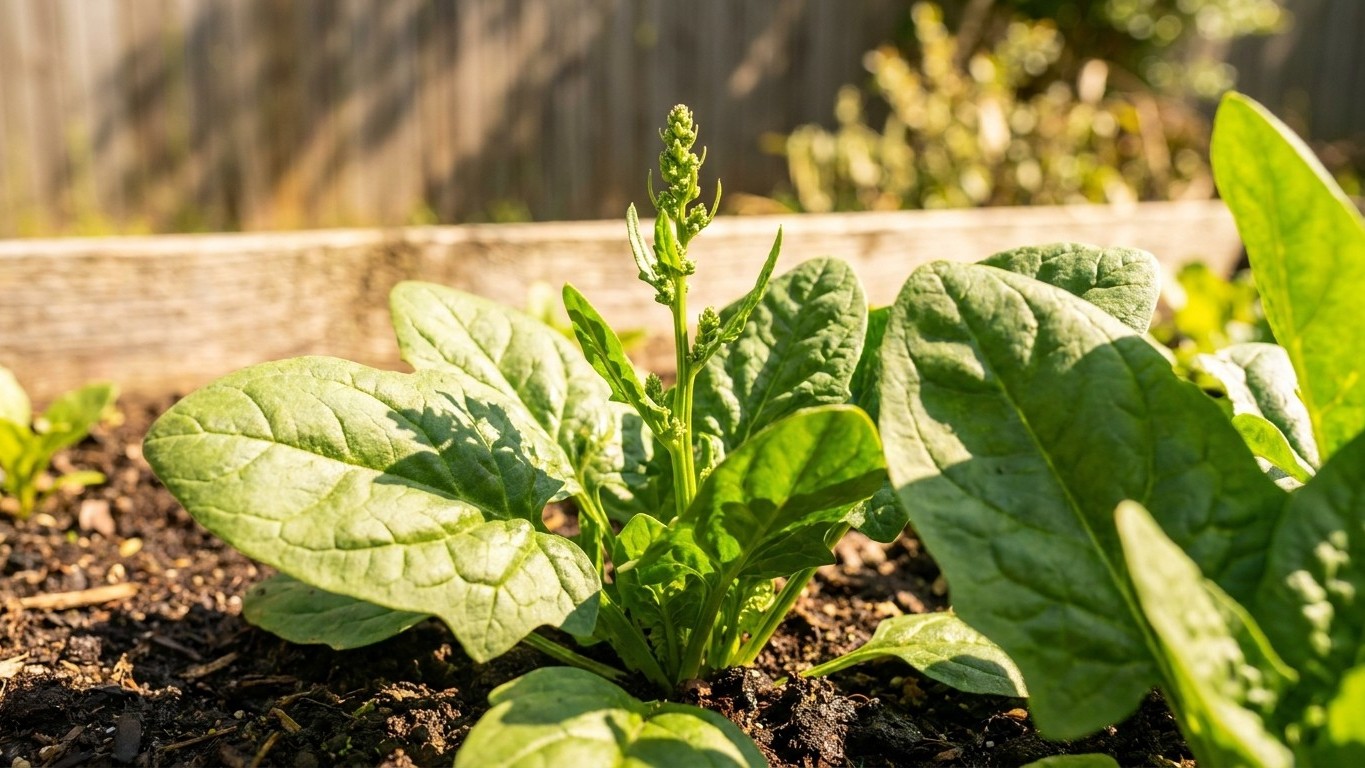

No. Georgia’s summer days stretch to 14 hours and 14 minutes at the solstice, and that alone is enough to push spinach into flower long before the calendar says summer has arrived. Add in a state where the thermometer clears 90 degrees on average 35.8 days a year, and spinach faces a double squeeze: the light tells it to bolt, and the heat backs that signal up. The real question for a Georgia gardener isn’t whether spinach will bolt early. It’s how many weeks of good growth you can squeeze in before it does.
The short answer
Spinach bolts (sends up a flower stalk and turns bitter) in response to two triggers working together: long daylight hours and warm temperatures. Georgia delivers both, and it delivers them fast. At 14 hours and 14 minutes of daylight on the longest day of the year, the state sits well past the point where spinach starts reading the calendar as “time to flower.” That’s a fixed, physical signal. It doesn’t matter whether the summer that follows is mild or scorching. The day-length trigger fires on schedule every year, tied to the sun’s position, not the thermometer.
Where Georgia adds insult to injury is the heat. Spinach grows best when temperatures stay under 75 degrees Fahrenheit. Past that ceiling, growth slows and the plant becomes more likely to bolt and to turn bitter in the leaf. Georgia’s climate normals show 35.8 days a year reaching 90 degrees or higher at the reference station, a heat load that has nothing to do with a mild Vermont or Minnesota summer. That means the state doesn’t just cross the 75-degree line once in early summer and hold there. It blows past it and keeps climbing for a good chunk of the season.
So the honest answer is: both mechanisms are working against you in Georgia, not just one. In a cooler northern state with the same long summer days, growers sometimes get a partial reprieve because the air stays under 75 degrees longer into the season, buying a few extra weeks before bolting sets in hard. Georgia doesn’t get that grace period. The day length triggers flowering on the same solar schedule as anywhere else at this latitude, and the heat arrives early enough and hard enough to reinforce it rather than soften it. Put plainly: there’s no version of a Georgia summer, however wet or overcast, that keeps spinach in a leafy, non-bolting state past the point where the days get long. The plant is responding to the sun angle overhead as much as to the mercury in the thermometer, and only one of those is negotiable.
This is why Spinach in Georgia is treated as a strict spring-and-fall crop, never a summer one. Growers who try to stretch a spring planting into June are usually fighting a battle they can’t win, watching plants shoot up a central stalk and turn tough no matter how much they water or shade the bed.
How long the spring window really is
- Start with the sowing rule. Spinach seed goes in the ground 2 to 3 weeks before the last expected frost, not after it. That’s the standard timing for a cool-season crop that tolerates a light freeze better than it tolerates heat.
- Anchor that to Georgia’s frost date. The last spring frost at the reference station falls somewhere between March 11 and March 29. Counting back 2 to 3 weeks puts a realistic sowing date in the last days of February through the first half of March, depending on exactly where in that range your particular spring lands.
- Mark the point where growth stops being good. Spinach’s performance ceiling sits at 75 degrees Fahrenheit. Once daytime highs start holding above that mark on a regular basis, and once the long days of late spring are fully in force, the plant’s days as a productive leaf crop are numbered.
- Watch how fast Georgia gets there. This is where the state’s climate works against a long harvest. Spring in Georgia doesn’t ease into summer heat gradually the way it might farther north. Afternoon highs climb into the 80s well before the calendar reaches late spring, and by the time day length alone would be pushing spinach toward bolting, the heat has usually already arrived to speed the process along.
- Add it up. Sown in late February to mid-March, and pushed into bolting by the combination of rising heat and lengthening days, Georgia’s usable spring spinach window runs roughly six to eight weeks. That’s enough time for a full harvest of baby leaves and a partial harvest of mature leaves for most home gardeners, but it leaves no room for a leisurely, staggered planting schedule the way a cooler climate might allow.
Variety choice is often raised at this point, and four names come up repeatedly in spinach growing guides: Bloomsdale, Melody, Teton, and Olympia. Utah State University Extension names these varieties without publishing specific maturity dates or heat-tolerance ratings for any of them, so no claim here should be read into which one buys extra time in a Georgia bed. The window described above applies regardless of variety choice.
The autumn crop, and when the soil lets you sow
Fall is where Georgia gardeners usually have better luck with spinach than spring, mostly because the day length is heading in the right direction, shortening rather than lengthening as the season goes on. But two separate obstacles still bracket the fall planting window, and they don’t move together.
Soil that’s still too warm to germinate
Spinach seed germination drops off once soil temperatures climb above 80 degrees Fahrenheit. That’s not an occasional problem in Georgia, it’s the default state of the soil for most of late summer. With 35.8 days a year hitting 90 degrees in the air, the ground beneath a Georgia garden bed holds heat well past Labor Day in most years. Sowing spinach seed into soil still sitting above that 80-degree mark usually means poor, patchy germination rather than an outright failure, but it wastes seed and time. The practical result is that an early September sowing date, which might work fine in a cooler state, is often still too warm underground in Georgia. Waiting until the soil has genuinely cooled, typically deeper into September, produces a far more reliable stand.
The frost that ends the season
On the other end of the calendar sits the first fall frost, which arrives at the reference station somewhere between November 13 and December 1. Utah State University Extension’s guidance for a fall crop is to sow 50 to 75 days before the date you want to harvest. Working backward from a harvest target in early-to-mid November, a 50-to-75-day count lands the sowing date somewhere in the window running from late August through late September.
Overlay that against the soil-temperature problem and the realistic sowing window narrows considerably. The late-August end of the 50-to-75-day count is usually still too warm in the ground for good germination in Georgia, even though it fits the frost math. That pushes the practical sowing date toward the back half of that range, closer to mid-to-late September, when soil has cooled enough to sprout the seed reliably and there’s still enough of the 50-to-75-day count left before frost shuts things down. It’s a narrower window than the frost date alone would suggest, squeezed from the early end by warm soil and from the late end by the arrival of the first hard freeze.
Gardeners in north Georgia and the mountains should treat the November 13 end of that frost range as more relevant to their location, since higher elevations freeze several weeks earlier than the Atlanta-area station the frost dates are drawn from. Coastal plain growers, by contrast, often see conditions closer to the December 1 end of the range, giving a few extra weeks of room on the back end of the fall crop.
| Season | Main obstacle | What limits it | Approximate window |
|---|---|---|---|
| Spring | Day length plus rising heat | Bolting triggered once days lengthen and highs push past 75 F | Roughly 6 to 8 weeks from late February/early March sowing |
| Fall | Warm soil, then frost | Germination fails above 80 F soil; season ends at first hard frost | Sowing typically mid-to-late September, per the 50-to-75-day count |
Common questions
Can shade cloth stop spinach from bolting in Georgia?
Shade cloth can lower leaf temperature somewhat, which helps with the heat side of the equation, but it does nothing to change day length. Since day length alone is enough to trigger bolting once the growing season runs into late spring, shade cloth delays the problem more than it solves it.
Is fall-sown spinach less likely to bolt than spring-sown spinach in Georgia?
Generally yes, because day length is shortening through the fall growing period rather than lengthening, removing one of the two triggers that push spinach toward flowering. Soil warmth at sowing time remains the main obstacle for a fall crop, not bolting itself.
Does the 75-degree threshold mean spinach dies above that temperature?
No. It’s a performance ceiling, not a survival limit. Growth slows and the plant becomes more prone to bolting and to bitter-tasting leaves once temperatures climb consistently above 75 degrees Fahrenheit, but the plant itself doesn’t simply die at that mark.
Why does soil temperature matter more than air temperature for fall sowing?
Germination is a below-ground process. Seed sitting in soil above 80 degrees Fahrenheit struggles to sprout even if the air above it feels comfortable, particularly in early morning or evening. Georgia’s soil holds summer heat well after the air has started to cool, which is why sowing too early in fall often produces a thin, uneven stand.