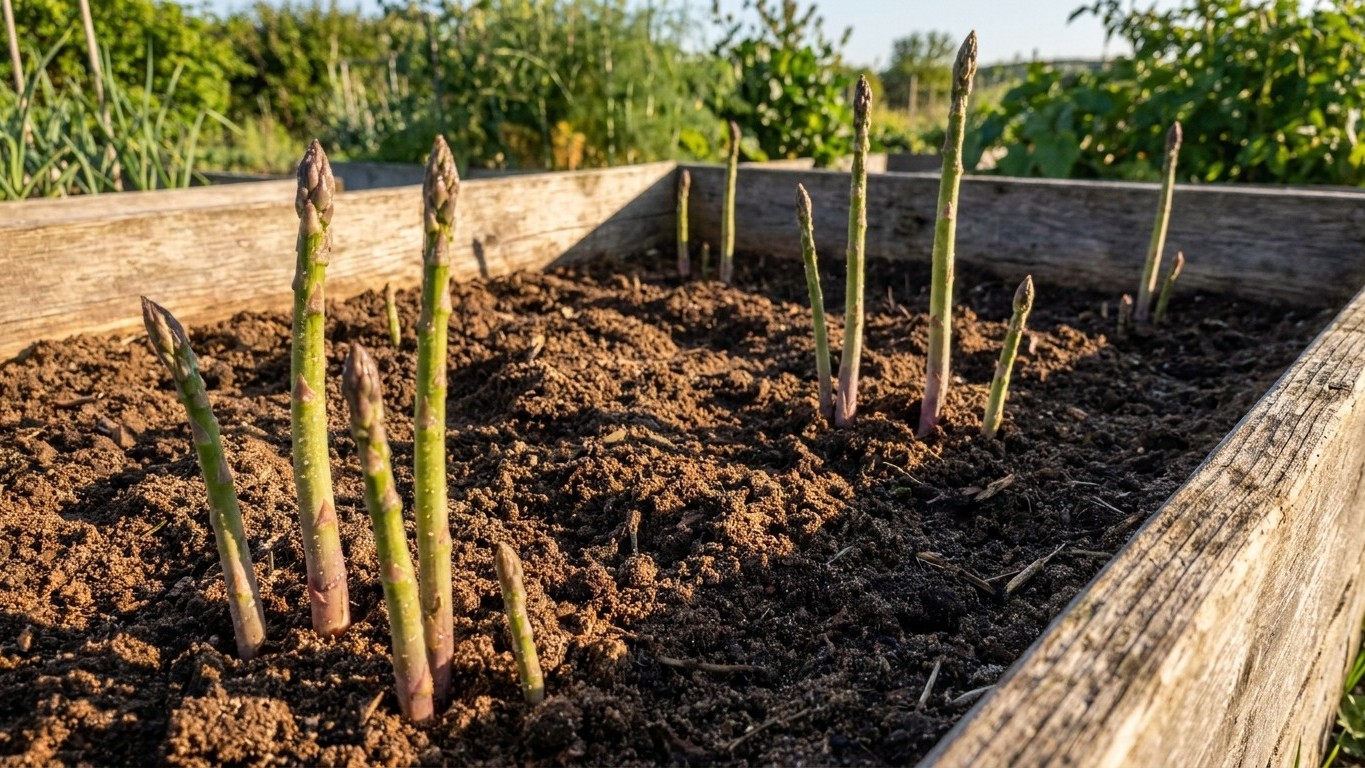

Idaho’s representative soil, an Andisol built from volcanic ash, drains moderately well on its own terms, and that happens to be the only soil requirement asparagus actually carries. That’s the encouraging part. The harder part is that this state soil describes one mapped series, not the dirt under any single backyard, and a fifteen-year bed forgives almost nothing once it’s in the ground.
The short answer
an Asparagus Bed is not a normal vegetable planting. Once the crowns settle in, the bed keeps working the same patch of ground for ten to fifteen years, and the first three of those years give nothing back at all. No spears get cut in year one or year two. Year three brings a short harvest window, about four weeks, before the plant is left alone to build strength again. Year four stretches to roughly six weeks. From year five onward, the harvest runs about eight weeks, and the rule for stopping isn’t a date on a calendar, it’s what the spears look like: once most of them come up thinner than a pencil, cutting stops for the season, whenever that happens to fall.
That kind of commitment is exactly why drainage matters more here than with almost anything else grown in a home garden. The Threebear series, which USDA lists as representative of Idaho, is described as moderately well drained: light, porous, volcanic-ash material that holds onto both water and phosphorus unusually well for a mineral soil. The texture reads as loam to silt, roughly 35 percent sand, 15 percent clay and 50 percent silt at the surface. On paper, that’s a workable structure for a crop that mainly asks to never sit in standing water.
Two numbers from that same soil record deserve a second look before anyone trusts them at face value. The surface pH sits around 5.0, strongly acid, and the organic matter figure runs close to 75 percent. That organic-matter number is the tell: anything above roughly 20 percent usually means the mapped surface is a natural organic layer, peat, muck, or forest litter, not a tilled garden bed. A worked vegetable patch will not carry anything close to that figure, so neither number should be read as a stand-in for what’s actually under a gardener’s boots. The source on asparagus itself is silent on soil pH entirely, so there’s no published target to chase here anyway.
What actually decides whether a given yard can carry a bed for fifteen years is a home soil test and a simple observation: does water sit on the surface an hour after a hard rain, or does it disappear? If it disappears, the ground is probably fine. If it lingers, the fix isn’t amending it every spring, since nobody wants to dig into an established asparagus crown to rework the soil beneath it. The fix is building a raised bed or a mounded row before planting, so drainage is solved once, permanently, rather than fought every year for a decade and a half.
Will the summer here water it for you?
Once the bed is established, the watering rule is straightforward: about 1 to 2 inches every other week for the first two years, tapering to about 1 to 2 inches every three weeks after that. What a given summer contributes toward that number depends entirely on where the reader’s garden sits, but the regional normals for this area give a useful baseline.
- Check what summer actually delivers. Across June, July and August combined, the region’s 1991-2020 climate normals show about 1.1 inches of rain total for the entire three-month stretch. Broken down by month, that’s roughly 0.75 inches in June, 0.21 inches in July, and just 0.17 inches in August, the driest month of the growing season.
- Compare that to what the bed needs. At 1 to 2 inches every other week across a thirteen-week summer, an established bed calls for somewhere between roughly 6 and 13 inches of water over that stretch. Against 1.1 inches of natural rainfall, nearly all of that has to come from a hose or an irrigation line, not the sky.
- Weight the shortfall toward July and August. June at least offers something close to three-quarters of an inch. By August, with only 0.17 inches expected, the bed is functionally on manual watering for the entire month, regardless of how the spring behaved.
- Let the soil buy a little time, not skip a week. A porous, volcanic-ash surface like the Threebear series holds water more efficiently than a straight sandy soil would, which can stretch the interval between waterings slightly. It does not erase the gap between 1.1 inches of rain and 6 to 13 inches of demand.
- Confirm with a rain gauge on the actual plot. These are station normals, not a forecast for one backyard. A slope, a windbreak, or a spot that sits in a different microclimate than the reference station can shift the real number in either direction, so a simple gauge settles the question better than any regional average can.
When to put the crowns in
Crowns go into the ground in early spring, and for this region that window sits around the last spring frost date, which the 1991-2020 climate normals place somewhere between April 23 and May 7 for the reference station used in these figures. That’s a mean date built from three decades of records, not a guarantee for any single spring, so “around” is the operative word rather than a fixed line on the calendar. It’s also worth remembering that reference station sits in a low valley; most of the state runs higher and colder, with a shorter window on both ends of the season, so a grower well outside that valley should treat the date as a rough anchor and watch their own local conditions rather than count on it directly.
The planting itself goes into furrows about 8 inches deep. The crowns are set at the bottom, and the furrow is not filled in all at once. Backfilling happens gradually across the year, adding roughly 2 inches of soil back into the trench every other month as the new growth pushes up, rather than burying the crown under a full 8 inches on planting day.
Seed is the alternative route to crowns, for gardeners who’d rather start from scratch than buy established roots. The source material here centers on crown planting in early spring and doesn’t lay out a separate seed-starting calendar, so anyone going that direction should treat it as a different timeline than the one above, worked out on its own terms rather than borrowed from the crown schedule.
On variety, Utah State University Extension names four options without ranking them on flavor or yield: Jersey Giant and Jersey Knight, both all-male varieties, and UC 157 F1 and Purple Passion, both male and female. That’s the full extent of what’s published, sex of the plant and nothing more, so there’s no documented reason from that source to favor one over another. Anyone choosing between them is choosing on availability or personal preference, not on any published performance difference.
Common questions
Does Idaho’s soil pH need to be adjusted before planting asparagus?
The asparagus source used here doesn’t publish a pH target at all, so there’s no benchmark to adjust toward. The state’s representative soil reads around 5.0 at the surface, strongly acid, but that figure describes one mapped series’ native surface horizon, not a tilled bed, and shouldn’t be treated as the reader’s own number without a test.
How do I know if my own yard drains well enough for a fifteen-year bed?
Watch a spot after a hard rain. If standing water is gone within an hour or two, drainage is likely adequate. If it lingers for half a day or longer, that’s the moment to build up a raised bed or mounded row before planting, since asparagus can’t be dug up and reworked once it’s established without losing the crop.
Can I harvest a few spears in the first or second year if the bed looks strong?
No. The bed produces nothing to cut in year one or year two regardless of how vigorous it looks. The first harvest, a short window of about four weeks, doesn’t arrive until year three, and cutting early trades long-term yield for a handful of spears that aren’t worth the setback.
What tells me the harvest season is over each year?
Not a date. Once most of the spears coming up are thinner than a pencil, that’s the signal to stop cutting for the season and let the plant rebuild its energy for next year, whether that happens in early summer or later.