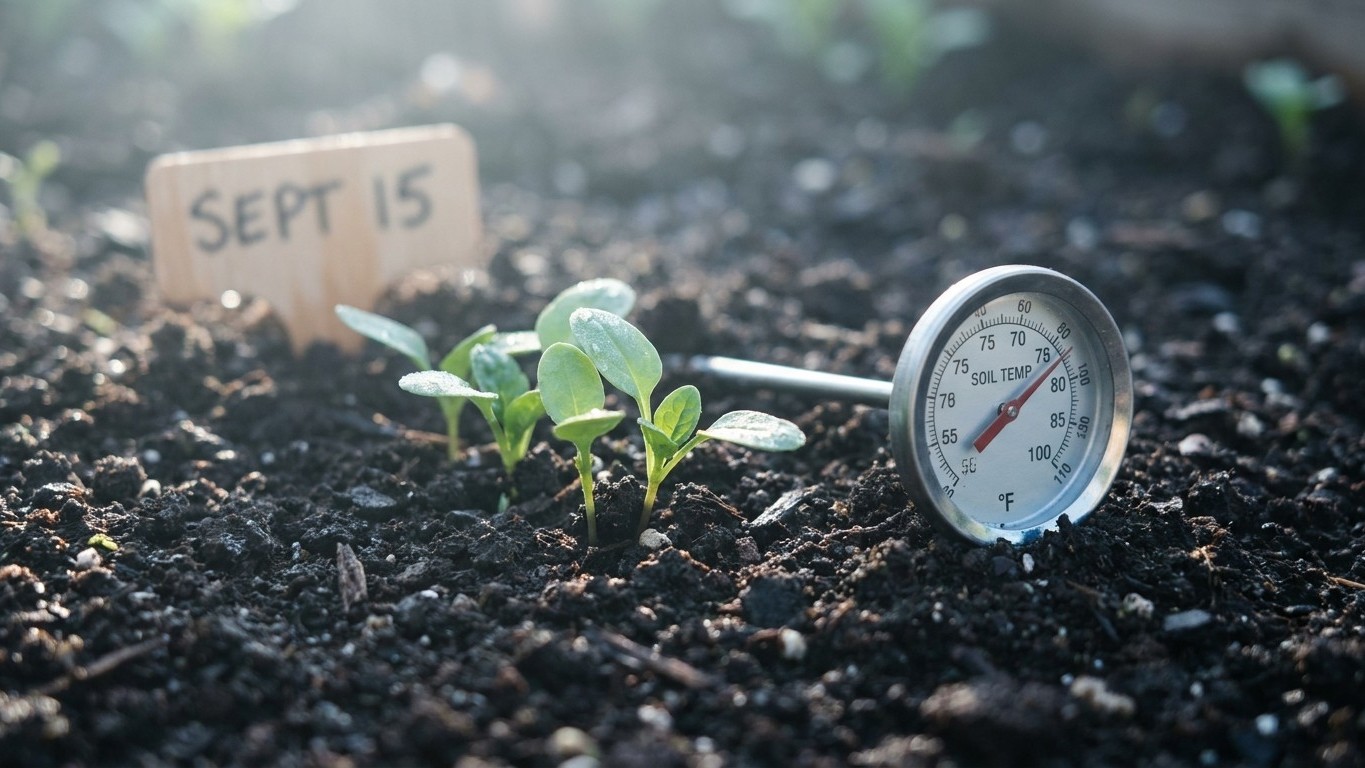

Sow Autumn Spinach in Idaho’s low valleys once the soil has cooled below 80 F, which typically happens by mid-to-late August, aiming for 50 to 75 days before the first fall frost expected between October 7 and 21. That timing dodges summer’s germination failure and still leaves enough days to mature before cold shuts things down. Higher, colder parts of the state need to shift that whole window earlier.
The short answer
Boise’s longest day of the year holds 15 hours and 15 minutes of daylight. For spinach, that’s not a bonus, it’s a warning. Long days push the plant toward flowering, or bolting, whether or not the thermometer cooperates, so a mild afternoon in June does nothing to slow a crop that’s determined to send up a seed stalk once daylight stretches that far. Gardeners who assume a cool spell buys them a few extra weeks of leafy growth are working against how the plant actually reads the calendar.
Heat compounds the problem instead of replacing it. The reference station near Boise averages 47.5 days a year at 90 F or hotter, a heat load concentrated in the same months when day length is longest. Spinach grows best below 75 F and turns bitter once it crosses that line, so the same stretch of summer that trips the bolting trigger also cooks the leaves into an unpleasant crop. Both mechanisms fire together, not one after the other, which is why a spinach patch can look lush one week and bolted the next during a July heat spell.
That double bind is why the limiting factor in Idaho isn’t day length alone, and it isn’t heat alone either. It’s both arriving at once. A garden at higher elevation, where day length changes little across a state this size but summer heat runs far milder, might squeeze out another week or two of decent leaves before bolting sets in. Down on a valley floor, where 90-degree afternoons stack up through July and into August, the plant has almost no room to stall.
This is also why the fall crop tends to outperform any attempt to stretch spring spinach through summer. Once day length starts shortening again after the solstice, the long-day trigger stops fighting against the plant. The catch, covered below, is that the soil has to cool first, and in a region that racks up nearly 50 days above 90 F a year, that cooling can take longer than the calendar suggests. Watching soil temperature rather than the date on the wall is the more reliable approach for anyone planning a second crop.
How long the spring window really is
- Start counting from the last frost. Spinach goes in the ground 2 to 3 weeks before the last spring frost, which at the reference station falls somewhere between April 23 and May 7. That puts sowing in early to mid-April for most low-valley gardens.
- Cold doesn’t stop this crop. Spinach germinates in cool soil and shrugs off a light frost, so there’s no need to wait for frost-free conditions the way tender crops like tomatoes require. The early sowing date is a real advantage.
- Day length keeps building anyway. Through May and June, daylight climbs toward that 15-hour-15-minute peak at the solstice, and the bolting pressure builds right along with it, independent of temperature.
- Heat arrives on a similar schedule. The 47.5 average days a year at 90 F or hotter mostly land in summer, but the climb toward that heat starts earlier, and spinach quality slips as soon as afternoons routinely cross the 75 F growth ceiling, well before outright failure.
- Add it up. From an early-April sowing to the point where long days and rising heat both turn against the crop, low-valley Idaho gardeners get something like six to eight usable weeks of good spring spinach, not a season-long supply. That’s why most treat the spring crop as a short, early harvest rather than something to stretch into summer.
The autumn crop, and when the soil lets you sow
Fall spinach solves the day-length problem simply by arriving after the solstice, but it runs into two different obstacles before it can get established.
Soil still too warm to germinate
Germination drops once soil temperature climbs above 80 F, according to Utah State University Extension. Even after daylight has started shrinking, Idaho’s soil holds onto summer heat for weeks. Given that the region logs 47.5 days a year at 90 F or hotter, mostly concentrated in July, soil in low valleys likely stays above that 80 F mark well into August. The practical fix is to check soil temperature directly rather than trust the date on a calendar; once it settles below 80 F reliably, usually as August cools toward September, sowing can begin. Gardens at higher elevation, which see fewer 90-degree days, tend to have cooler soil sooner, opening the fall window earlier than in the valley floor.
The frost that ends the season
Work backward from a harvest date instead of forward from a sowing date. The first fall frost at the reference station is expected between October 7 and October 21, according to NOAA’s 1991-2020 climate normals. Utah State University Extension gives no specific days-to-maturity figure for spinach, only a general planting rule: sow 50 to 75 days before the date you want to harvest. Using the midpoint of that frost window, around mid-October, counting back 50 to 75 days lands sowing somewhere between roughly the end of July and late August.
Overlay that with the soil-temperature obstacle above, and the realistic window narrows further. Since soil in the valley likely stays too warm through much of that early range, most fall crops end up sown in the second half of August, aiming closer to the 50-day mark than the 75-day mark so the harvest lands safely before the season’s cold arrives. Gardeners at higher elevation, where both frost and cool soil arrive weeks earlier, need to move the entire target range up accordingly, and should expect a shorter, tighter window than the valley floor allows. Boise sits low; most of the state sits higher and colder, with seasons that close in faster than these dates suggest.
Common questions
Can spinach be sown twice in one year in Idaho? Yes. A short spring crop, sown 2 to 3 weeks before the last frost, and a fall crop sown once soil cools below 80 F, are both workable, and they bracket the long-day, high-heat stretch of midsummer that spinach can’t tolerate well.
Does spinach need long summer days to grow? No. That’s the opposite of how the plant behaves. Long days push spinach toward bolting, not toward better growth. This is a different response than short-day onions, which use long days to trigger bulb formation. The two crops read the same signal in opposite ways.
What about gardens above the valley floor? Higher elevations in Idaho are colder, with a shorter frost-free season than the reference station near Boise. Both the spring sowing date and the fall sowing date need to shift earlier, and the fall harvest target needs to move up as well, since frost arrives sooner at altitude.
Which spinach varieties work best in Idaho? Bloomsdale, Melody, Teton, and Olympia are commonly grown varieties, but no performance data comparing them for Idaho conditions is published in the sources behind this article, so no variety-specific recommendation can be made here.