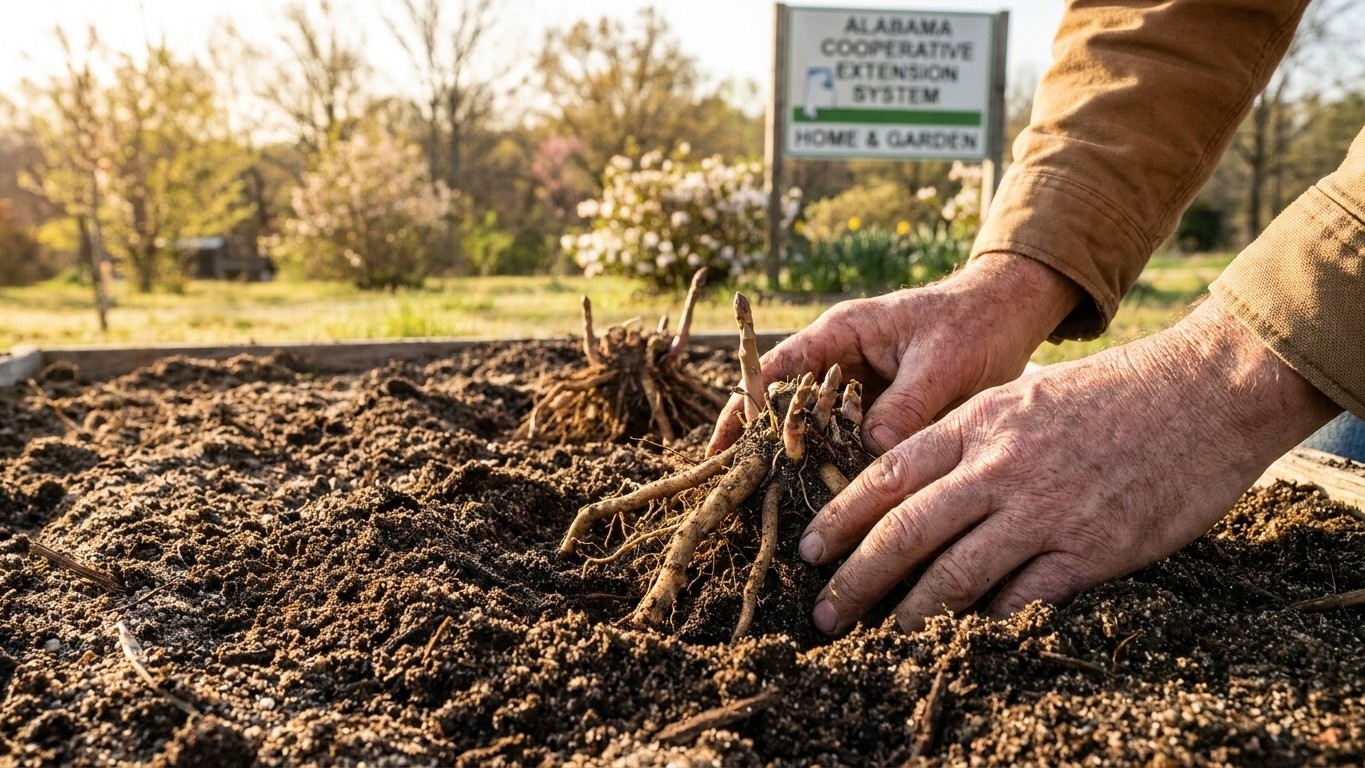

Plant asparagus crowns around early spring in Iowa, timed to land near the last spring frost window of April 12 to April 24. The bed you dig will still be producing spears a decade from now, so the real question isn’t just the calendar — it’s whether the ground you pick can handle a plant that isn’t going anywhere for 10 to 15 years.
The short answer
Asparagus is a plant you commit to, not a plant you rotate. Utah State University Extension notes the bed produces for 10 to 15 years once it gets going, and that most soils will work as long as one condition is met: the ground has to drain. That single requirement matters more here than the exact week you dig the furrow, because a soggy asparagus crown doesn’t recover the way a soggy tomato does. You can’t just pull it and replant somewhere else next season.
The soil USDA records as representative of Iowa is the Tama series, a Mollisol — the deep, dark prairie soil that built the reputation of the Corn Belt. It runs about 4 percent sand, 26 percent clay, and 70 percent silt at the surface, with organic matter around 3.5 percent and a surface pH near 6.5. USDA NRCS lists it as well drained. That’s a reasonable starting point: a soil this dark and this rich in organic matter, sitting on old prairie ground, generally moves water through rather than holding it in a puddle.
But “well drained” on a soil survey map and “well drained” in your actual backyard are two different claims. The Tama series is what USDA uses to represent the state broadly — it says nothing about the fill dirt around a newer subdivision, the low corner of a rural lot where water collects every spring, or a garden built over what used to be a farm pond. The state soil is a starting point, not a diagnosis of one garden. If you dig a hole a foot deep, fill it with water, and it’s still standing there hours later, that’s your answer regardless of what the county soil map says.
If your ground doesn’t drain on its own, the fix isn’t to force asparagus into it and hope. Utah State’s guidance is that most soils are fine provided they drain, which leaves the door open for gardeners to build a raised bed or a mounded row instead of fighting a heavy, wet spot for fifteen years. Given that this crop only asks for one soil condition, and given how long you’re locked into wherever you plant it, spending an afternoon building drainage into a raised bed before you ever place a crown is cheap insurance against a decade and a half of standing water.
On soil pH, no figure is published here for what asparagus specifically wants, and none should be invented. The Tama series runs slightly acid at about 6.5, which is simply a description of that reference soil, not a recommendation for the crop.
Will the summer here water it for you?
an Asparagus Bed needs 1 to 2 inches of water every other week for its first two years, then eases to about every three weeks once it’s established. Iowa summers don’t hand that over evenly, and the numbers show why the gardener still has to pay attention through July.
- What the region delivers. Across June, July and August, the area around the reference station averages about 13.2 inches of rain, with June the wettest at 5.26 inches, August close behind at 4.17 inches, and July the driest stretch of the summer at just 3.82 inches.
- Where the gap shows up. Spread over roughly 13 weeks of summer, that 13.2 inches works out to something close to an inch a week on average — but July’s 3.82 inches is noticeably behind June and August, meaning the mid-summer stretch is where a new asparagus bed is most likely to fall short of its every-other-week target.
- What normals don’t capture. These are 1991-2020 averages for one reference station, not a forecast for this season and not a measurement of your yard. Rain that falls as one heavy thunderstorm can run off a slope or a compacted patch of ground rather than soaking down to root depth, even in a month that looks wet on paper.
- The soil connection. A silty, well-drained soil like the Tama series lets water move through rather than pooling, which is good for root health but also means it holds less water in reserve than a heavier clay would. That cuts both ways: less risk of rot, but less buffer during a dry July.
- The practical move. Set a rain gauge in the bed itself during the first two summers. If a two-week stretch comes up short of an inch or two, especially in July, add water by hand rather than assuming the sky will catch up in August.
When to put the crowns in
Crowns go in during early spring, planted about 8 inches deep in a furrow, according to Utah State University Extension. In this territory, that window sits around the last spring frost date, which the NOAA NCEI 1991-2020 climate normals place between April 12 and April 24 for the reference station. That’s a mean, not a guarantee — some springs run earlier, some later — so treat it as the target you plan around rather than a date circled in permanent marker. Iowa State Extension’s own county-level figures, drawn from a longer 1950-2021 record, tend to run about 4 days later in spring than this airport station, which is worth keeping in mind if your garden sits well outside town.
The furrow itself isn’t backfilled all in one afternoon. Crowns are set at that 8-inch depth and covered gradually across the season, with soil added back in roughly two-inch increments every couple of months as the new shoots grow up through the loosely filled trench. Rushing to fill the whole furrow at planting time defeats the point of setting the crowns that deep in the first place.
Seed is the alternative route, and it’s worth naming because not every gardener starts with crowns. Starting from seed simply adds time to a project that’s already a long-term one — you’re growing a plant to crown size before it ever goes into its permanent bed, on top of the three years before any harvest begins. For most home gardeners, buying crowns and setting them directly around the early-spring frost window is the more direct path, but seed remains an option where crowns aren’t available or where a gardener wants more variety choice than the local nursery carries.
On varieties, Utah State University Extension names four: Jersey Giant and Jersey Knight, both all-male types, and UC 157 F1 and Purple Passion, which produce both male and female plants. No flavor comparison, yield figure, or reason to prefer one over another is published in that source, so none is offered here. The choice comes down to what’s locally available and whether an all-male bed, which avoids the volunteer seedlings that female plants scatter, matters to you.
Whichever variety you plant, remember the harvest timeline before you get impatient with a young bed: no cutting at all in year one or two. Utah State University Extension is specific that harvest doesn’t start until year three, and even then it’s staged — a short four-week harvest window the first cutting year, extending to six weeks, then eventually eight weeks in later years. The stopping point each season isn’t a date on the calendar either; it’s a visual cue, cutting stops once most of the spears coming up are thinner than a pencil, letting the plant put energy back into the roots for next year.
Common questions
Can I Plant Asparagus Crowns in Iowa in the fall instead of spring?
The source used here specifies planting in early spring and gives no fall planting guidance, so no fall recommendation is made in this article.
How do I know if my soil drains well enough for a 10-15 year asparagus bed?
Dig a test hole about a foot deep, fill it with water, and see how long it takes to disappear. Standing water after several hours suggests you need a raised or mounded bed rather than planting directly into that spot.
Where the Tama series is used as a reference, it’s mapped as well drained, but that’s a regional description, not a test of any individual yard.
Does Iowa’s soil pH need to be adjusted before planting asparagus?
No pH requirement for asparagus is published in the source used for this article, and the Tama series’ surface pH of about 6.5 describes that reference soil rather than a target for the crop. A soil test of your own bed is the only way to know where your ground actually sits.
Why can’t I harvest asparagus the same year I plant the crowns?
The plant needs its first two seasons to build a root system strong enough to support repeated cutting. Utah State University Extension specifies harvest doesn’t begin until year three, starting with a short four-week window that lengthens in later years as the roots mature.