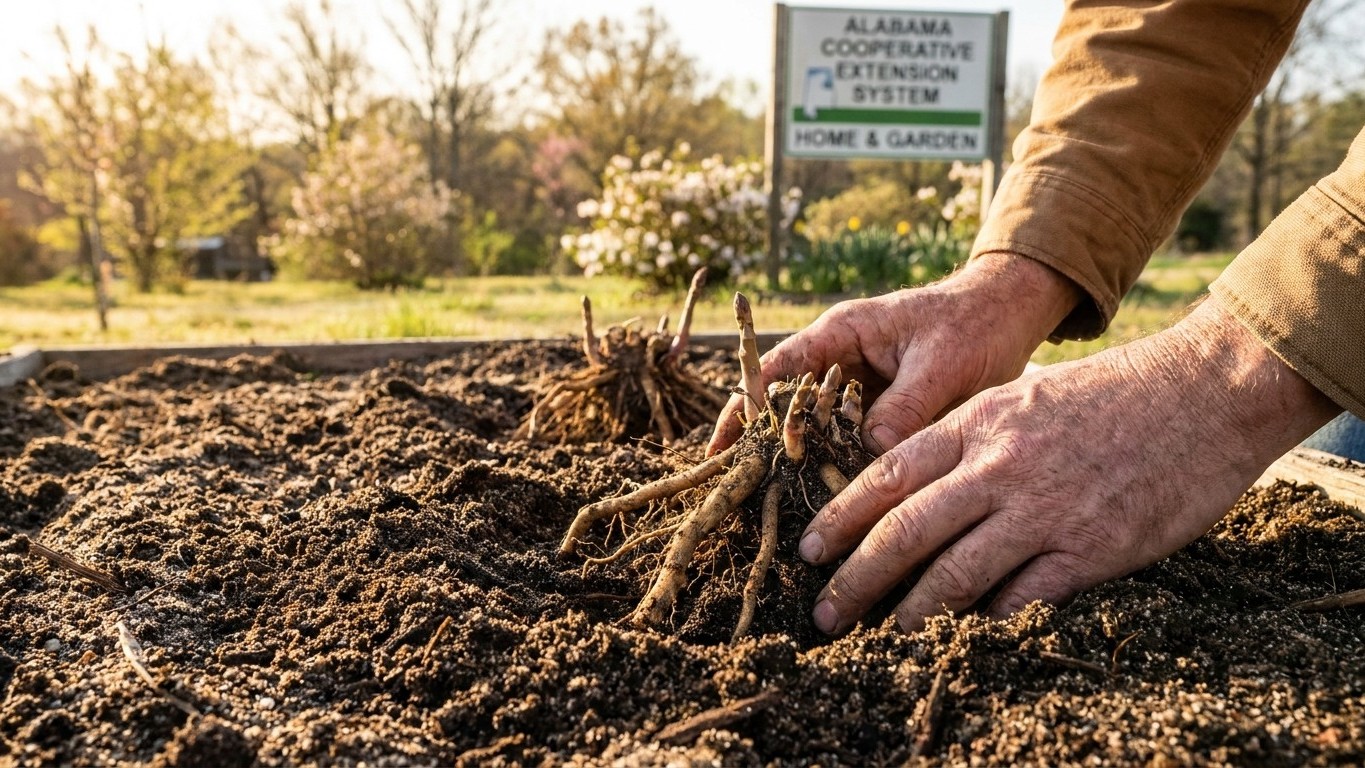

Kansas gardeners can put Asparagus Crowns in the ground once the soil has warmed after the last spring frost, in a furrow that runs about 8 inches deep, and only in ground that drains freely. Because a bed stays productive for a decade or more, the planting window matters less than getting the site right the first time.
The short answer
Before a single crown goes into the ground, the real question is what kind of ground it’s going into for the next 10 to 15 years. That’s how long a well-managed asparagus bed produces, according to Utah State University Extension, and it’s the one detail that should shape every decision that follows. There’s no yearly do-over here. A gardener who plants tomatoes in soggy clay can amend the bed next spring and start fresh. An asparagus grower who does the same thing is stuck with the consequences for over a decade.
Kansas’s official state soil, the Harney series, gives a useful starting point for what much of the state’s ground tends to do. It’s a Mollisol, the deep, dark prairie soil that built the Corn Belt, running loam to silt in texture: about 9 percent sand, 24 percent clay, and 67 percent silt, with organic matter around 2.0 percent and a surface pH near neutral at about 6.7. According to USDA NRCS Soil Data Access, the Harney series is classified as well drained. That’s the one soil trait Utah State University Extension flags as non-negotiable for asparagus: most soils will grow it, provided they drain.
None of that means every Kansas backyard behaves like the state soil. The Harney series describes a mapped surface horizon across many sampled components, not the compacted fill dirt behind a new build, the heavy bottomland along a creek, or a low spot that stays wet after every storm. A gardener working ground that holds water after rain, where puddles linger for a day or more, is not working Harney-type soil regardless of what the county map says. A simple soil test, or just watching how a hole in the ground drains after a hard rain, tells the truth faster than any state-level average.
If drainage turns out to be the problem, the fix is not to abandon asparagus. It’s to build up rather than dig down: a raised bed or a mounded row lifts the crowns out of standing water while keeping the rest of the planting method the same. Crowns still go into an 8-inch furrow, and that furrow gets backfilled gradually rather than all at once, about 2 inches of soil added back every other month across the season as the spears grow. Harvest itself waits until year three of the bed’s life, and even then it starts light: about 4 weeks of cutting the first harvest year, stretching to roughly 6 weeks the next, then about 8 weeks once the bed is fully established. The signal to stop cutting each season isn’t a date on a calendar. It’s the spears themselves: when most of what’s coming up is thinner than a pencil, harvest is done for the year.
Will the summer here water it for you?
An established asparagus bed asks for 1 to 2 inches of water every other week for its first two years, then eases to about every three weeks once it’s mature, according to Utah State University Extension. Kansas summers don’t hand that over on their own, at least not on the reference station’s numbers.
- What summer actually delivers. NOAA’s 1991-2020 climate normals for the reference station put summer rainfall at about 13.2 inches across June, July, and August, out of roughly 34.3 inches for the whole year. Broken down by month: June averages 4.93 inches, July 3.98 inches, and August 4.30 inches.
- Where the gap opens up. July is the driest of the three summer months by a clear margin, nearly an inch below June and about a third of an inch under August. That’s exactly the stretch, mid-summer, when a young bed still needs consistent moisture every other week.
- Why the total number can mislead. Monthly rainfall in Kansas often arrives as a handful of heavy thunderstorms rather than steady, spread-out showers. A storm that drops an inch in twenty minutes mostly runs off instead of soaking into the root zone, especially on ground with more clay and less structure than the well-drained Harney profile.
- What that means for a new bed. In a normal year, a gardener can expect summer rain to cover a meaningful share of the every-other-week target, but not to be relied on for it, particularly through July. Supplemental watering during dry stretches, especially in the bed’s first two seasons, is the difference between crowns that establish and crowns that stall.
- What settles it for good. A rain gauge on the actual planting site, checked weekly through the growing season, is the only way to know whether a given summer is coming close to that 1-to-2-inch target or falling short of it. Station normals describe the region’s tendency, not any one backyard’s weather in any one year.
When to put the crowns in
Crowns go into the ground in early spring, once the soil can be worked and the hard freezes have passed. For the reference station used in NOAA’s 1991-2020 climate normals, the 32°F freeze probability window for the last spring frost falls around April 4 to April 18. That’s a mean figure built from three decades of data, not a promise for any single spring, and it comes from one weather station, not a statewide guarantee. Suburban and rural gardens often see their own last frost run later than an airport station’s figure, sometimes by a week or two, and higher elevations push that further out still. Checking local frost history for the specific county a bed will sit in is worth the ten minutes it takes.
Once that window has passed and the soil is workable, crowns go into their 8-inch furrows and get covered gradually as described earlier, not buried all at once. Utah State University Extension names four varieties by their flower type and nothing else: Jersey Giant and Jersey Knight are all-male selections, while UC 157 F1 and Purple Passion produce both male and female plants. The source publishes no information on flavor, yield, or which performs better in which conditions, so there’s no published basis here for preferring one over another. Choosing between them comes down to availability and personal preference rather than any documented performance difference.
Starting from seed is the other route, and it simply shifts the timeline back. Seed-grown plants need a season in a nursery bed before the resulting crowns are ready for transplant into their permanent spot, so a gardener starting from seed is looking at an extra year before the bed even begins its own countdown toward that year-three harvest. For most home gardeners, buying dormant crowns and planting them directly in early spring, around the same window as the last frost date, is the faster and more common path.
Common questions
Can asparagus crowns be planted in fall instead of spring?
The Utah State University Extension guidance behind these figures describes early spring planting, when soil can be worked after the last frost. It doesn’t address a fall planting window, so nothing here supports recommending one.
Does the state soil mean my garden is automatically well drained?
No. The Harney series is Kansas’s official state soil and it is classified as well drained, but that describes a sampled set of components across the state, not any individual yard. Fill dirt, bottomland, and compacted lots can all behave very differently. A simple drainage check on the actual planting site is the only reliable answer.
Why can’t I harvest asparagus the first two years?
Utah State University Extension is clear that harvest doesn’t start until the bed’s third year. The plant needs that time to build the root system that will support over a decade of production afterward; cutting spears earlier weakens the crown before it’s established.
How do I know when to stop cutting spears each season?
Not by counting weeks. The cue is the spears themselves: once most of what’s coming up is thinner than a pencil, that season’s harvest is over, regardless of how many weeks have passed since cutting began.