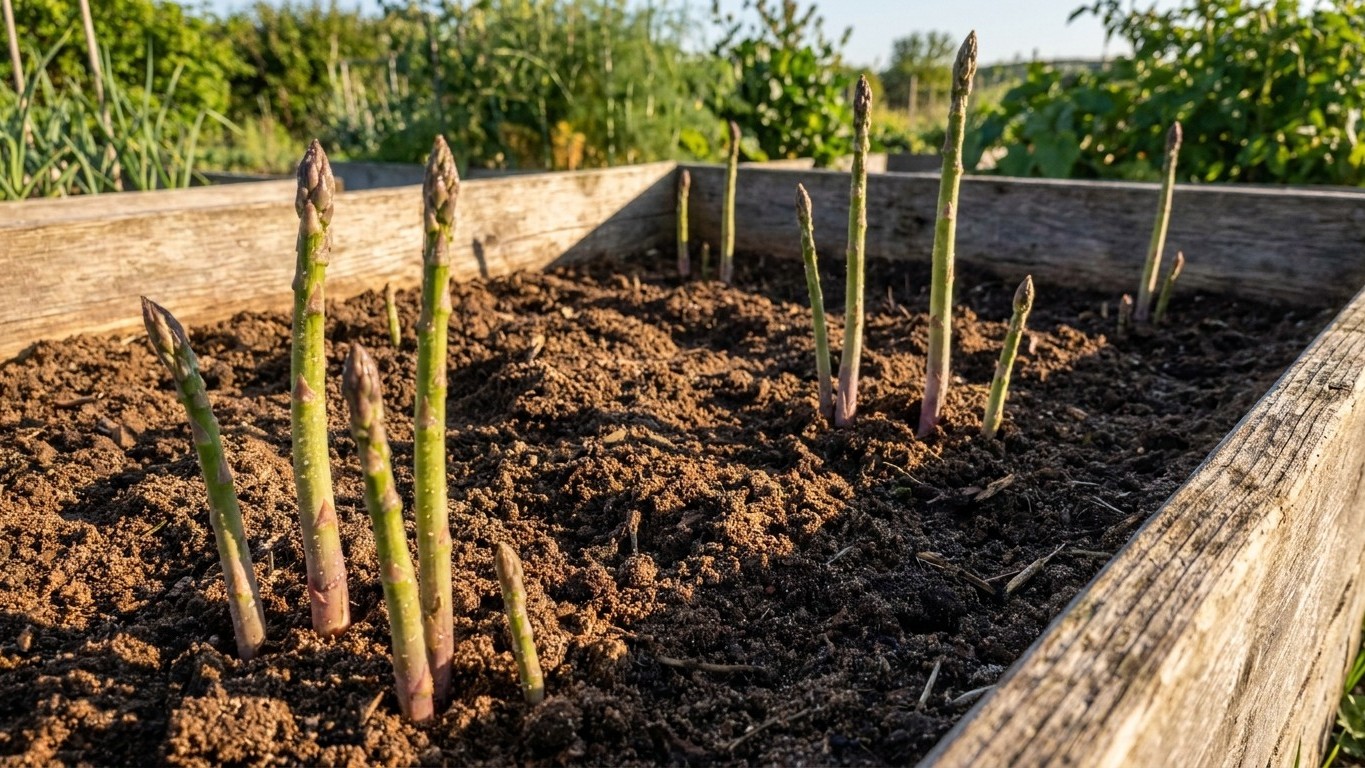

Yes, in most of the state, the ground under a Kansas garden will Hold an Asparagus Bed for the full ten to fifteen years the crop asks for. The state’s own official soil, the Harney series, drains well and runs close to neutral. The catch isn’t the soil map, it’s the ten feet of ground behind your own house, which may or may not match it.
The short answer
Asparagus makes exactly one demand of the dirt it’s planted in: it has to drain. Utah State University Extension, the only authority behind the planting details in this piece, puts it plainly: most soils will grow asparagus fine as long as they’re well drained. Everything else, texture, fertility, the fine print of pH, is negotiable. Drainage is not.
Kansas answers that question better than a lot of states can. The Harney series, named the official state soil by Kansas law in 1990, is a Mollisol, the deep, dark prairie soil that built the Corn Belt. USDA NRCS Soil Data Access records it as loam to silt, about 9 percent sand, 24 percent clay, 67 percent silt, with organic matter around 2.0 percent and a surface pH near 6.7. It’s classed well drained. On paper, that’s a green light for a bed you won’t touch again until the next decade turns over.
But a state soil is a survey average, not a soil test from your backyard. The Harney series describes what the ground tends to do across a wide stretch of the state. It says nothing about the low corner of a yard where water sits after a storm, the compacted strip a builder left behind a foundation, or the clay-heavy pocket a mile from a river bottom that behaves nothing like the mapped surface. If your ground holds water for days after rain, or a shovel comes up sticky and airless, that’s the soil talking, not the county name on a map. The fix is straightforward: raised beds, or a planting trench amended heavily with compost, get around a slow-draining spot without waiting on it to change.
The other half of the long-term math is patience. There’s no harvest at all in year one or two. In year three, the bed gives up spears for about four weeks. The following year that window stretches to six weeks, then eight in the years after, and the rule for when to stop cutting each season isn’t a date on a calendar, it’s a look at the spears themselves: once most of what’s coming up is thinner than a pencil, harvest is over for the year. Fifteen years of that rhythm is the actual commitment a well-drained bed is buying you.
Will the summer here water it for you?
An asparagus bed has a simple watering rule for its first two years, and a lighter one after that. Getting it right means checking that schedule against what a Kansas summer actually drops from the sky, which isn’t quite the same thing as the monthly rainfall total suggests.
- What the bed asks for, years one and two: 1 to 2 inches of water every other week while the crowns are establishing. Spread over a summer, that’s the heaviest watering demand the plant will ever make.
- What the bed asks for, year three onward: the schedule relaxes to 1 to 2 inches every three weeks, roughly a third less frequent watering than the establishment years require.
- What summer delivers, on average: NOAA’s 1991-2020 climate normals put summer rainfall (June, July, August) at about 13.2 inches total, broken down as June 4.93 inches, July 3.98 inches, and August 4.3 inches. July is the dry month of the three.
- Where the totals fall short: monthly totals look generous, but they arrive as thunderstorms, not a steady drip. A single 2-inch downpour followed by three dry weeks can leave a bed thirsty even in a month that “averaged” enough rain, because most of that water ran off or evaporated instead of soaking into the root zone on schedule.
- What that means for the hose: treat the monthly normals as a floor, not a guarantee. During the driest stretches, particularly through July, a new bed still in its first two establishment years is the planting most likely to need a manual top-up between storms.
- The one tool that settles it: a rain gauge on the actual bed, checked weekly against the 1-to-2-inch target, beats any regional average for deciding whether to turn the hose on.
When to put the crowns in
Crowns go into the ground in early spring, set into furrows about 8 inches deep. In Kansas, “early spring” lines up with the tail end of frost season rather than the calendar page. NOAA’s 1991-2020 normals put the last spring freeze at the reference station, using the standard 32F threshold, somewhere between April 4 and April 18. That’s a probability band from one weather station, not a promise for every county, and suburban and rural gardens away from that station often see their own last frost run later, sometimes by a week or two, more at higher elevation. Use it as a rough anchor, not a fixed date, and cross-check against local frost history before crowns go in the ground.
Once the furrow is dug and the crowns are laid in, the trench isn’t backfilled all at once. Soil goes back in gradually, about 2 inches every other month across the growing year, rather than filling the hole level on planting day. That staged backfill is part of how the bed establishes its root system before the crown is fully buried.
Seed is the alternative route for gardeners who want to start from scratch instead of buying crowns. It’s a slower path: seed-grown plants need an extra season of growth before they’re the size of a purchased crown, which pushes the eventual first harvest further out than the standard year-three timeline for crown-planted beds. For most home gardeners working around a specific frost window, crowns remain the faster way to get a bed established and producing on the usual schedule.
Which variety, if any
Utah State University Extension names four varieties without ranking them on flavor, yield, or any other performance measure, only on their sex:
| Variety | Type |
|---|---|
| Jersey Giant | All-male |
| Jersey Knight | All-male |
| UC 157 F1 | Male/female |
| Purple Passion | Male/female |
That’s the full extent of what’s published on variety choice. No source here says one produces more spears, tastes better, or suits Kansas conditions over another, and no nursery is named as a source for buying crowns.
Common questions
Does the Harney series tell me my garden’s actual pH?
No. The 6.7 figure is the surface pH recorded for the Harney series as mapped across the state, not a reading from any individual yard. The source behind the asparagus planting guidance is also silent on pH requirements for the crop, so there’s no published target to match your soil against either way. A soil test remains the only way to know your own number.
Is there a winter chilling requirement for asparagus in Kansas?
Not published here. The planting source used for this piece doesn’t address winter chilling hours at all, and hardiness zone alone isn’t a substitute for a chilling figure. If that detail matters to your planning, it needs a separate source, because it isn’t part of the record behind these numbers.
Can I harvest a few spears in the first or second year to see how the bed is doing?
No. The guidance is unambiguous that there’s no harvest at all until the third year. Cutting spears early weakens the crown’s ability to store energy for the seasons ahead, which is exactly what the two-year wait is protecting.
What if my yard doesn’t drain like the state soil map suggests?
Then the map isn’t describing your ground, and that’s fine, it happens constantly across a state the size of Kansas. A raised bed or a heavily compost-amended trench solves a slow-draining spot without forcing you to relocate the whole planting. The only rule that can’t be worked around is the drainage requirement itself.