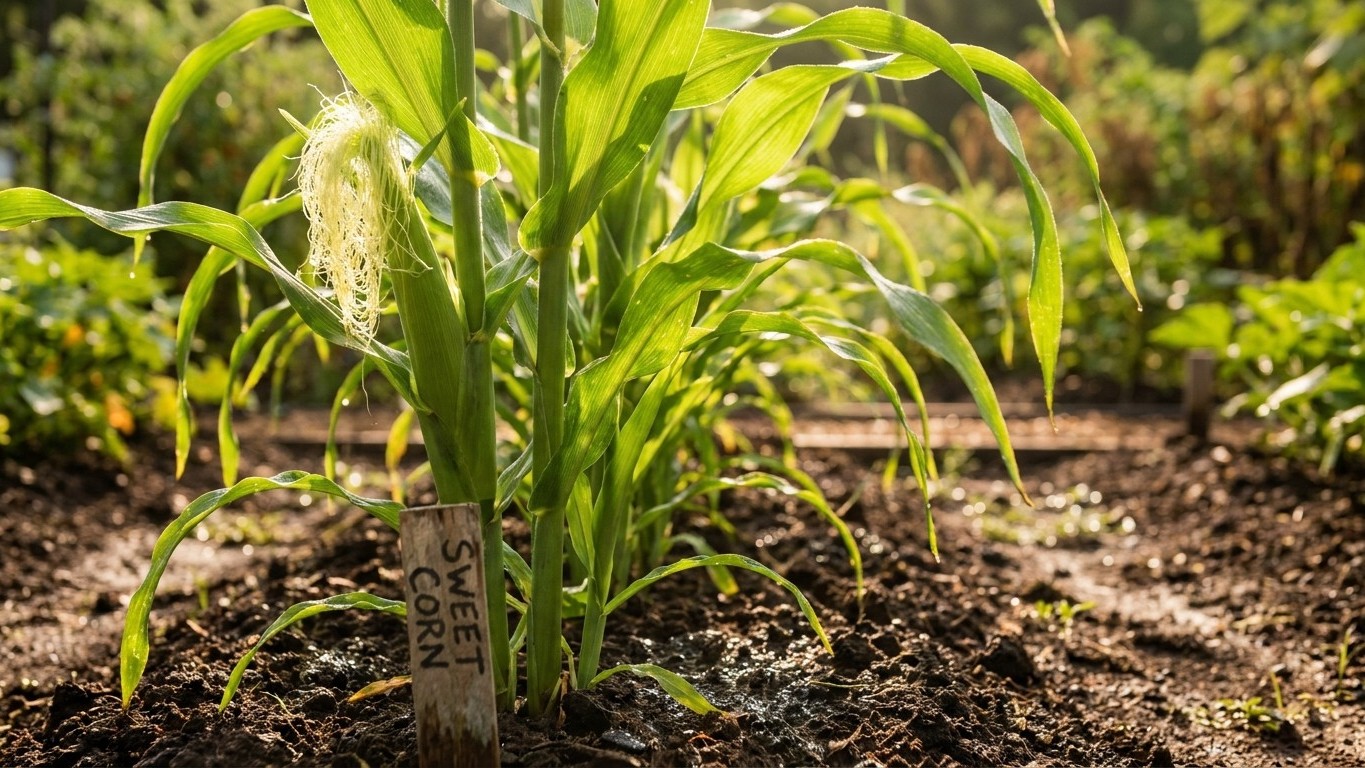

Yes, sweet corn can ripen in Kansas, and most years it ripens with room to spare. The catch isn’t the calendar you’d expect. It’s soil temperature, not the last frost, that decides when you can actually plant, and that single detail changes everything downstream.
The short answer
Here’s the mechanism gardeners miss: sweet corn seed needs soil above 60°F to germinate reliably, and that threshold arrives well after the last spring frost, not on the same day. At the reference weather station used for this region (Wichita), the last spring frost typically falls somewhere between April 4 and April 18. Soil doesn’t jump to planting temperature the moment that frost passes. It takes real time for a Kansas garden bed to warm from the low 40s and 50s up past 60°F, so anyone planting on the last-frost date alone is usually planting into cold, wet soil that will rot seed rather than sprout it.
Once soil does clear that 60°F line, the clock that actually matters starts running: sweet corn needs 60 to 90 days from planting to reach harvest. The question is whether that window closes before the first fall frost shuts things down. At the same reference station, the first fall frost lands between October 23 and November 2. Count backward from late October and there’s a wide margin, even allowing for soil that doesn’t warm until several weeks after the frost-free date opens. A 90-day variety planted in late spring still finishes well before the first hard frost in most seasons.
That margin is the real story here. Kansas isn’t a marginal corn state where growers are racing the calendar. The frost-free stretch between the last spring freeze and the first fall freeze runs roughly six and a half months at the reference station, and that’s before accounting for how much of the growing season falls during peak summer heat. The same climate record shows an average of 57.6 days a year reaching 90°F or higher. That’s a heavy heat load, and it matters more for water demand and pollination stress than it does for whether the crop technically has time to mature.
One caution worth repeating: airport-station data smooths over a lot of local variation. Suburban and rural gardens across Kansas commonly see their last spring frost arrive later than the station date, and their first fall frost arrive earlier, sometimes by a week or two, more at higher elevation. That trims the safety margin without eliminating it. Check your own county’s typical frost pattern before betting a full season on a slow-maturing variety.
Does a late variety fit here?
The 60-to-90-day range covers a lot of ground, and where a specific variety lands in that range changes how much cushion you’re working with. Here’s how the two ends of that range play out against the frost dates above.
A 60-day variety
A fast, 60-day sweet corn is the low-risk choice almost anywhere in Kansas. Even planted on the later side, once soil finally crosses 60°F sometime after the April 4-18 frost window, a 60-day crop is done and picked well before the October 23 to November 2 fall frost arrives. This is the variety that works even in a garden where the local microclimate runs a week or two colder than the reference station, or where a wet spring pushed planting back further than planned. There’s very little scenario in this state where a 60-day corn runs out of season.
A 90-day variety
The longer end of the range still fits comfortably in most of Kansas, which isn’t always true in shorter-season parts of the country. Counting 90 days forward from a typical planting date, even with the delay it takes soil to warm past 60°F after the last frost, harvest lands in mid-to-late summer with weeks to spare before the first fall frost at the reference station. The margin narrows in gardens that run colder than the airport reference, particularly at higher elevation or in low-lying spots where cold air pools. In those specific microclimates, a full 90-day variety leaves less buffer, and a gardener who plants late after a slow, wet spring could see it push close to the fall frost window. For the state as a whole, though, the answer is that a late-season variety does fit, and gardeners don’t need to default to the fastest option out of fear the season will run out.
What goes wrong here
- Soil sown too cold. The most common failure isn’t frost damage, it’s planting by the calendar instead of the thermometer. Seed dropped into soil that hasn’t cleared 60°F sits and rots before it germinates, especially in a wet spring. The fix is simple: check soil temperature directly rather than counting days from the last frost, and hold off until it’s consistently above that line.
- A variety too late for the local window. This mostly bites gardeners in colder microclimates, such as higher elevation spots or areas where the local frost dates run noticeably earlier and later than the airport reference. Pushing a full 90-day variety in one of those pockets, especially after a delayed planting, can leave the crop caught by an early fall frost before it fully matures. The remedy is matching the variety to the actual local frost record, not the regional average, and leaning toward a 60-to-75-day type where the margin is tight.
- Sweetness lost to a neighboring block. This one has nothing to do with weather. Sweet corn comes in different genetic types (su, se, and sh2 among them), and if two different types tassel and release pollen at the same time nearby, cross-pollination flattens the sweetness of the harvest, even when every plant looks perfectly healthy. The fix isn’t a matter of distance, it’s timing: stagger plantings so the types don’t tassel together, or keep to a single type in a given season. Corn should also be planted in blocks of three or more rows rather than a single thin row, since that shape is what allows wind pollination to work properly within a planting.
Common questions
How do I know sweet corn is actually ripe?
Look for three signs together, not just one: the silks have turned dry and brown, the husk is still moist and green underneath, and a punctured kernel releases milky juice rather than clear liquid or a dry, doughy texture. Any single sign alone can be misleading; all three together is the reliable check.
Is the days-to-maturity number counted from planting or from when the silks appear?
It’s counted from planting, and that’s a different clock than the one used for deciding which week to pick. Once silks emerge, harvest typically follows within roughly 17 to 24 days, according to Utah State University Extension. Confusing the two clocks is a common mistake: the planting-to-harvest window tells you whether the variety fits the season at all, while the silk-to-harvest window tells you which week to actually check the ears.
Can I grow more than one sweet corn variety in the same garden?
Yes, as long as the varieties don’t tassel at the same time. Since cross-pollination between su, se, and sh2 types degrades sweetness rather than plant health, the practical fix is staggering planting dates so tasseling windows don’t overlap, rather than relying on any particular planting distance.
Should I trust the frost dates for my specific town?
Treat the April 4-18 and October 23-November 2 window as a reference-station figure, not a guarantee for every yard in the state. Suburban and rural gardens often see a later last frost and an earlier first fall frost than an airport station records, sometimes by one to two weeks, more at elevation. Checking local frost history for your own county is worth the ten minutes it takes.